Artificial intelligence already works behind many familiar tools, from recommendations and route planning to phone security and household robots. More advanced systems can now generate new content, drive vehicles, support regulated medical tasks and help scientists study biological structures.
The examples below show what information each system receives, what the AI does with it and what result a person can actually see or use.
Quick Take
AI is not one technology that behaves the same way everywhere. Some systems rank choices or predict what may happen next, while others recognize patterns in images, generate new material or control physical machines. The useful question is not simply whether a product is called “AI,” but what task the system is performing, such as predicting, recognizing, ranking or generating.
What Counts as Artificial Intelligence?
A simple timer can switch an appliance on at 8:00 every morning, but it does not need to recognize a new situation or learn patterns from data. An AI system usually performs a less rigid task, such as identifying a face, estimating future traffic, ranking possible recommendations or interpreting a natural-language request.
Machine learning is one common way to build AI. Instead of giving the software a fixed rule for every possible situation, developers train a model to find useful patterns in data. The model can then use those patterns when it receives new information.
A product can contain both kinds of technology. A robot vacuum may use an ordinary schedule to decide when cleaning begins, while a separate vision system helps it recognize an obstacle on the floor. Calling the whole device “AI” can hide that distinction.
Generative AI Assistants
Type a request into a modern AI assistant and it may produce an explanation, rewrite text, analyze a file or work with an image. This is generative AI: software that creates new output from instructions and the context it receives instead of only selecting from a fixed list of prepared answers.
Some generative AI assistants can work with more than text. ChatGPT, for example, supports tasks involving text, images, files, audio and data. OpenAI’s current image system can also generate images, make focused edits and maintain changes across multiple editing turns.
That ability is different from a recommendation engine. A recommendation system mainly scores or orders existing choices; generative AI produces new material from patterns learned during training and information supplied in the conversation.
Generative output still needs checking. ChatGPT can produce incorrect or misleading responses, including fabricated facts or references, so important claims should be verified.
Recommendation Systems
When two people open the same streaming service and see different titles near the top of the screen, a recommendation system may be helping decide that order. The system uses available signals about content, activity and context to estimate which options are likely to be relevant.
Netflix uses recommendation and search algorithms to personalize the entertainment suggestions and search results shown to members. The underlying idea is broader than entertainment: AI can take a large pool of possibilities, score them and place some ahead of others.
The same principle appears in other AI ranking systems, although matching people with jobs can involve more complex signals and consequences than choosing a movie. A high position in either case remains an estimate produced from the information and objective available to the system. It is not proof that the first result is objectively perfect for the user.
AI-Powered Maps and Traffic Prediction
A navigation app can do more than display roads. If traffic begins building along your route, the software can estimate how conditions are likely to change and compare alternative paths before deciding which route to suggest.
Google Maps combines historical traffic patterns with live traffic conditions and uses machine learning to predict near-future traffic. This matters because choosing a route often depends on what conditions may be like when you reach a road, not only what they look like at the moment you start driving.
The role of AI in maps has also expanded beyond traffic prediction. In March 2026, Google introduced Ask Maps as a conversational map experience for complex place questions, alongside a redesigned navigation experience.
Predictions still have limits. An unexpected crash, closure, weather change or other event can alter conditions after a route is calculated. AI improves the estimate; it does not make the future certain.
Face Recognition and Biometric Authentication
Unlocking a phone with a glance is another form of AI that can become almost invisible through frequent use. The system must analyze visual or sensor information, extract useful patterns and decide whether the face being presented is a close enough match to the enrolled user.
This kind of task belongs to computer vision, the use of computing systems to interpret visual information. Apple’s Face ID provides a concrete example: its facial matching is performed using neural networks within the Secure Enclave. A neural network is a machine-learning model made of connected computational layers that learn patterns from training data.
The important AI task is the matching decision, not simply the presence of a camera. A basic camera can capture an image without understanding whether it matches an enrolled face. The trained model performs the pattern recognition needed for authentication.
Household Robots
A robot vacuum becomes more interesting as an AI example when it does more than follow a fixed cleaning schedule. A capable model may need to map a room, detect objects and change its path when something blocks the floor.
Some current Roomba models with PrecisionVision navigation can recognize categories of obstacles such as cords, shoes, pet waste and other floor objects. Certain models can also present detected obstacle images in the app so the user can give feedback about whether an area should be avoided or cleaned later.
The distinction matters because robotics and AI are not the same thing. Motors allow the machine to move. Sensors collect information. Mapping and recognition software can help interpret the environment. AI is one part of that wider system, not a synonym for every moving machine.
Autonomous Vehicles
A driverless vehicle has to perform several demanding tasks continuously. It needs to perceive roads and nearby objects, estimate what other road users may do, plan a path and translate that plan into safe vehicle movement.
This is no longer limited to small laboratory demonstrations. Waymo reports that its vehicles had completed 271.3 million rider-only miles through June 2026, meaning those miles were driven without a human driver behind the wheel. That figure shows the scale at which one autonomous-driving system has operated in its service areas.
Autonomous driving also shows why advanced AI systems often combine several specialized models rather than relying on one all-purpose intelligence. Perception, prediction, planning and control solve different parts of the driving problem but must work together quickly enough to respond to a changing environment.
The example should not be read as evidence that every vehicle can drive itself anywhere. Driverless services operate within defined geographic and operational conditions, and capability varies by system and deployment.
AI-Enabled Medical Devices
AI is also used in products where an error can have much greater consequences than a poor movie recommendation. Medical systems may analyze images, sensor readings or other clinical information to support a specific task, but their intended use must remain clearly defined.
The U.S. Food and Drug Administration reported that it had authorized more than 1,600 AI-enabled medical devices for U.S. marketing as of September 2026. Examples listed by the regulator include systems that detect diabetic retinopathy from retinal images, software that sharpens medical images, a sensor that estimates heart-attack probability and algorithms used in automated insulin dosing.
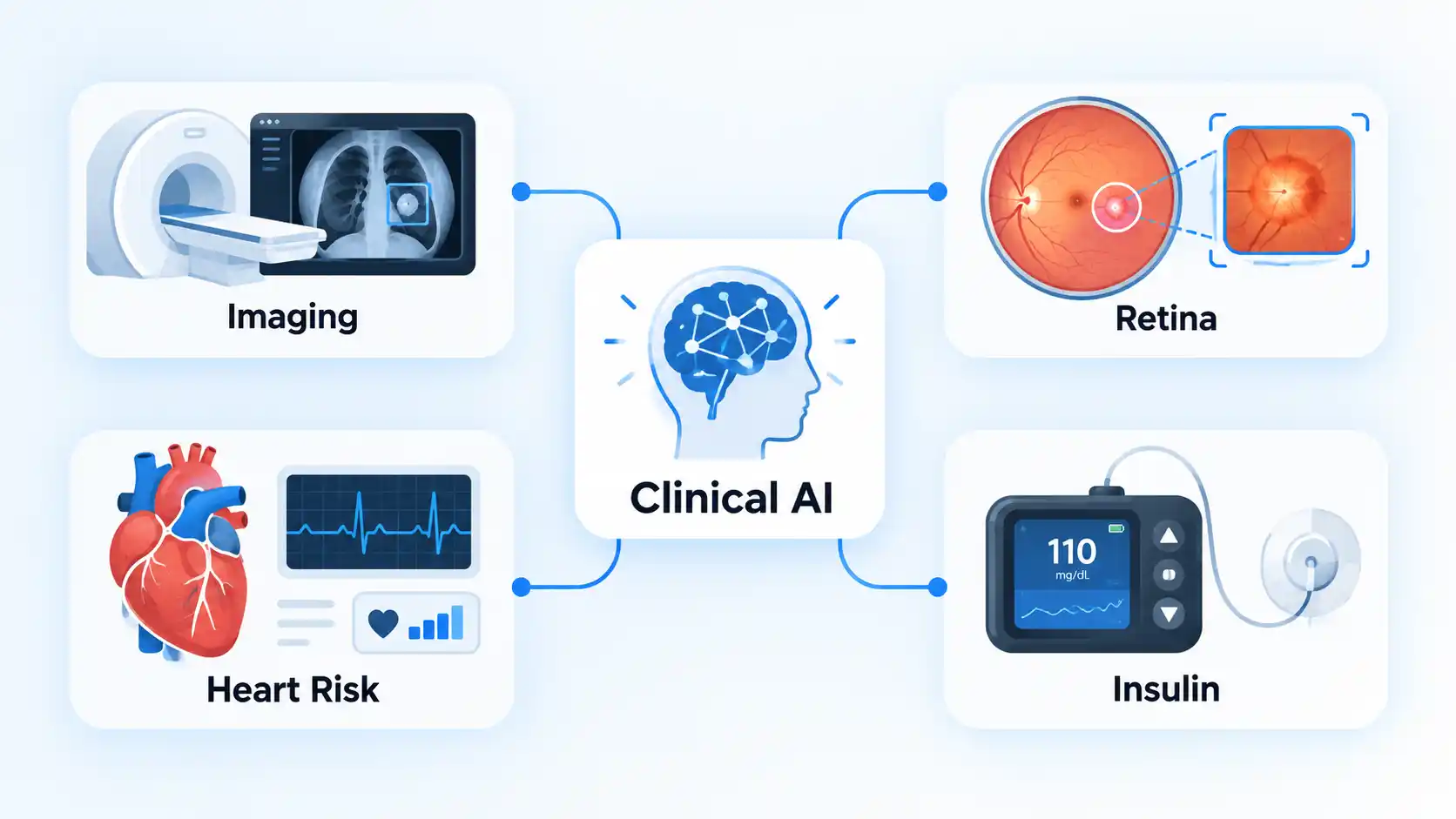
These examples do not mean that a general-purpose AI is replacing a doctor. Each device is designed for a defined function, and its output has to be understood within that intended use. Wider AI in healthcare also includes clinical software, monitoring and workflow tools, where validation, data quality and ongoing oversight matter more than they do for a low-consequence consumer recommendation.
AI in Scientific Discovery
Artificial intelligence can also help researchers work with problems that are difficult to solve directly. Protein structure prediction is a useful example. Proteins are biological molecules, and their three-dimensional shapes affect how they function and interact with other molecules.
The AlphaFold Protein Structure Database provides access to more than 200 million predicted protein structures. AlphaFold 3 expanded the system’s scope to predicting structures and interactions involving a wider range of biological molecules.
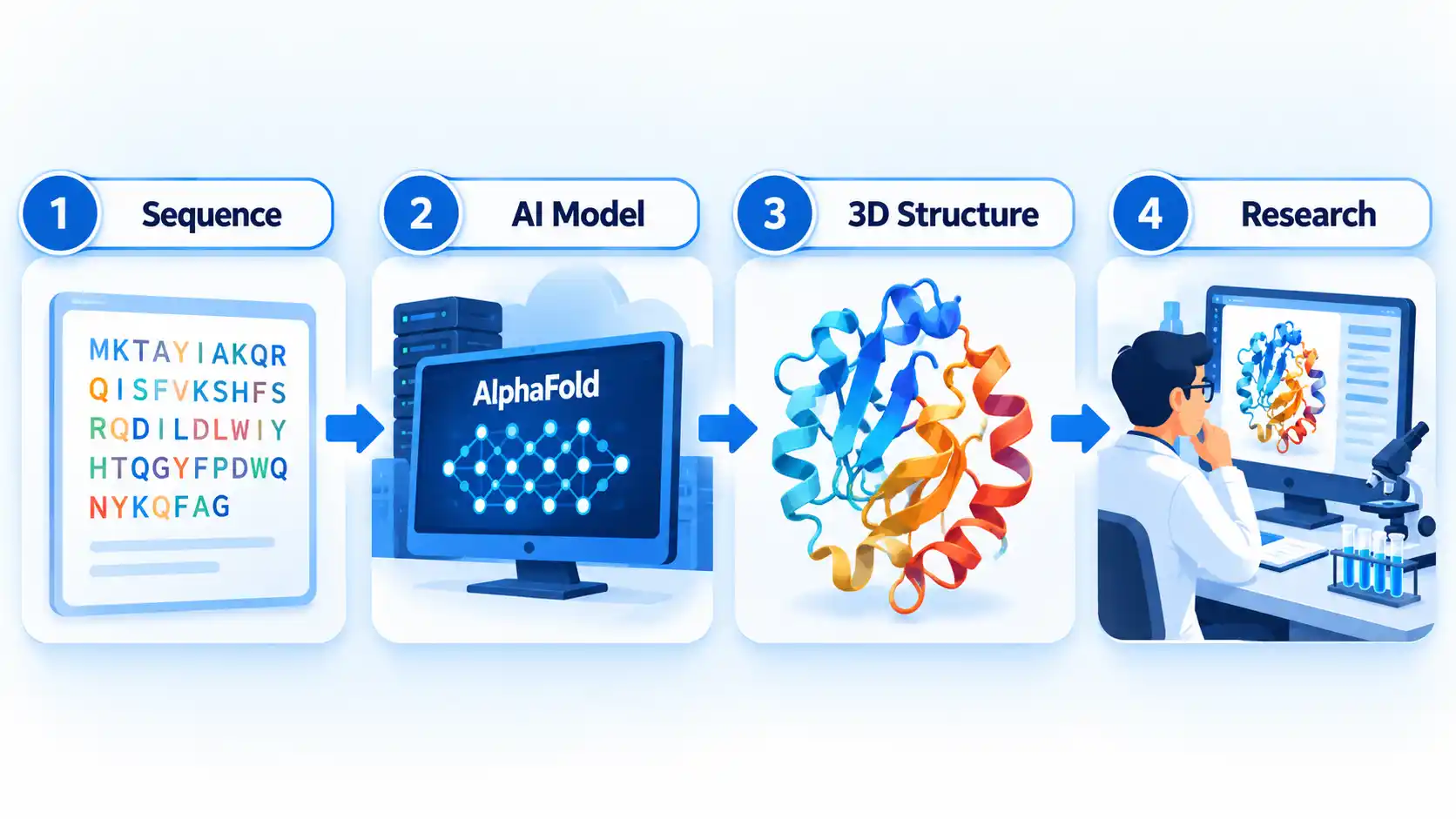
This illustrates a different kind of AI value from a chatbot or recommendation engine. The output can become an input to scientific research, helping researchers decide what to investigate next. A prediction is still not the same as experimental proof, however. Laboratory work and other forms of validation remain important.
What These Examples Show About How AI Has Changed
The eight examples cover different tasks, but comparing them side by side makes the broader progression easier to see. Some systems estimate relevance or future conditions. Others recognize complex patterns, create new material or connect perception to physical action.
| Example | Main input | What AI does | Reader-visible output | Capability illustrated |
|---|---|---|---|---|
| Generative AI assistants | Prompts, conversation context, files or images | Generates or transforms content from learned patterns and supplied context | Text, speech, analysis or images | Generation |
| Recommendation systems | User, content and context signals | Scores and ranks available options | Personalized ordering or suggestions | Prediction and ranking |
| AI-powered maps | Road data, live traffic and historical patterns | Predicts traffic and evaluates routes | ETA and route suggestions | Forecasting |
| Biometric authentication | Facial and sensor data | Compares learned visual patterns | Match or authentication decision | Recognition and classification |
| Household robots | Camera and sensor information | Recognizes obstacles and adapts movement | Navigation around the home | Perception linked to action |
| Autonomous vehicles | Road, object and vehicle sensor data | Perceives, predicts and plans movement | Driverless vehicle control | Autonomous physical action |
| AI-enabled medical devices | Medical images, sensor readings or other clinical data | Performs a defined analytical or control task | Clinical information or device action | Regulated decision support and automation |
| AI in scientific discovery | Biological sequence and molecular information | Predicts structures and interactions | Scientific models for further research | Research-scale prediction |
One major change is the move from AI that mainly classifies, predicts or ranks toward systems that can also generate new content. Another is the growing connection between AI and the physical world, from household navigation to autonomous driving.
The medical-device and AlphaFold examples show a further shift into regulated and scientific settings, where the output may influence research or high-consequence decisions. That does not mean these systems have become human-like general intelligence. Each still performs particular tasks within the limits of its training, design, inputs and operating conditions.

💬 Comments