AI job matching turns information about a candidate and a job into signals, narrows the available pool, scores plausible matches, and ranks the results. More advanced systems can also use semantic similarity, behavior, and feedback, but a high-ranked match is still an estimate of relevance rather than proof that a person and job are objectively compatible.
There is no single algorithm that every job platform uses. Different systems can use different data, models, filters, ranking objectives, and feedback signals. The useful way to understand AI job matching is therefore as a common pipeline rather than as one universal formula.
AI Job Matching Is a Ranking Problem, Not a Mind Reader
AI job matching does not understand a person’s career in the same way a human recruiter or career adviser might. Instead, software converts available information about people and vacancies into data it can compare.
A signal is a piece of information a system can use when estimating how relevant a candidate and job appear to each other. Signals can come directly from profile fields, job postings, resumes, search preferences, or interactions with the platform.
Consider a nurse searching for a remote role. The candidate side might contain a nursing qualification, years of experience, location, preferred work arrangement, and listed skills. A vacancy might contain a title, required license, location rules, schedule, experience requirements, and employment type. A matching system can compare some of those details and use the result to narrow or order vacancies.
The same general idea works in the opposite direction when recruiters search for candidates. LinkedIn’s current Recruiter documentation describes a process in which candidates matching requested keywords and facets are selected and then ranked using additional signals such as work-experience or skill similarity and likelihood of response.
One important limitation appears before any sophisticated ranking occurs: both sides can be incomplete. A candidate may omit a relevant skill or certification, while a job description may leave an important requirement unstated. Missing information therefore does not necessarily mean the candidate lacks a qualification or that the job lacks a characteristic.
Step 1: Turn Profiles and Job Posts Into Matching Signals
The first technical challenge is converting messy information into signals the system can actually compare. These signals fall into several broad categories, although individual platforms can define and combine them differently.
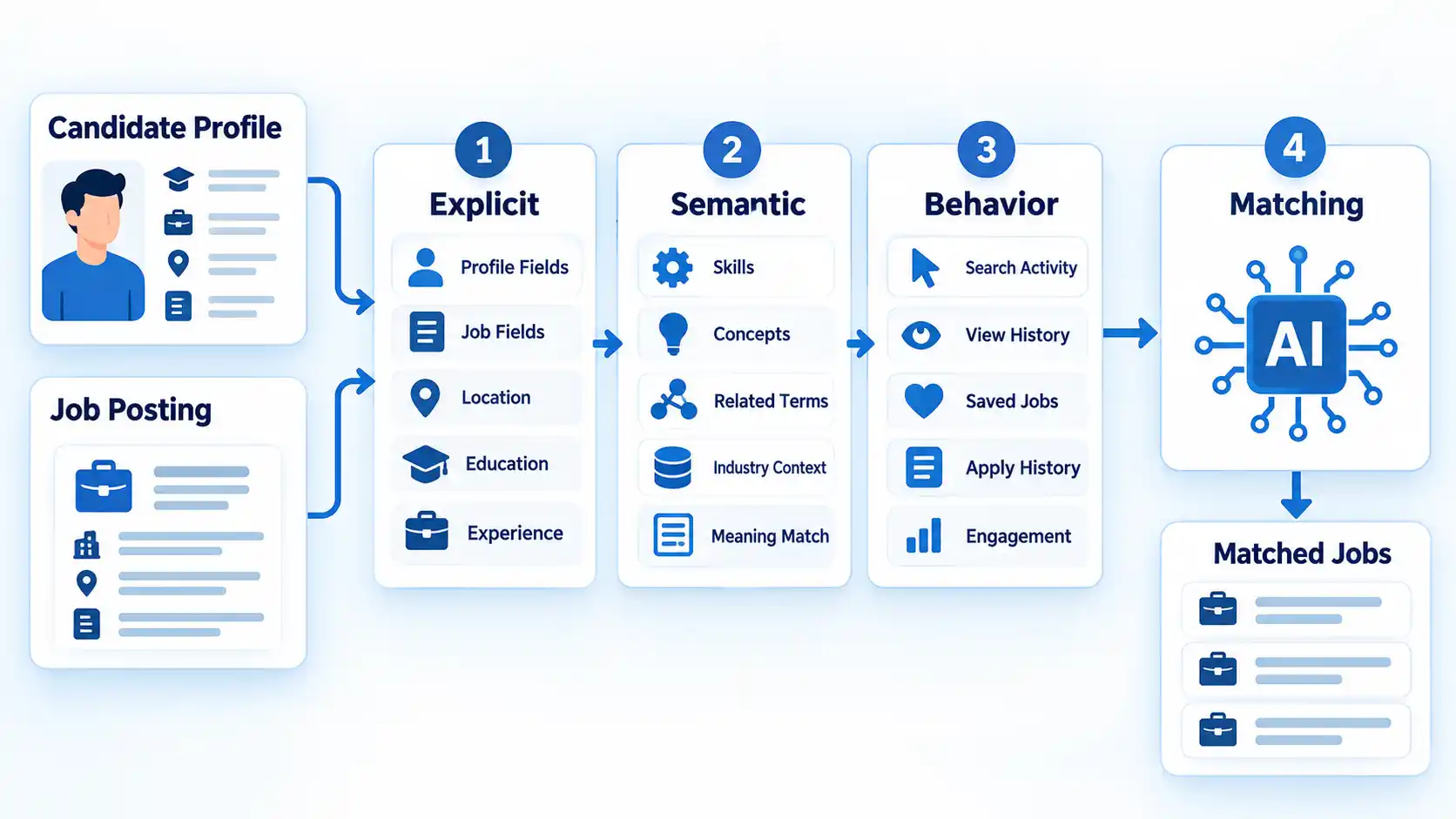
Explicit signals
Explicit signals are information that a user, recruiter, employer, or platform records directly. Examples include job title, location, employment type, degree, certification, salary preference, years of experience, and whether a person wants remote, hybrid, or on-site work.
LinkedIn’s current job-recommendation documentation says recommendations can use preferences including job titles, locations, location types, and employment types. It also says profile-based recommendations can consider information from a member’s headline, About section, experience, education, and location preferences.
Explicit information is useful because its meaning can be relatively clear. If a person selects remote work, the platform does not need to infer that preference from unrelated behavior. The limitation is that explicitly entered information can be incomplete, outdated, inconsistent, or too broad.
Inferred and semantic signals
Platforms can also derive signals from unstructured text. A skill, occupation, or concept may appear in a resume, profile summary, work history, or job description without being stored as a neatly selected field.
Semantic matching means comparing meaning or related concepts rather than depending only on identical text. For example, “SaaS” and “Software as a service” can describe the same concept even though the wording differs.
LinkedIn’s current Skills filter distinguishes explicit skills from implicit skills extracted or inferred from profile content. It also gives a concrete example in which a search for “SaaS” can return members whose profiles use “Software as a service” instead.
Semantic inference can expand useful matches, but it creates another failure mode: an inferred skill or concept can be wrong. Mentioning a technology in a project description does not always mean the person is proficient in it, and similar terminology can have different meanings in different industries.
Behavioral signals
Interactions can become signals too. Saving a vacancy or candidate, hiding a recommendation, messaging someone, applying for a job, or repeatedly searching for a particular role can provide evidence about likely interest or responsiveness.
LinkedIn’s Recommended Matches says recruiter actions such as saving, hiding, and messaging candidates are used as real-time hiring signals. It also describes job-posting signals such as titles, locations, and skills and member-side signals such as being open to work.
Behavior is useful but ambiguous. A user may ignore a job because it is irrelevant, because important information is missing, because they have already seen it, or simply because they never noticed it. Treating every interaction as a perfect description of preference can therefore teach a system the wrong lesson.
The table below separates the main signal categories from what they can reasonably tell a matching system. Every signal is a proxy for something the platform wants to estimate rather than a complete description of the person or job.
| Signal type | Example | What it can tell the system | Main limitation |
|---|---|---|---|
| Explicit profile or job fields | Job title, location, degree, employment type, listed skills | Directly stated requirements, qualifications, or preferences | Information may be missing, outdated, broad, or entered inconsistently |
| Inferred or semantic signals | Skills or concepts extracted from profile, resume, or job-post text | Potential similarity even when the same exact words are not used | An inference can misread context or overstate experience |
| Behavioral signals | Clicks, saves, hides, searches, applications, or messages | Possible interest, disinterest, or responsiveness | An action may have several explanations and may not reflect true preference |
| Outcome or feedback signals | Employer response, interview progression, hire, or another observed outcome | Whether previous matches led to later-stage outcomes | Historical outcomes can reflect earlier human decisions, unequal exposure, or other biases |
Step 2: Apply Constraints and Retrieve Plausible Matches
After signals exist, a platform does not necessarily run its most detailed scoring process against every possible person-job pair. Large marketplaces can contain enormous numbers of profiles and vacancies, so matching can begin by reducing the search space.
A hard constraint is a condition treated as required for a particular search or matching operation. Depending on the system and user-selected filters, examples can include a location requirement, employment type, occupational credential, or another must-have condition.
Retrieval is the stage that finds a manageable set of plausible candidates or jobs before more detailed ranking. It answers a broad question such as “Which possibilities are worth evaluating further?” rather than “Which one should appear first?”
LinkedIn’s current recruiter documentation describes this separation directly: candidates matching requested keywords and facets are selected and then ranked using other factors. Its current AI Search documentation also says natural-language requests can be translated into structured filters such as location, skills, and job titles.
This distinction creates an important failure point. If a strict filter removes someone during retrieval, the later ranking system may never evaluate that person. A qualified candidate can therefore disappear because a requirement was entered too narrowly, a profile field is missing, a job title is unusual, or an equivalent qualification is represented differently.
Retrieval quality matters as much as ranking quality. A ranking model cannot promote a relevant result that was never retrieved.
Step 3: Score and Rank the Remaining Matches
Once the system has a smaller set of plausible matches, it must decide which results deserve the most prominent positions.
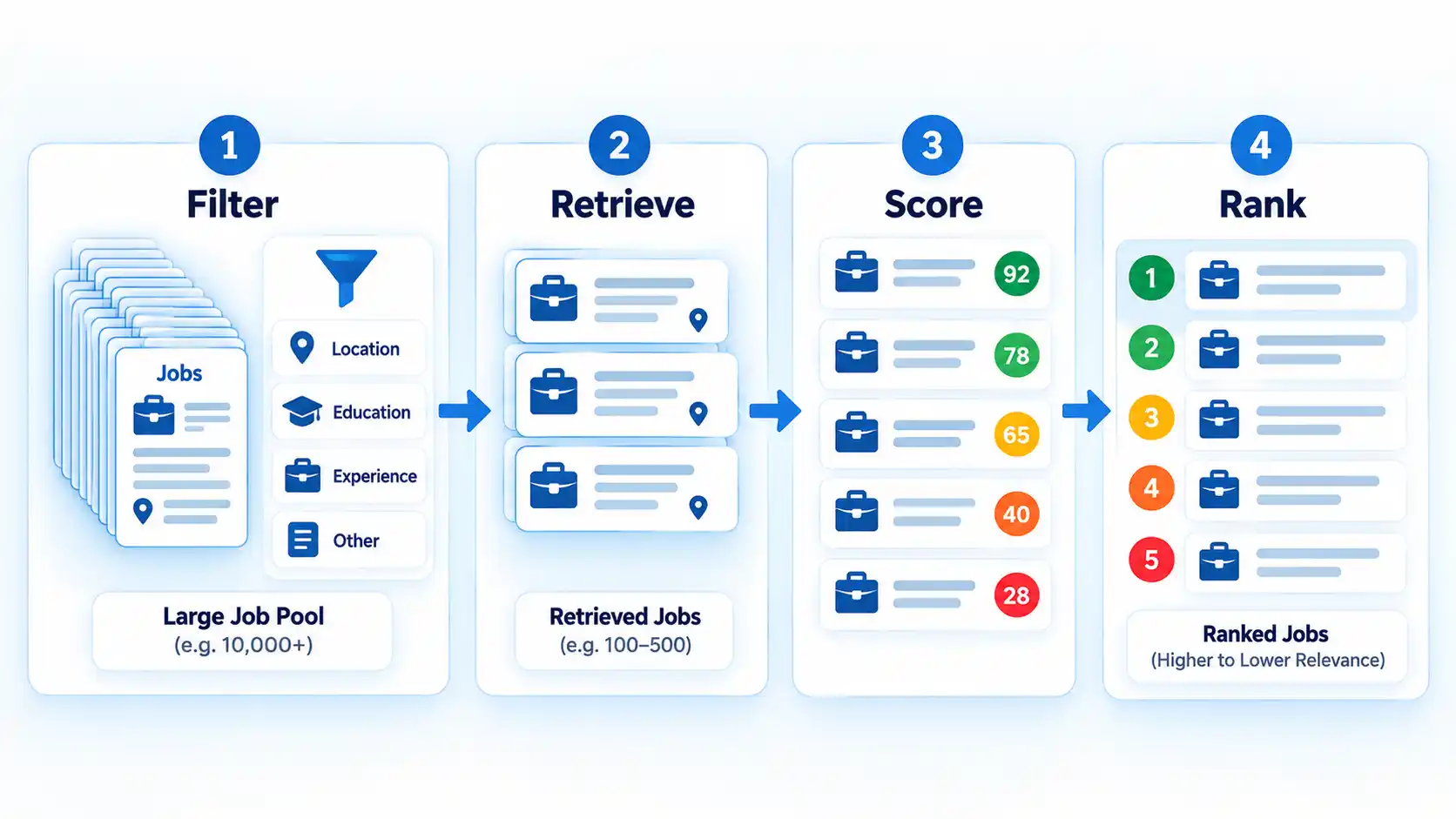
A relevance score is a model-produced value used to compare matches under the system’s chosen objective. Its exact meaning depends on the product. A score might reflect similarity, predicted responsiveness, expected usefulness, or a combination of signals.
It should not automatically be interpreted as a probability of being hired.
Current LinkedIn Recruiter documentation provides a concrete example of multi-signal ranking. It says candidates can be ranked using factors including similarity between their work experience or skills and the search criteria, together with the likelihood that an interested candidate will respond. LinkedIn says those factors are weighted using machine-learning models.
A simplified matching system might face a trade-off like this:
- Candidate A has very strong skills similarity but does not satisfy the preferred location.
- Candidate B has slightly weaker skills similarity but matches the location and employment preferences closely.
- Candidate C satisfies the stated search criteria but appears less likely to respond.
These are illustrative examples, not LinkedIn’s published scoring formula. The final order depends on the objectives and weights used by a particular system. Commercial platforms usually do not disclose a fixed percentage for every signal, so it would be misleading to assign arbitrary weights to skills, location, experience, or activity.
Some recommendation architectures use more than one ranking pass. Reranking means taking an already retrieved or initially ordered set and applying another model or scoring stage to refine the order.
A 2026 job-recommendation study, for example, combined metadata filtering, TF-IDF lexical retrieval, Sentence-BERT semantic retrieval, and optional cross-encoder reranking. The research demonstrates one possible hybrid architecture; it does not establish that LinkedIn, Indeed, Lensa, or every commercial job platform uses Sentence-BERT, cross-encoders, or the same model sequence.
Why Keyword Matching and Semantic Matching Produce Different Results
Keyword matching and semantic matching solve related but different problems.
Lexical or keyword matching looks for words, phrases, or standardized terms. It works well when a candidate and job use the same vocabulary. If both contain “project manager,” the connection is straightforward.
The weakness appears when equivalent ideas use different language. A job might request “Software as a service” experience while a candidate writes “SaaS.” A narrow exact-text approach could miss that relationship.
Semantic matching attempts to capture related meaning so concepts can still appear similar without identical wording. This can help retrieve profiles or vacancies that strict text matching might miss.
The two approaches do not have to compete. The 2026 research system cited above combined lexical and semantic retrieval rather than replacing one with the other. Structured filters can preserve precise constraints while semantic retrieval can broaden matching across terminology differences.
Semantic matching also has limits. Two phrases can appear related to a model while carrying different practical meanings. “Machine learning research” and “machine learning operations,” for example, overlap in vocabulary and domain but can require substantially different experience. Better semantic recall therefore does not automatically mean better job fit.
Job Matching Can Be a Two-Sided Recommendation Problem
Job recommendation differs from many ordinary recommendation systems because a useful match may depend on both sides of the marketplace. It is not enough for a job seeker to like a vacancy if the role has requirements the person does not meet, and an employer’s preferred candidate may have no interest in the location, schedule, salary, or role.
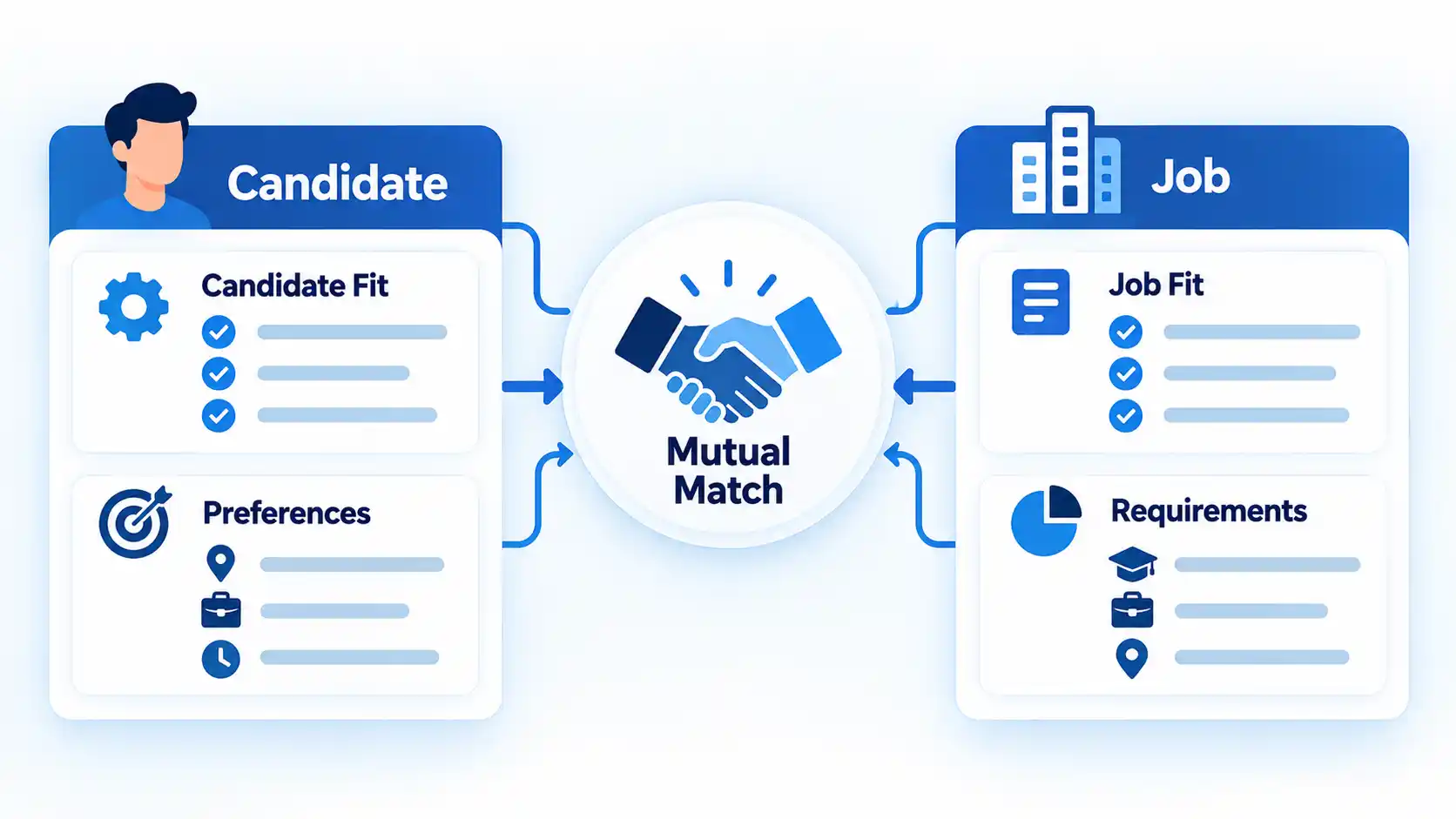
Researchers often describe this as a reciprocal recommendation problem because relevance can operate in both directions. A review of job recommender-system research identifies reciprocity as an important feature of the domain and also highlights data availability, temporal effects, fairness, and generalizability as evaluation challenges.
Consider two candidates for the same vacancy. Candidate A strongly prefers the job but lacks a mandatory professional license. Candidate B has the license and relevant experience but wants a fully remote role while the vacancy requires daily on-site work. A single similarity measure does not capture both sides of those constraints and preferences.
Indeed’s public explanation of its own matching system similarly describes a two-sided marketplace and a process of understanding people and jobs, narrowing and ranking possible matches, and learning from subsequent outcomes.
This does not mean every platform optimizes the same objective. A system might optimize for a useful recommendation, an application, a response, an interview, a hire, or another measurable outcome. Unless a platform documents its objective, the safest interpretation of a ranking is that the system estimates relevance or expected usefulness according to its own design.
Feedback Can Improve Rankings, but It Can Also Reinforce Mistakes
Matching systems can use what happens after recommendations are shown as additional information. A feedback loop occurs when earlier recommendations generate behavior that later influences future recommendations.
Possible feedback signals include clicking or saving a vacancy, hiding a recommendation, applying, replying to a recruiter, progressing to an interview, or being hired when the platform can observe that outcome.
Indeed says its system uses outcomes including applications, employer interview progression, ignored jobs, and successful hires as feedback for later matching. LinkedIn separately documents recruiter actions such as saving, hiding, and messaging candidates as signals in Recommended Matches.
This can make a system more responsive, but feedback is not neutral ground truth. Suppose a platform initially shows a software engineer mostly fintech jobs. If the person can interact only with the jobs the system exposes, later behavior may appear to confirm a strong fintech preference even if healthcare or education-technology roles were rarely presented.
This illustrates a filter-bubble risk. A 2025 LinkedIn research paper on large-scale job matching explicitly identifies cold start, filter bubbles, and bias as practical challenges in its research context. The paper describes a particular signal-integration system rather than establishing that every production job recommender experiences these problems to the same degree.
Cold start is the related problem that appears when the system has little historical information about a new user, new vacancy, or new type of role. In that situation, profile content, job metadata, skills, titles, or other non-behavioral signals can become especially important.
The Main Limitations of AI Job Matching
AI can make large job markets easier to search, but every stage of the pipeline introduces assumptions and possible errors. These are parallel failure modes, not a ranking of which problem is worst.
- Incomplete candidate profiles: a system cannot reliably use qualifications that are missing, outdated, or represented ambiguously.
- Weak job descriptions: vague titles, inflated requirements, missing conditions, or unclear working arrangements reduce the quality of the information being matched.
- Cold start: a new candidate, employer, vacancy, or occupation may have little interaction history from which to learn.
- Incorrect inference: semantic models can infer a skill, occupation, seniority level, or relationship that does not accurately describe the candidate or job.
- Feedback loops: future recommendations can become too dependent on what the system previously chose to expose.
- Optimizing the wrong outcome: more clicks or applications do not necessarily mean better jobs, stronger fit, better conditions, or successful hires.
- Ranking and exposure effects: higher positions receive more opportunity for attention, so ranking affects what users can see and act on.
- Bias and proxy variables: harmful patterns can enter through data, labels, system design, human processes, or variables correlated with sensitive characteristics.
- Changing labor-market patterns: occupations, terminology, skills, qualifications, and hiring behavior evolve, so relationships learned from older data may become less useful.
- Opaque scoring: users may see an ordered list or match label without knowing which signals dominated the result.
Bias deserves especially careful treatment. NIST’s current harmful-bias research page explains that bias can arise from more than training data and that AI systems can perpetuate or amplify harmful patterns. Removing one obvious sensitive field is therefore not enough to establish that a system is fair.
Ranking creates another issue: exposure. A result shown near the top has more opportunity to receive attention than one placed much lower. NIST’s TREC Fair Ranking work explicitly studies systems that balance result quality with fair exposure. That benchmark is not specific to employment, so it is used here only to illustrate the broader ranking principle that ordering affects who or what receives attention.
These concerns become more consequential when automation moves from recommending opportunities toward evaluating applicants. Job recommendation should therefore be separated from AI resume screening, where employer-side systems may evaluate or narrow applicant pools rather than simply recommend vacancies.
What a Match Score Does and Does Not Tell You
A high-ranked job or candidate generally means the system estimates that result to be more relevant under its available signals, filters, data, and optimization objective than at least some of the alternatives it considered.
That is useful, but it is narrower than many people assume. A high match score does not automatically prove that:
- the applicant satisfies every meaningful qualification;
- the employer will respond or offer an interview;
- the person will enjoy the role or workplace;
- the employer offers good conditions;
- the recommendation is free from bias;
- the score represents a probability of being hired; or
- the top-ranked vacancy is objectively the best opportunity available.
Real platforms show how these general ideas become product features. Lensa’s AI-assisted job matching, for example, provides a platform-specific case of AI-assisted job discovery and matching, while LinkedIn and Indeed document different combinations of preferences, profile information, search filters, behavioral signals, and ranked recommendations.
The safest way to use a match is as a search aid rather than a verdict. A ranking can reduce the number of possibilities you need to inspect, but broader job search strategies such as checking the employer, tailoring an application, reviewing requirements, and preparing for interviews still happen outside the matching score.
AI job matching is therefore most useful when its output is treated as an informed shortlist. The system can estimate relevance from the information it has, but the candidate and employer still provide context, verification, judgment, and decisions that a ranking cannot fully represent.

💬 Comments