To get more from your Xbox, start with the parts that can actually change how games look, respond, install, and connect: your display settings, network quality, and storage setup. Change one area at a time, test the result, and only move to advanced tweaks when you can identify a specific problem.
Quick tune-up: what to check first
You do not need to change every Xbox setting. Start with the symptom you can actually see or feel, then work on the system most likely to cause it.
Quick Take
- If movement looks choppy, the screen loses signal, or a higher frame-rate mode will not work, check the Xbox and TV display settings first.
- If multiplayer feels delayed or inconsistent, test the network before changing DNS, ports, or other advanced options.
- If a Series X|S game will not run from an external drive, check where it is installed and what type of storage the game requires.
- If captures or subscription features are not behaving as expected, check the current Xbox policy or plan instead of relying on older Xbox Live or Game Pass advice.
The order matters because changing several unrelated settings at once makes troubleshooting harder. A display problem will not be fixed by changing network settings, and a USB storage limitation is not the same thing as a slow internet connection.
Tune your Xbox in the right order
Use this sequence as a baseline tune-up. Each step removes one common source of trouble before you move to the next, making it easier to tell whether a change actually helped.
- Start from a clean, current console baseline. Finish any pending console update and make sure the Xbox can sign in, launch games, and use its normal services before changing performance-related settings. If you recently reset or migrated the console, establish that normal baseline first rather than troubleshooting several setup issues at once.
- Match the Xbox output to the display. Check the resolution and refresh rate your television or monitor supports, then enable advanced modes only when the full chain supports them. Xbox Series X supports true 4K gaming and frame rates up to 120 FPS, while Series S is designed around 1440p gaming and also supports frame rates up to 120 FPS. Those console capabilities do not mean every display or every game will run at 120 frames per second.
- Test network quality before tweaking it. Run the Xbox network tests and focus on whether the connection is stable, not only on the largest download-speed number. Microsoft separates bandwidth, latency, and packet loss in its network-condition testing because they represent different connection problems. If Wi-Fi is inconsistent, first test closer to the router or compare against Ethernet where practical before changing advanced network settings.
- Put games on storage they can actually use. Keep Series X|S-optimised games on the internal SSD or a compatible Storage Expansion Card when they require the Xbox Velocity Architecture storage path. External USB storage remains useful for storing games and for directly playing compatible Xbox One, Xbox 360, and original Xbox titles, but Microsoft’s storage comparison shows that USB storage does not provide the same direct-play path for Series X|S-optimised games.
Get the display basics stable before adding advanced modes
A higher refresh rate can make compatible games feel more responsive, but only when the game, console output, HDMI path, and display all support the mode you are trying to use. Variable refresh rate, or VRR, lets a compatible display vary its refresh timing to better follow the game’s frame output. Auto Low Latency Mode, or ALLM, lets compatible equipment switch to a low-latency display mode automatically.
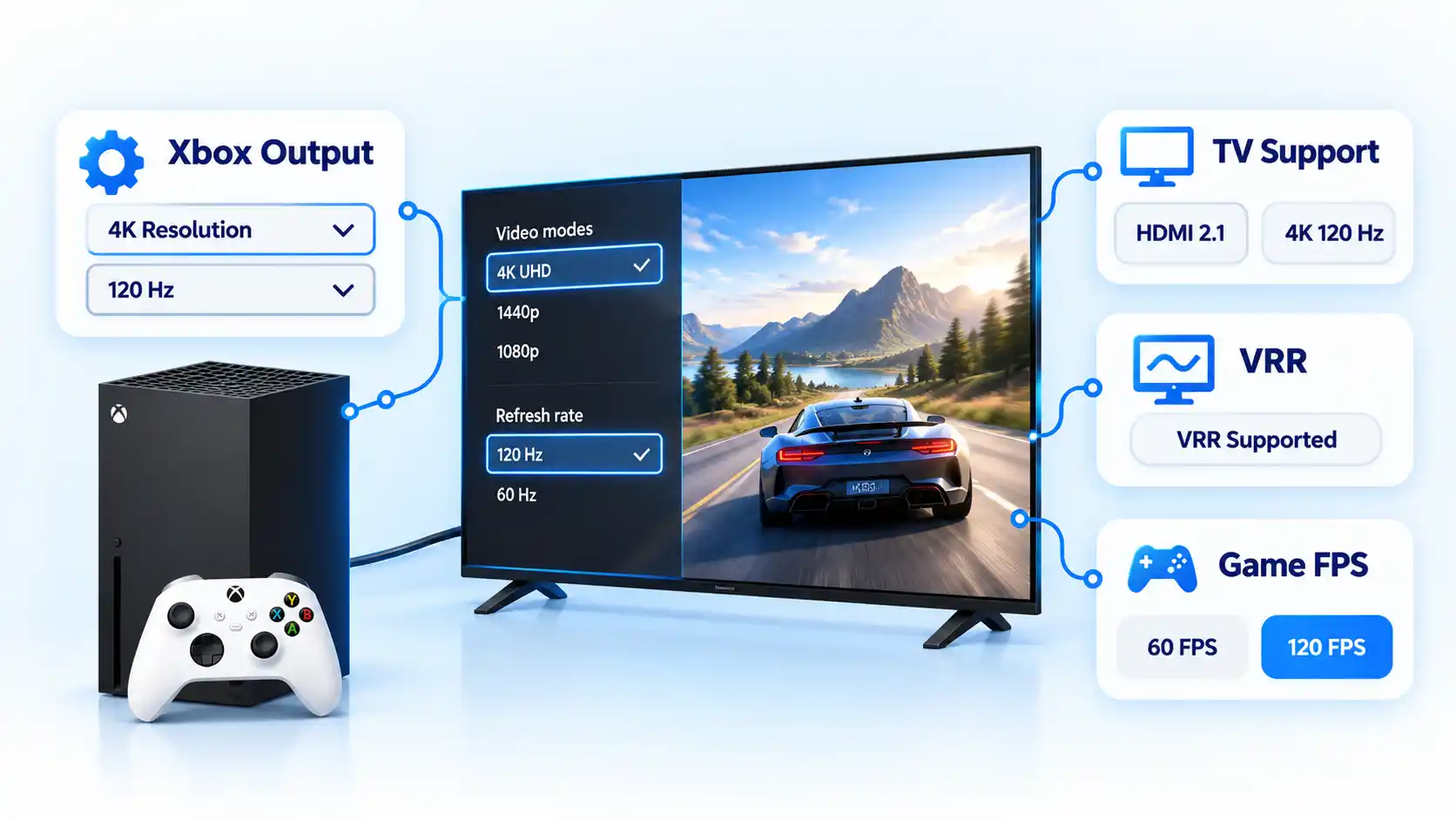
Start with a resolution and refresh rate you know the display handles reliably. Then enable VRR, 120 Hz, or high dynamic range (HDR) individually rather than switching everything on at once. If the picture turns black, flickers, loses signal, or behaves differently on a particular input, return to the last stable configuration and add features back one at a time.
If a supported mode still causes problems, isolate 120Hz, VRR and HDR problems one setting at a time. Some televisions expose their full gaming feature set only on particular HDMI inputs or after an input-specific enhanced mode is enabled.
Judge a network by responsiveness as well as speed
Download speed matters for installing games, but multiplayer traffic has a different priority: data needs to arrive consistently and on time. Latency is the delay involved in sending data across the network, while packet loss means some transmitted data never reaches its destination. A connection with plenty of raw bandwidth can still produce a poor multiplayer experience when latency or packet loss is unstable.
That is why a speed test should be the beginning of diagnosis rather than the verdict. Compare the same game under similar conditions, reduce competing network activity, and test Ethernet if it is practical. For gameplay traffic, Microsoft’s Quality of Service material identifies packet latency and available bandwidth as key connection-quality measures.
Advanced Quality of Service, or QoS, configuration belongs later in the process. Xbox packet tagging is intended to help on networks that support prioritisation of tagged traffic, so it is not a universal speed switch. Random DNS changes are also a poor first response to gameplay lag because they do not directly repair Wi-Fi interference, packet loss, or local congestion.
Choose storage by what the game needs
Xbox storage becomes much easier to manage once you separate two questions: Can this drive store the game? and Can this game run directly from that drive? Those are not always the same thing on Xbox Series X|S.
If you are deciding whether extra capacity is worth adding, start by understanding how Xbox storage options differ in what they can run directly. The internal SSD and compatible Storage Expansion Cards are intended for the high-speed storage path used by Series X|S-optimised games, while USB storage remains useful for archiving and for compatible previous-generation games.
| Storage option | Series X|S-optimised games | Older compatible games | Best practical use |
|---|---|---|---|
| Internal SSD | Designed for direct play | Direct play | Active games, especially Series X|S-optimised titles |
| Storage Expansion Card | Designed for direct play with internal-storage-class performance | Direct play | Expanding the high-speed active library |
| External USB HDD or SSD | Useful for storage and transfer; Series X|S-optimised titles generally require supported high-speed storage for direct play | Direct play for compatible Xbox One, Xbox 360, and original Xbox games | Archive space and a backward-compatible game library |
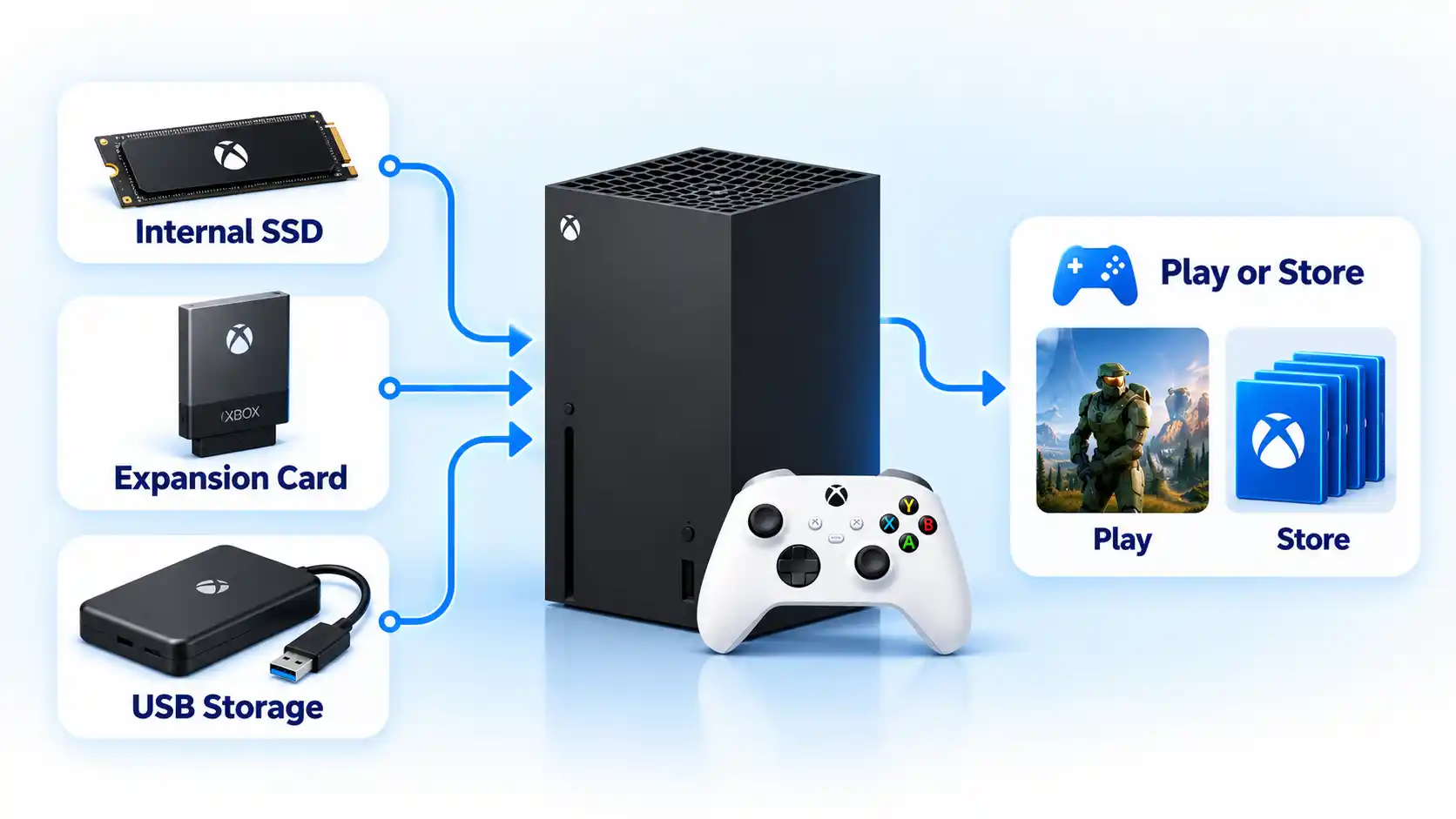
A Storage Expansion Card is designed to replicate the console’s custom SSD experience, while USB storage fills a different role. The practical consequence is that an external USB drive can still save download time by holding games you are not actively playing, even when a particular Series X|S version needs to be moved back to high-speed storage before launch.
Do not confuse capacity management with a universal performance claim. Keeping enough free room for installations and updates is useful, but there is not a good basis here for saying that an Xbox automatically produces lower frame rates merely because its drive is approaching capacity.
Keep Game Pass and captures from becoming surprises
Older Xbox advice often refers to Xbox Live Gold or Game Pass Core as though those names still describe the current range. Xbox’s current Game Pass pages now include Ultimate, Premium, Essential, and PC Game Pass among their plan labels, so check the plan attached to your account instead of troubleshooting against an old entitlement name.
If the plan names blur together, compare Game Pass Essential, Premium and Ultimate by the benefits you actually use, such as online console multiplayer, game access, and cloud play, instead of assuming an older Core or Gold description still applies.
Cloud gaming is also in a transition period. Xbox announced that monthly included cloud-play limits begin in November 2026: 15 hours for Ultimate, 10 for Premium, and 5 for Essential. Because this article’s reference date is October 3, 2026, those figures are upcoming limits rather than limits that should be assumed active for every subscriber today.
If you buy Game Pass outside the Xbox Store, read the fulfilment details as carefully as the plan name and region. The Xbox Game Pass Ultimate 1 Month listing, for example, says it supplies a new preloaded account rather than a conventional game key, so its activation model differs from buying a subscription directly through your Microsoft account.
Captures need similar housekeeping. Xbox’s published network-retention policy says game captures stored on the Xbox network are deleted after 90 days. If a clip or screenshot matters, back it up rather than treating network storage as permanent. Xbox also provides a OneDrive backup path for captures you want to keep.
Troubleshoot by symptom
When the baseline is set correctly, troubleshoot the symptom rather than cycling through unrelated settings. The goal is to narrow the cause with each action.
The screen goes black or shows “No signal” after a display change
Return to a known stable resolution and refresh rate first. Confirm that the television input supports the feature you were trying to enable, then reintroduce 120 Hz, VRR, or HDR one at a time. If one feature consistently triggers the failure, leave it disabled until you can verify the display input, cable path, and game mode support.
Multiplayer feels laggy even though the download speed looks fast
Look beyond throughput. Recheck latency and packet loss, reduce other heavy network activity, and compare Wi-Fi with a wired connection if possible. If the problem disappears on Ethernet, investigate Wi-Fi distance, interference, or congestion before experimenting with DNS or router-level prioritisation.
A Series X|S game will not launch from an external USB drive
Check whether the installed version is optimised for Series X|S. If it requires the Xbox high-speed storage path, move it to the internal SSD or a compatible Storage Expansion Card. Keep the USB drive for storage, transfer, or compatible previous-generation games instead.
A capture disappeared or is approaching deletion
Open the Captures app and check which captures are stored on the Xbox network. Preserve anything important before the retention period expires by using an available backup destination such as OneDrive.
Verify the tune-up worked
The final step is not another setting. It is checking whether the original problem changed after your adjustment. Keep the test as consistent as possible so you can distinguish an actual improvement from a different game, server, or network condition.
Verify the result
- Launch the same game or scene you used before the change and check whether movement, camera panning, and display stability improved.
- If you changed the network setup, rerun the Xbox network test and compare latency, packet loss, and connection stability under similar household conditions.
- If you moved a game, verify that it launches from the intended storage and that you understand whether that drive is for active play or archive use.
- If you changed subscription or capture settings, confirm the expected entitlement or backup result rather than assuming the menu change completed it.
Once the problem is solved, stop changing settings. A stable Xbox setup is more useful than a long list of tweaks whose effects you cannot separate.

💬 Comments