An image-to-text converter uses Optical Character Recognition (OCR) to locate text inside an image, recognize the letters and words, and turn them into machine-readable text that you can search, copy, edit, or process. Modern OCR systems may also preserve information about where the text appears on the page, its reading order, and how confident the system is in each recognition result.
Quick Take
An image-to-text converter does more than match pictures of letters to an alphabet. A typical OCR pipeline cleans the image, finds text regions, recognizes characters and words, determines their order, and returns digital text. Poor resolution, blur, skew, unusual layouts, handwriting, and language mismatches can reduce accuracy.
What Is an Image-to-Text Converter?
An image-to-text converter is software that extracts written or printed information from a photograph, screenshot, scanned page, or other image and converts it into digital text.
The important difference is that an ordinary image stores visual information as pixels. If a JPG contains the sentence “Total: $125,” the computer does not automatically treat those shapes as editable letters and numbers. OCR bridges that gap by analyzing the visible shapes and identifying the text they most likely represent.
For example, you might photograph a receipt with your phone and send the image to an OCR tool. Instead of returning another picture, the converter can produce selectable text such as the merchant name, item descriptions, and total amount.
OCR is the foundational technology behind this process. Microsoft describes modern OCR as text recognition or text extraction and notes that machine-learning-based systems can extract printed and, in supported scenarios, handwritten text from images and documents. Its OCR systems can return words, lines, paragraphs, locations, and confidence information rather than only one long block of text. Microsoft’s OCR documentation explains these capabilities.
For a deeper treatment of the core recognition technology itself, Optical Character Recognition and how OCR works is the underlying concept to understand.
How Does Image-to-Text Conversion Work?
Different OCR engines use different models and processing techniques, so there is no single universal internal pipeline. However, most practical systems need to solve the same sequence of problems: prepare the image, locate the text, recognize it, determine its structure, and return useful output.
1. The Converter Receives the Image
The process begins when you upload, scan, photograph, paste, or otherwise provide an image.
Depending on the service, the input might be a JPEG, PNG, TIFF, PDF page, screenshot, camera photograph, or another supported format. The converter decodes the file into pixel data that its image-processing and recognition systems can analyze.
At this stage, the quality of the source already matters. A high-resolution scan of a printed page preserves more character detail than a heavily compressed screenshot or a distant photograph of small text.
This is one reason two pictures of the same document can produce different OCR results even when both are processed by the same engine.
2. The Image Is Prepared for Recognition
Before trying to read the words, OCR software may process the image so that text is easier to separate from the background.
Common operations include adjusting contrast, resizing the image, converting it into a simpler tonal representation, removing some visual noise, correcting rotation, and isolating the useful portion of the page.
For example, imagine photographing a receipt at a slight angle. If the text lines slope upward from left to right, the OCR engine may first correct that skew so the lines become horizontal.
Preprocessing is not merely cosmetic. Tesseract’s official documentation notes that image resolution, binarization, skew, borders, and page segmentation can materially affect recognition quality. A badly skewed page, for example, can interfere with line segmentation before the engine even starts interpreting the words. Tesseract documents these image-quality factors in detail.
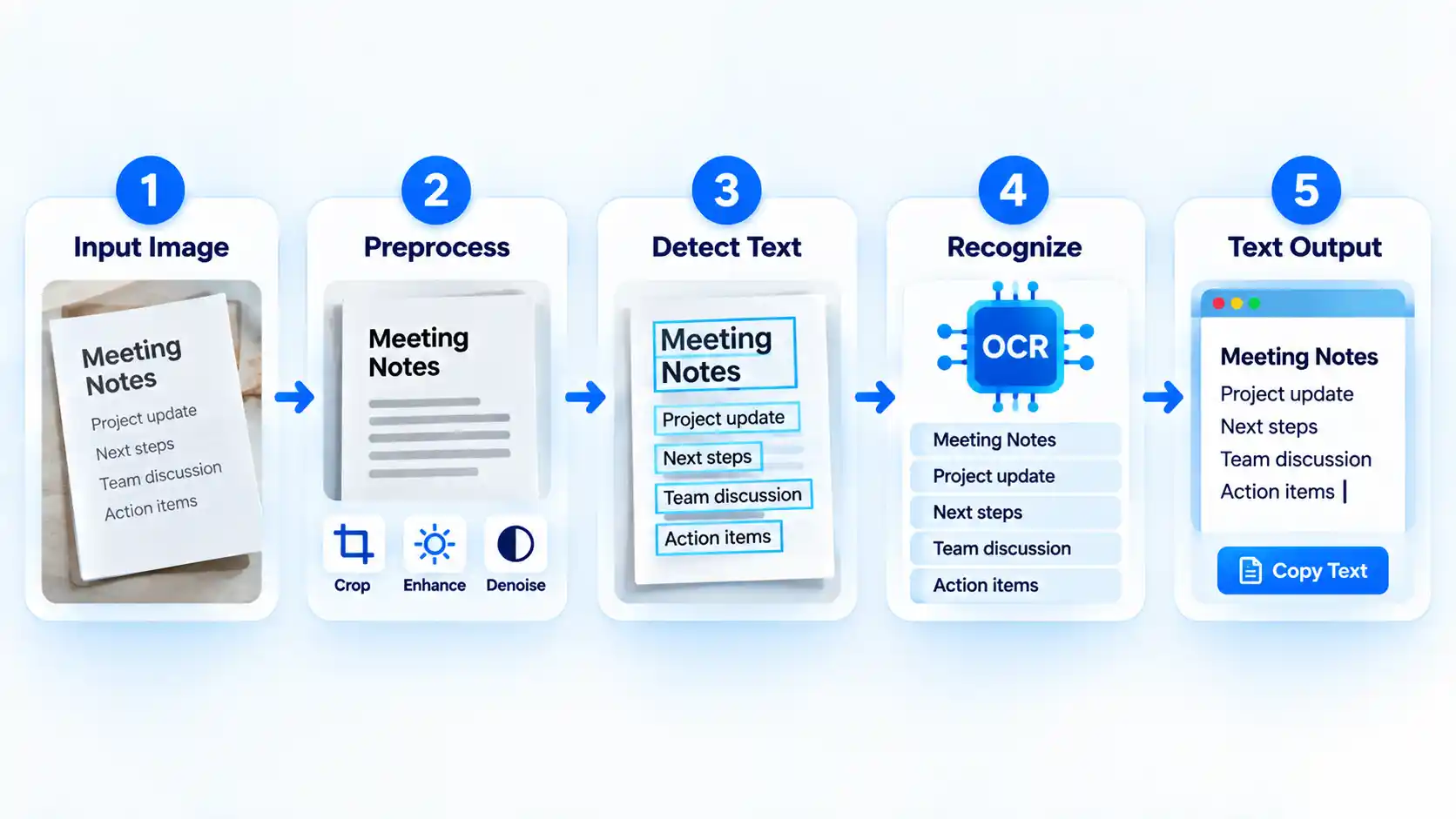
3. The System Finds Text Regions and Page Structure
Once the image is usable, the system needs to determine where the text actually is.
A simple photograph may contain only a street sign. A scanned report might contain a title, two columns, several paragraphs, a table, page numbers, and an image caption. Treating all of those pixels as one continuous line of text would produce poor results.
OCR and document-processing systems therefore identify regions that appear to contain text and may divide them into progressively smaller structures such as blocks, paragraphs, lines, words, and individual symbols or tokens.
Google Cloud Vision, for example, distinguishes general text detection from document-oriented detection. Its document mode can return page, block, paragraph, word, and break information, while general image OCR can return the recognized string, individual words, and their bounding boxes. Google Cloud’s OCR documentation shows this structural difference.
A bounding box or polygon is simply a set of coordinates describing where an item appears in the image. That positional information allows software to know not only that the word “Total” exists, but also where it appeared on the page.
4. Recognition Models Interpret the Characters and Words
The recognition stage determines what the visible shapes most likely say.
Older explanations of OCR sometimes describe this as simple character matching, as though the software compares every symbol with a fixed library of letter pictures. That does not accurately describe many modern systems.
Current OCR engines can use trained machine-learning models to recognize patterns in printed and handwritten text. The model evaluates visual features and predicts the characters, words, or text sequence represented by the image.
Context can help resolve ambiguous shapes. A zero and an uppercase “O,” for example, may look nearly identical in some fonts. Similarly, “rn” can sometimes resemble the letter “m.” Recognition models and language information can help determine which result is more plausible in context.
This does not mean the software understands a document exactly as a person does. OCR primarily answers a narrower question: what text is most likely visible here?
5. Language and Context Can Refine the Result
Many OCR engines support multiple languages and writing systems. Some can detect likely languages automatically, while others work better when the expected language is supplied in advance.
Language information can narrow the set of plausible characters and words. This becomes especially important when visually similar symbols occur in different alphabets or when one image mixes several languages.
Google’s OCR response model, for example, can include detected languages and confidence values. Microsoft’s current OCR documentation likewise describes support for numerous printed-text languages and a more limited set of supported handwritten languages.
Support is not the same as perfect recognition. Performance can still vary according to language, script, handwriting style, image quality, model version, and the kind of document being processed.
6. The Converter Reconstructs and Returns the Text
After recognition, the system assembles the detected words into useful output.
A basic image-to-text website may return only plain text that you can copy to the clipboard. More advanced document systems can preserve page structure or expose coordinates, confidence scores, tables, fields, and relationships between different pieces of content.
Amazon Textract provides a straightforward example of this structure. Its text-detection API returns PAGE, LINE, and WORD blocks and records the parent-child relationships between them. AWS documents how these OCR blocks are organized.
That distinction matters in practice. Extracting the sentence “Balance Due $420” is one task. Determining that “$420” is the value associated specifically with the “Balance Due” field is a more structured document-processing problem.
What Happens After OCR Recognizes the Text?
OCR recognition is often only the first stage of a larger workflow.
The recognized text may be copied into a document, indexed for search, added as a searchable layer to a PDF, placed into a database, checked against business rules, or passed to another system for further analysis.
Document-processing platforms can go beyond ordinary OCR by identifying tables, form fields, key-value pairs, and other relationships. Google Document AI, for example, exposes pages, blocks, paragraphs, lines, tokens, form fields, and tables as separate structures. Google’s Document AI response documentation illustrates this richer output.
Translation is also a separate process. OCR can read the French words on a restaurant menu and convert them from pixels into digital French text. A translation system then converts that recognized French text into English or another language.
Google’s own image-translation workflow uses separate Vision and Translation services, which demonstrates this distinction. Google’s Vision tutorials treat OCR and translation as separate stages.
The same distinction applies to spreadsheets. OCR can recognize numbers and labels inside an image, while additional layout analysis is needed to place them reliably into the correct rows and columns. BlogTheTech’s guide on converting JPG images to Excel covers that more specific workflow.
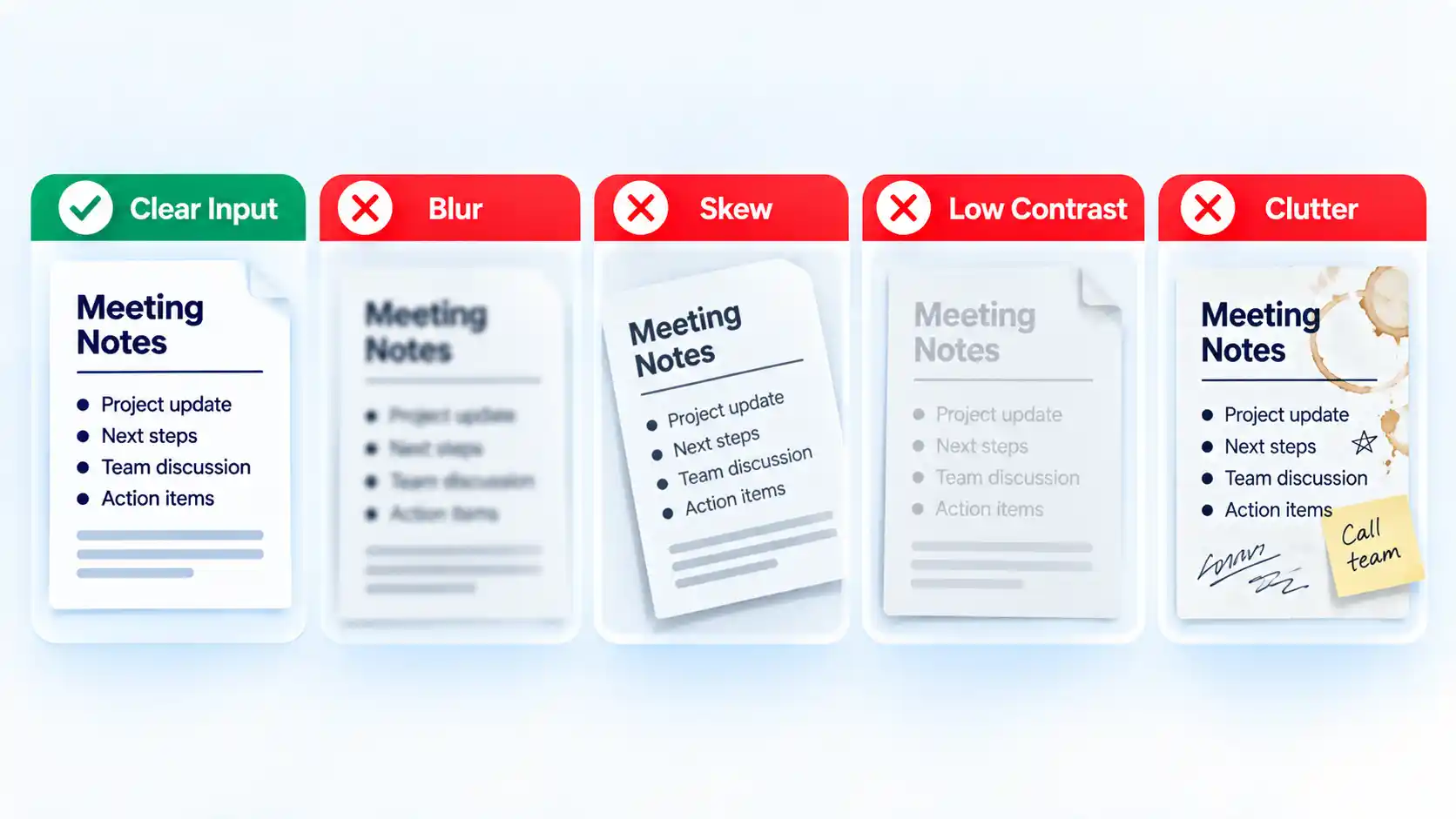
Why Do Image-to-Text Converters Make Mistakes?
OCR is not error-free. Recognition is an inference based on the visual information available to the system, so poor or ambiguous input can lead to the wrong result.
Common causes include:
- Low resolution: Small characters may contain too few pixels to distinguish similar letters reliably.
- Blur: Motion blur or poor focus can merge character edges.
- Skew and perspective: Text photographed from an angle can distort line structure and character shapes.
- Low contrast: Pale text on a similar-colored background is harder to separate.
- Complex backgrounds: Patterns, photographs, shadows, stamps, and overlapping graphics can interfere with text detection.
- Decorative fonts: Unusual letter shapes may differ substantially from the patterns represented in a recognition model.
- Very small text: Detail can disappear during capture, resizing, or compression.
- Handwriting: Individual writing styles introduce much more variation than ordinary printed fonts.
- Complex layouts: Multiple columns, captions, tables, sidebars, and rotated text can produce incorrect reading order.
- Language mismatch: Using an unsuitable language or recognition model can make otherwise clear characters harder to interpret correctly.
A character-level error can also change the meaning of the result. An OCR engine might confuse “0” with “O,” “1” with “I,” or “8” with “B.” In a paragraph this may be obvious. In an invoice number, account identifier, measurement, or monetary amount, it may not be.
That is why OCR output used for important financial, legal, medical, or operational decisions should be verified rather than assumed to be correct merely because the conversion was automated.
For a focused diagnosis of recognition problems, common causes of poor OCR recognition include both image-quality problems and recognition-model limitations.
OCR, ICR, Document AI, and Translation Are Different
Several technologies can appear inside the same document workflow, but they do different jobs. The table below separates their primary roles.
| Technology | Primary job | Typical input | Typical output | Important limitation |
|---|---|---|---|---|
| OCR | Recognize printed or supported handwritten text | Photos, scans, screenshots, document images | Machine-readable words, lines, or text blocks | Accuracy depends on the engine and input quality |
| ICR | Recognize hand-printed characters in systems that distinguish ICR from OCR | Forms and defined handwriting fields | Recognized hand-printed characters | The term and capabilities vary by vendor; cursive support should not be assumed |
| Document AI / IDP | Extract document structure and meaning beyond raw text | Invoices, forms, reports, receipts and similar documents | Text plus fields, tables, relationships, entities or other structured data | Requires more than basic text recognition |
| Machine translation | Convert recognized text from one language to another | Digital text, including OCR output | Translated text | It does not replace the initial OCR step needed to read text from an image |
The boundary between OCR and handwriting recognition is not universal. Microsoft, for example, includes supported handwriting within its modern OCR offering. ABBYY uses the term Intelligent Character Recognition (ICR) for recognition of separately written hand-printed characters and notes that its ICR implementation does not simply cover ordinary cursive handwriting. ABBYY’s ICR documentation explains that vendor-specific distinction.
Similarly, Intelligent Document Processing (IDP) builds on OCR rather than replacing the concept. Microsoft describes OCR as the foundational technology used by IDP systems before additional models extract structure, relationships, key-value pairs, entities, and other document-level information.
For a direct terminology breakdown, OCR, ICR, and Document AI differ mainly in the type and depth of information they extract.
Common Uses of Image-to-Text Conversion
Image-to-text conversion is useful whenever information exists visually but needs to become searchable, editable, or reusable.
Common examples include:
- Scanned documents: Convert printed pages into searchable or editable text.
- Receipts and invoices: Extract visible merchant names, dates, amounts, and descriptions for later processing.
- Screenshots: Copy text from an interface or image when the original text cannot be selected.
- Printed notes: Digitize typed or clearly printed material without manually retyping every line.
- Signs and labels: Recognize text captured in photographs.
- Document archives: Make previously image-only scans easier to search and index.
- Spreadsheet workflows: Recognize tabular text that can then be reconstructed into rows and columns.
If the goal is simply to test several consumer-facing options, BlogTheTech also maintains a roundup of free OCR tools for extracting text from images. Tool capabilities should still be checked individually because supported formats, languages, handwriting features, privacy terms, and output options can differ.
How to Get Better OCR Results
You usually get better text extraction by improving the source image before asking the software to recognize it.
Start with the clearest original available. Use a sharp image with enough resolution for small letters to remain distinct. When photographing a page, hold the camera as parallel to the document as possible so the text does not narrow toward one edge.
Good lighting also matters. Avoid strong glare, deep shadows, and uneven illumination across the page. If the useful text occupies only a small part of a large photograph, cropping unnecessary background can reduce distractions.
For a scanned document, correct obvious rotation and make sure text lines are horizontal. Tesseract specifically warns that excessive skew can reduce the quality of line segmentation and therefore the OCR result.
When the software lets you choose a language, document type, handwriting mode, or recognition model, select the option that matches the material. A model optimized for a photographed street sign does not necessarily behave identically to one optimized for a dense multipage report. Microsoft’s current OCR documentation explicitly separates general image OCR from document-oriented OCR for this reason.
Finally, proofread information that matters. Confidence scores can help applications identify uncertain recognition, but they do not guarantee that every high-confidence result is correct.
Privacy Matters When Uploading Sensitive Images
An online image-to-text tool may need access to the image contents in order to process them. That can matter if the file contains identification documents, financial information, confidential business records, medical information, or other sensitive material.
Do not assume that every OCR service handles uploads in the same way. Processing may happen in the cloud, on the device, inside a browser, or on an organization’s own infrastructure depending on the product.
Before uploading sensitive material, check the provider’s privacy policy, retention practices, processing location, and security options. Microsoft, for example, provides both cloud OCR services and certain container-based deployment options for organizations with different security and data-governance requirements.
Conclusion
An image-to-text converter works by turning visual information into machine-readable text through OCR. The system first receives and prepares the image, locates likely text regions, recognizes characters and words, reconstructs their order, and returns the result in a usable digital form.
More advanced systems can also preserve page coordinates, confidence information, tables, fields, and other document structure. However, OCR remains dependent on the quality of the input and the capabilities of the recognition model. Clear images, appropriate language or document settings, and human verification of important data remain the most reliable way to get useful results.

💬 Comments