Preparing for a multi-cloud environment requires conducting a comprehensive application workload audit, deploying a cloud-nimble binary and container abstraction layer, enforcing unified zero-trust Identity and Access Management (IAM), building cross-cloud network egress safeguards, and establishing single-pane observability and FinOps controls. By systematically decoupling infrastructure dependencies before migrating workloads, enterprise organizations eliminate single-vendor lock-in while preserving operational reliability across Amazon Web Services (AWS), Microsoft Azure, and Google Cloud Platform (GCP).
Quick Take
Migrating to a multi-cloud model offers enterprise elasticity and workload agility, but success depends on strategic preparation rather than ad-hoc provisioning. Organizations must move beyond basic cloud-native tools to establish a unified “cloud nimble” architecture across all target providers. By standardizing build artifacts, centralizing security policies, and controlling cross-cloud egress patterns, engineering teams can modernize operations and sustainably improve business workflows without introducing unmanageable operational friction.
Prerequisites & Readiness Audit
Before provisioning resources across secondary or tertiary cloud service providers (CSPs), enterprise IT leadership must establish clear architectural guardrails and evaluate operational maturity. Jumping into multi-cloud without a pre-flight assessment leads to duplicated tooling costs, security blind spots, and fragmented governance.
Complete the following prerequisites prior to initiating multi-cloud deployment:
- Business Objectives Alignment: Define the explicit trigger for multi-cloud adoption (e.g., regulatory data residency requirements, disaster recovery failover targets, vendor negotiation leverage, or specialized machine learning capabilities).
- Cloud Maturity Assessment: Audit internal DevOps and Site Reliability Engineering (SRE) capabilities to confirm team proficiency with declarative Infrastructure as Code (IaC) and container orchestration.
- Network Topology Baseline: Map current bandwidth utilization, perimeter firewalls, and dedicated hybrid connections (such as AWS DirectConnect, Azure ExpressRoute, or GCP Cloud Interconnect).
- Compliance and Governance Review: Document data protection constraints (GDPR, HIPAA, SOC 2) to identify which workloads are legally restricted from residing in specific geographic regions or cloud environments.
Step-by-Step Multi-Cloud Preparation Plan
Step 1: Inventory, Rationalize, and Categorize Enterprise Workloads
The foundational step in preparing for a multi-cloud transformation is taking a complete, data-driven inventory of all enterprise software applications and services. Migrating legacy tech debt into distributed cloud environments compounds operational cost without providing performance gains.
Utilize automated discovery tools (such as AWS Application Discovery Service, Azure Migrate, or Google Cloud Migration Center) to discover dependencies, network traffic patterns, and compute consumption. Once inventoried, evaluate each application using a structured cloud migration framework to assign one of the primary rationalization pathways:
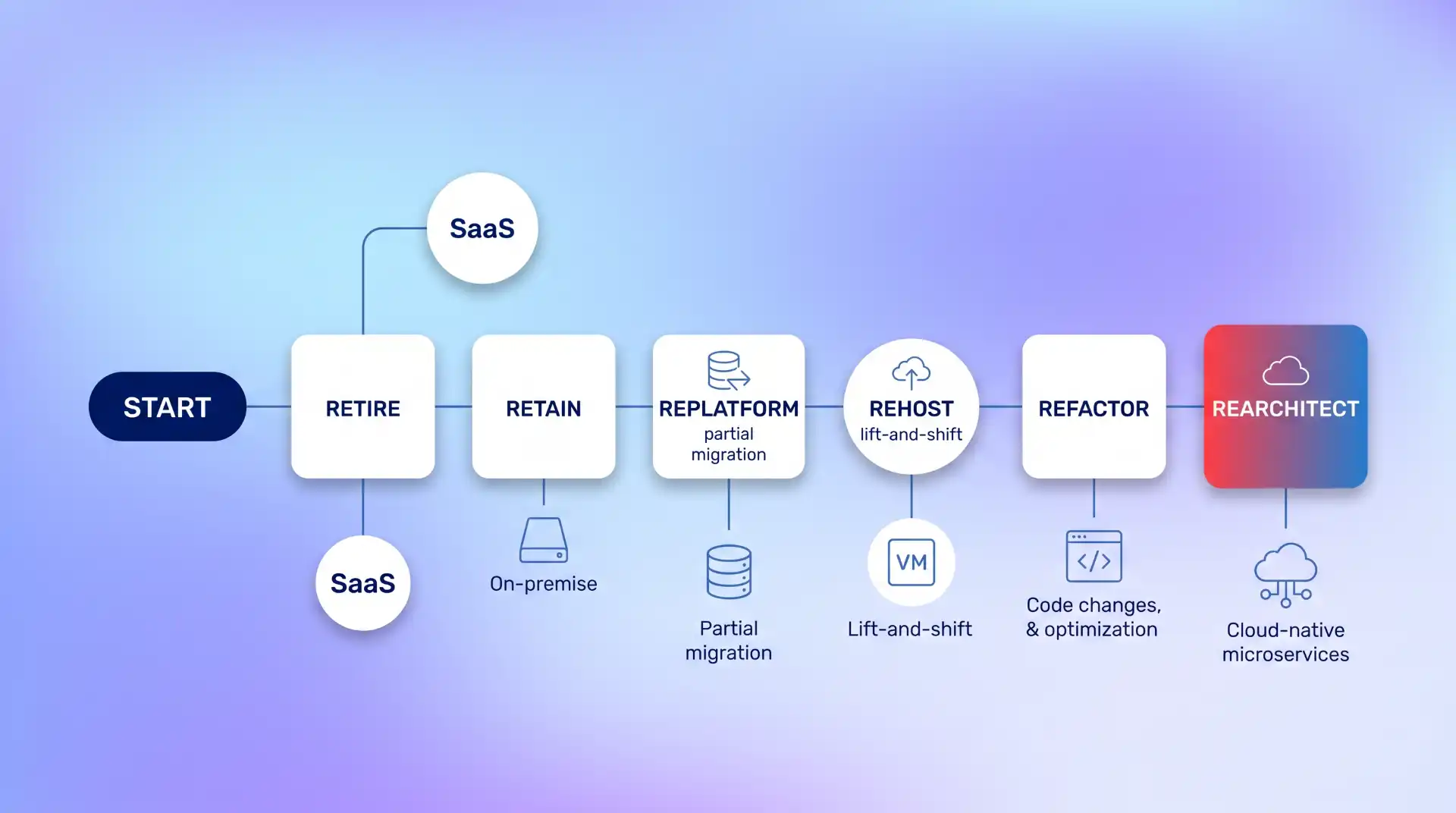
- Retire or Replace (SaaS): Eliminate redundant internal tools. If a commercial Software-as-a-Service solution provides equal or superior functionality at lower total cost of ownership (TCO), decommission the custom instance.
- Rehost (Lift-and-Shift): Move standard, monolithic applications to cloud virtual machines when fast infrastructure evacuation is required, planning for future optimization.
- Refactor / Rearchitect: Redesign core proprietary applications into microservices-based architectures to maximize portability and horizontal scaling across public cloud networks. Conducting a thorough application inventory and business dependency mapping ensures critical competitive differentiators receive the architectural investment they require.
- Retain: Keep highly sensitive, low-latency, or legacy mainframes on-premises or within specialized private cloud infrastructure until modernization is viable.
Step 2: Establish a “Cloud Nimble” Abstraction Layer and Container Strategy
Building applications directly against vendor-specific cloud APIs locks your operational model into a single platform. True multi-cloud flexibility requires going beyond basic cloud-native services to build portable, decoupled architectures.
Deploy application workloads using standard container platforms like Docker and manage them with multi-cluster Kubernetes orchestration. To prevent infrastructure drift between environments, maintain declarative deployment configurations using open-source Infrastructure as Code tools such as Terraform or OpenTofu.
Furthermore, decouple build dependencies from underlying cloud infrastructures by implementing a centralized binary management system. Adopting an integrated multi-cloud DevOps strategy allows development teams to maintain consistent build artifacts, release pipelines, and security scanning regardless of whether the underlying target environment resides in AWS, Azure, or GCP. Standardizing artifact distribution ensures rapid workload migration and uniform release cadence across all public and private domains.
Step 3: Implement Unified IAM and Zero-Trust Security Protocols
Security management represents one of the highest risk factors in multi-cloud operations. Each major cloud provider utilizes proprietary Identity and Access Management (IAM) structures, role definitions, and policy syntax. Managing access through separate native consoles inevitably creates permission drift and security vulnerabilities.
Mitigate security risks before launching secondary cloud environments by establishing a single identity provider (IdP) and enforcing standard zero-trust principles:
- Centralized Identity Provider: Route all user and service account authentication through a federated identity provider (such as Okta or Microsoft Entra ID) utilizing SAML 2.0 or OpenID Connect (OIDC). Implement strictly enforced zero-trust identity access controls across every cloud perimeter.
- Policy-as-Code Enforcement: Standardize security guardrails across platforms using Policy-as-Code engines like Open Policy Agent (OPA) or Kyverno. This ensures storage buckets, network firewalls, and encryption settings meet baseline compliance standard before deployment.
- Least Privilege and Role-Based Access: Eliminate long-lived static API credentials. Utilize short-lived access tokens and federated role assume policies to minimize attack surfaces. Deploying a enterprise-wide zero-trust security architecture across cloud boundaries protects sensitive corporate data from unauthorized access across cloud perimeters.
Step 4: Build Cross-Cloud Network Routing and Egress Cost Safeguards
Network latency and unexpected data transfer fees are common technical obstacles during multi-cloud rollouts. Cloud service providers generally allow free ingress (data entering their network) but charge substantial fees for egress (data leaving their network). Uncontrolled inter-cloud communication can quickly inflate monthly infrastructure bills.
Design your multi-cloud network topology around data boundary isolation:
- Minimize Inter-Cloud Data Dependencies: Architect application tiers so that high-frequency transactional data stays within a single cloud provider boundary. Avoid active-active database configurations where individual database writes require real-time synchronous replication across different cloud vendors.
- Deploy Private Network Interconnects: For essential cross-cloud traffic, avoid routing data over the public internet. Secure high-speed, predictable connectivity via cloud exchange providers (such as Equinix Fabric or Megaport) or dedicated IPSec VPN tunnels.
- Localize Caching and Storage: Place edge caching servers and content delivery networks (CDNs) near client traffic to minimize direct data requests back to central cloud storage buckets. Addressing unbudgeted cross-cloud egress costs and identity management drift early prevents budget overruns during scaling phases.
Step 5: Deploy Single-Pane Observability and FinOps Governance
Operating multiple cloud platforms without centralized monitoring leads to fragmented operational visibility, delayed incident response times, and uncoordinated cloud expenditure. Implementing a single control plane for monitoring and cost control is mandatory before onboarding enterprise workloads.
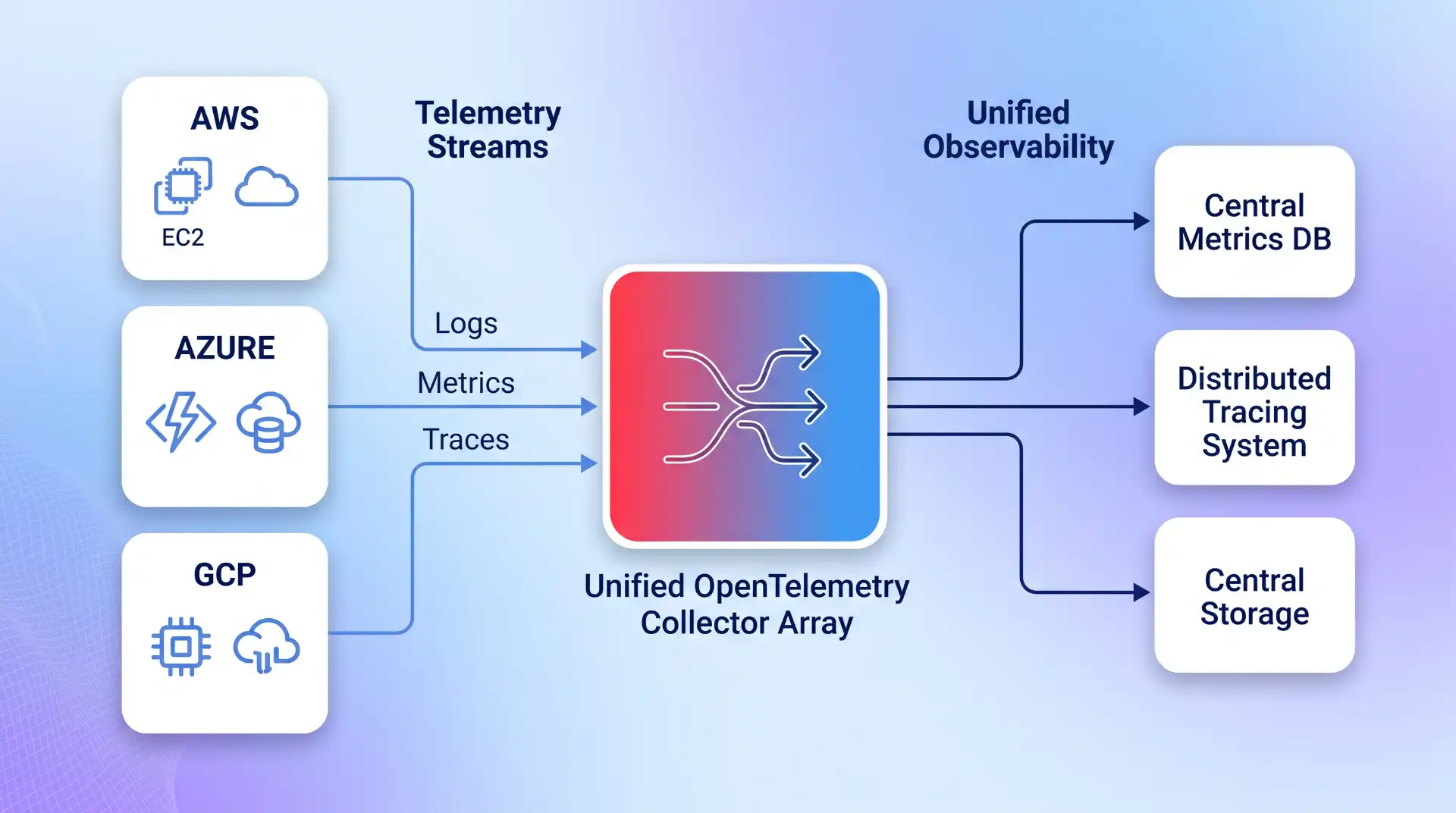
Establish unified operational visibility by implementing the following core control mechanisms:
- Centralized Telemetry Collection: Deploy vendor-neutral telemetry agents (such as OpenTelemetry) to stream logs, performance metrics, and distributed traces from all cloud hosts and Kubernetes clusters into a single unified monitoring platform (e.g., Datadog, Dynatrace, or Grafana Enterprise).
- Automated Cost Tracking (FinOps): Tag every deployed cloud resource with explicit metadata labels (`environment`, `owner`, `cost-center`, `application`). Implement continuous cloud cost management tools to monitor multi-cloud spend, detect cost anomalies, and highlight idle virtual resources in real time.
- Unified Incident Orchestration: Route alerts from all cloud platforms into a single incident management pipeline to ensure Site Reliability Engineering teams maintain fast mean-time-to-detection (MTTD) and mean-time-to-resolution (MTTR). Adopting unified container orchestration and infrastructure as code standards simplifies operational overhead and establishes clear accountability across SRE teams. Implement dedicated FinOps cloud cost optimization routines to align multi-cloud performance with fiscal targets.
Decision Routing: Choosing Your Multi-Cloud Deployment Pattern
Not all enterprise workloads require the same degree of multi-cloud integration. Select the deployment pattern that directly matches your organization’s technical capability and operational goals:
| Deployment Pattern | Primary Target Scenario | Operational Complexity | Key Architectural Trade-Off |
|---|---|---|---|
| Active-Passive (Disaster Recovery) | Mission-critical applications requiring business continuity during total provider outages. | Moderate | Requires robust secondary environment standby automation and tested cloud disaster recovery failover strategies. |
| Workload Isolation (Best-of-Breed) | Deploying specific application tiers to providers based on specialized capabilities (e.g., GCP for AI/ML, Azure for Windows enterprise systems). | Low to Moderate | Easiest pattern to execute, but requires strict data boundary controls to avoid egress cost escalation. |
| Active-Active (Distributed) | Global applications demanding ultra-low latency and localized high availability across multiple regions and clouds simultaneously. | High | Requires complex asynchronous data replication frameworks and sophisticated global traffic management (GTM) routing. |
Verification: How to Validate Multi-Cloud Readiness Before Live Traffic
Before executing production migrations, run the following technical verification checks to ensure your multi-cloud environment meets operational standards:
- Cross-Cloud Latency and Throughput Testing: Execute automated network performance scripts between cloud providers to baseline round-trip time (RTT) and identify bandwidth bottlenecks under peak load.
- Automated Failover Dry-Runs: Simulate a simulated cloud outage by isolating primary cloud resources and validating that traffic re-routes to secondary provider endpoints within established Recovery Time Objectives (RTO).
- IAM Access Policy Audit: Perform automated role permission checks across all accounts using IAM evaluation tools to verify zero-trust policies block unauthorized inter-cloud access attempts.
- Deployment Pipeline Integration: Run test build runs using your centralized CI/CD pipeline to verify continuous integration scripts deploy identical release candidates into both primary and secondary cloud clusters without configuration adjustments. Specialized multi-cluster Kubernetes management tooling can streamline these automated deployment validation passes.
Troubleshooting Common Multi-Cloud Deployment Failures
Unexpected issues often arise during multi-cloud transitions. Reference the diagnostic grid below to resolve frequent operational roadblocks:
| Symptom / Failure Mode | Likely Root Cause | Immediate Diagnostic & Remediation Step |
|---|---|---|
| Spiking Egress Data Costs | Microservices residing in Cloud A making high-frequency API or database calls to services residing in Cloud B. | Audit cross-cloud network traffic using flow logs. Restructure application boundaries to consolidate dependent microservice tiers within the same cloud network perimeter. |
| Authentication & Access Denied Errors | IAM role drift or expired token federation configurations between central Identity Provider (IdP) and target CSP. | Verify OIDC/SAML trust configurations in target cloud console. Re-sync federated group claims and ensure token TTL balances security with SRE operational needs. |
| High Transaction Latency in Active-Active Setup | Synchronous cross-cloud database locking or unoptimized distributed database transactions. | Convert synchronous database replication across clouds to an asynchronous event-driven architecture using distributed messaging queues (e.g., Apache Kafka). |
Where This Approach Has Limits: The Cost of Over-Abstraction
While avoiding vendor lock-in is a primary motivation for multi-cloud adoption, attempting absolute vendor independence comes with noticeable engineering trade-offs. Attempting to abstract away every cloud-native feature to force total portability can lead to the “Lowest Common Denominator” trap.
If an enterprise strictly forbids using cloud-native Managed PaaS solutions (such as AWS DynamoDB, Azure Cosmos DB, or GCP BigQuery) in favor of running self-managed instances in basic containers, engineering teams incur massive maintenance overhead. The operational cost of patching, upgrading, and maintaining self-managed infrastructure often exceeds the theoretical financial savings of avoiding proprietary services.
Pragmatic multi-cloud engineering accepts strategic vendor lock-in where a proprietary managed service delivers overwhelming efficiency gains, reserving complete cross-cloud portability for core business logic, container workloads, and CI/CD pipelines.
Key Takeaways
- Audit Before Migrating: Rationalize enterprise workloads using the 6 R’s framework before transferring software assets to cloud environments.
- Standardize Build Artifacts: Utilize a “cloud nimble” binaries-first DevOps approach with Kubernetes and declarative Infrastructure as Code to keep application workloads portable.
- Enforce Unified Security: Centralize authentication under a federated identity provider with zero-trust role policies to prevent IAM permission drift.
- Architect for Egress Efficiency: Structure data boundaries to keep transactional traffic within single cloud providers and minimize cross-cloud transfer charges.
- Centralize Operational Control: Implement single-pane telemetry monitoring and unified FinOps tagging to maintain visibility across all environments.
Frequently Asked Questions (FAQ)
What is the difference between hybrid cloud and multi-cloud environments?
A hybrid cloud environment specifically combines private on-premises infrastructure (or dedicated private cloud hardware) with public cloud services (such as AWS or Azure). In contrast, a multi-cloud environment utilizes services from two or more distinct public cloud providers simultaneously (e.g., combining AWS and GCP), regardless of whether on-premises resources are involved.
How do you manage data compliance and governance across multiple cloud providers?
Managing data compliance in multi-cloud environments requires defining strict Policy-as-Code rules that mandate geographic data boundaries and automated encryption standards. Centralized security tools automatically inspect storage configurations across all target cloud platforms to detect unencrypted buckets or unauthorized regional data replication instantly.
Does a multi-cloud strategy completely eliminate vendor lock-in?
No strategy completely eliminates operational friction when moving between providers, but a multi-cloud approach substantially minimizes lock-in risk. By packaging applications into standard containers, deploying configurations via vendor-neutral Infrastructure as Code, and managing build artifacts centrally, organizations reduce the technical switching costs of moving workloads between cloud platforms.
How can enterprise engineering teams prepare for the increased operational complexity of multi-cloud?
Engineering teams manage multi-cloud complexity by investing in standardized platform engineering tooling rather than manually learning separate cloud management consoles. Standardizing deployment workflows around Kubernetes, OpenTelemetry, and unified CI/CD pipelines allows SRE teams to maintain operational consistency regardless of where infrastructure resides.

💬 Comments