You can use an online fortune-telling site by checking its pricing and privacy terms, choosing a reader and communication method, setting a spending limit, and starting a chat, phone, or video session. Treat the reading as entertainment or a prompt for reflection rather than verified evidence about future events.
That distinction matters because the technology of an online reading is straightforward, while claims about psychic prediction are not scientifically established. The safest approach is to understand how the platform works, decide in advance what you are willing to spend and disclose, and keep important medical, legal, financial, or safety decisions separate from the reading.
Quick Take: What to Check Before You Start
- Check whether the service charges per minute, per session, or through prepaid credits.
- Confirm the normal rate as well as any introductory or promotional rate.
- Read the refund, account-credit, cancellation, and subscription rules before paying.
- Review what personal information the site collects and whether calls or chats may be recorded.
- Choose chat, phone, or video based on the level of privacy and interaction you want.
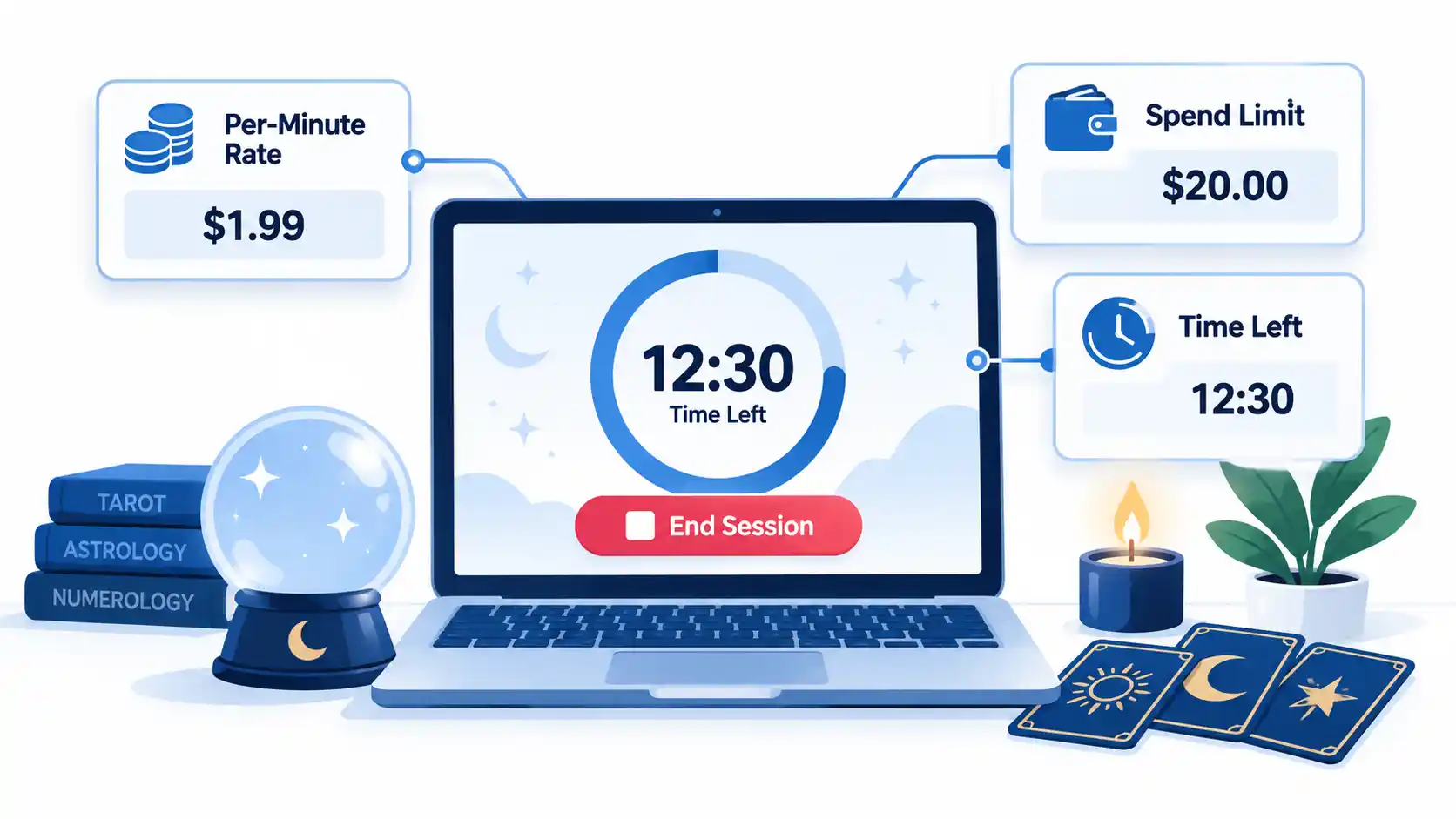
- Set a maximum session length and spending limit before connecting.
- Do not use a reading as a substitute for qualified medical, legal, financial, or other professional advice.
Per-minute pricing can become expensive quickly. For example, a reader charging $4 per minute would cost $80 for a 20-minute session. Decide whether that amount fits your budget before the session begins rather than making the decision while the clock is running.
What You Need Before Using an Online Fortune-Telling Site
A compatible device and a private connection
Most online fortune-telling services work through a web browser, telephone system, mobile app, or a combination of these. Chat requires a device on which you can type comfortably. Video also needs a working camera, microphone, and reasonably stable internet connection.
If you are discussing personal matters, use a private device where practical and avoid exposing account passwords, payment screens, private messages, or other unnecessary information on camera. Familiar online safety habits, such as checking the domain before entering credentials and avoiding suspicious links, apply to fortune-telling sites just as they do to other paid online services.
A focused topic rather than an unlimited question
A focused question makes it easier to control the direction and duration of a session. Instead of asking, “Tell me everything about my future,” you might say, “I am considering two career paths. What questions could I reflect on before choosing between them?”
This wording keeps the reading in a reflective role rather than transferring the decision to the reader. If you want to understand how different formats are positioned, a tarot versus psychic reading comparison can help distinguish the tools and styles without treating either method as verified prediction.
A firm time and spending limit
Many live services use per-minute billing. That means the final cost depends on both the published rate and the length of the conversation. Prepaid services may instead deduct minutes or account credit as the session continues.
Calculate your maximum acceptable spend before connecting. A practical per-minute service budget starts with a fixed dollar limit and works backward to the maximum session length at the displayed rate.
Also check whether promotional credits, subscriptions, scheduled appointments, unused balances, and refunds follow different rules. A headline introductory price may not be the rate that applies after the promotion expires.
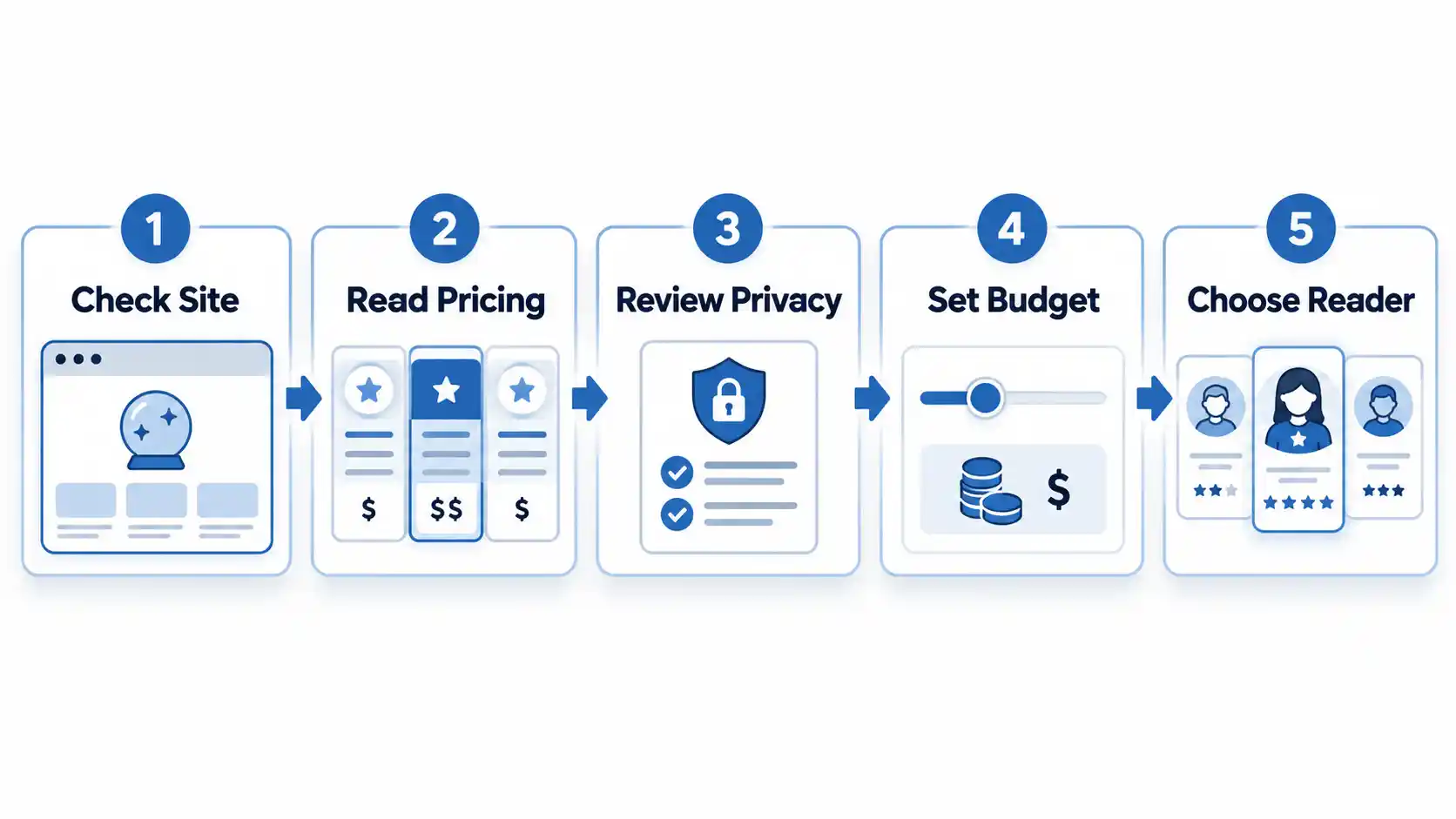
How to Use an Online Fortune-Telling Site Step by Step
Check the site’s identity, pricing, and policies
Before creating an account, confirm that you are on the intended website and inspect the site’s pricing, terms, privacy policy, and customer-support information. The checkout page should clearly show what you are buying, what rate applies, and whether you are purchasing a fixed session, prepaid balance, or per-minute access.
Pay particular attention to introductory offers. They may apply only to a first purchase, selected readers, a limited number of minutes, or a particular promotional checkout. Psychic Source’s current published pricing information, for example, describes a one-time introductory offer while stating that regular advisor rates apply afterward. Because promotional displays can change, the rate shown at checkout is the one you should verify before authorizing payment.
If you want to use an unfamiliar platform, review its contact details as well. A professional-looking page alone does not establish that the business or reader is trustworthy.

Create an account only after reviewing the data requirements
A legitimate payment flow may require information such as your name, email address, billing details, and payment information. That does not mean an individual reader needs access to every piece of identifying information associated with your account.
For example, a conversation about a relationship does not require you to disclose a bank login, Social Security number, one-time verification code, email password, or payment-card security code to the reader. Do not provide highly sensitive credentials simply because someone claims the information is needed to improve a reading.
Privacy policies can also reveal how much information the platform itself collects. Psychic Source states in its current privacy policy that online purchases can involve collection of details including a name, email address, billing address, telephone number, and credit-card information. Its policy also describes collection of technical and usage information.
Choose a reader using observable criteria
Reader profiles commonly include a communication method, availability, price, stated specialties, reading methods, biography, and customer ratings. These details can help you choose the type of interaction you want.
Use ratings carefully. A rating can tell you something about a customer’s reported experience, communication style, or satisfaction with a session. It does not establish that a reader can predict future events with scientifically verified accuracy.
Likewise, a platform may describe screening or vetting procedures. Treat those descriptions as information about the company’s recruitment process, not independent proof of paranormal ability.
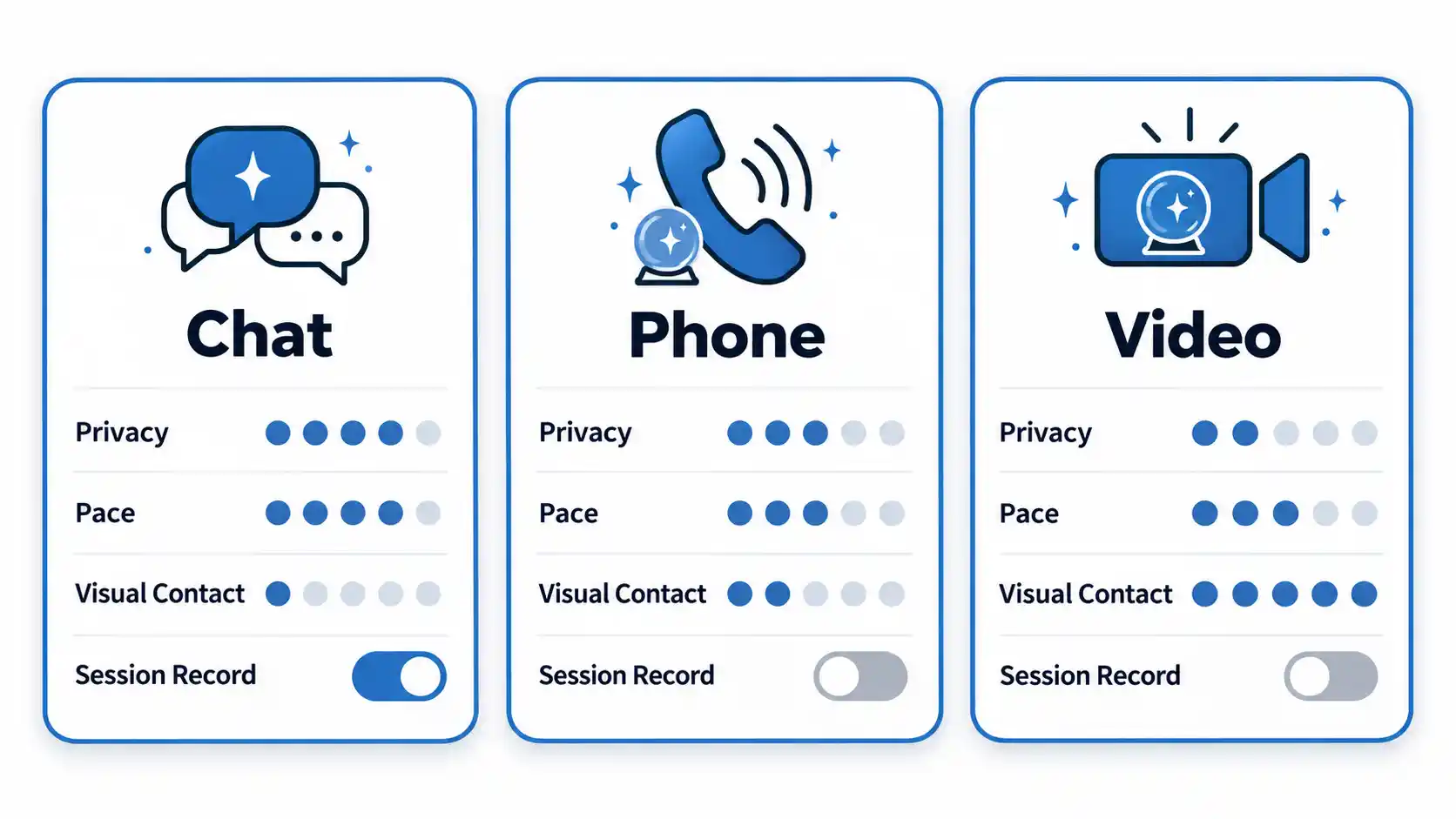
Choose between chat, phone, and video
The communication method changes the experience even when the subject of the reading is the same.
Practical differences between common online reading formats Format Main advantage Main limitation Privacy consideration Chat You can type at your own pace and may have a written conversation history if the platform retains it. Typing can consume paid time on a per-minute service. Messages may be stored or reviewed under the platform’s privacy policy. Phone Conversation usually moves faster than typed chat. You do not get visual cues from the other person. Calls may be recorded or retained depending on platform policy. Video Provides face-to-face visual interaction. Requires more bandwidth and exposes more of your surroundings. Your face, voice, room, and anything visible on camera may reveal additional information. Do not assume that avoiding video means the session cannot be stored. Some platforms reserve the right to record or save calls, chats, messages, or video sessions for quality assurance, safety, or legal purposes.
Purchase only the amount you intend to use
Review the displayed rate immediately before paying. Promotions can change, and different advisors may have different rates. Avoid assuming that a price quoted on an old review or search-result snippet is still available.
Psychic Source illustrates why this matters. Its dedicated pricing page currently describes a first-time offer as low as $1 per minute, while another live area of the site has displayed a different promotional rate. That inconsistency makes the practical rule simple: check the active offer, eligible advisor, number of minutes, and total charge on the actual purchase screen rather than relying on an older quoted price.
If a service encourages you to purchase substantially more minutes because the introductory rate is temporary, treat that as a sales decision, not a reason to exceed the budget you established beforehand.
Start the reading with one bounded topic
Open with one issue you want to discuss and decide what role the session will play. A useful reflective prompt might be, “I am deciding whether to change jobs. What factors should I think through?”
Avoid using a psychic session to obtain supposed factual answers to questions that need verifiable evidence. Examples include “Which stock will rise next month?”, “Do I have cancer?”, “Will I win this lawsuit?”, or “Is this person secretly committing a crime?” Those questions involve financial, medical, legal, or reputational consequences that require appropriate evidence or qualified professional advice.
Watch the clock and the direction of the conversation
Keep track of how long the session has run and how much you have spent. End it when you reach the limit you set, even if the conversation feels unfinished.
Also end the session if the reader starts pressuring you to make additional payments, requests money outside the platform, asks for sensitive credentials, guarantees health or wealth in return for further payment, or tells you that a curse or danger can be removed only by buying more services.
The U.S. Postal Inspection Service specifically warns about psychic scam warning signs involving guaranteed health, wealth, fortune, curse removal, escalating payments, and unclear ongoing costs. Those patterns are different from simply receiving a reading you dislike.
End the session and separate reflection from factual claims
When the session finishes, write down what was actually said before interpreting it further. Separate specific statements from broad themes and from your own conclusions.
This is useful because general predictions can feel more precise in hindsight than they were during the conversation. Recording your own notes immediately after the session gives you a clearer reference point.
If the discussion raises a real-world decision, independently verify any relevant facts before acting. A session can prompt questions to consider, but it should not become the evidence used to diagnose an illness, accuse another person, invest money, abandon legal rights, or make another high-consequence decision.
How to Verify That the Session Ended Correctly
Do not close the browser or app immediately without checking the session status. A short post-session review can catch billing or account problems while the details are still fresh.
- Confirm that the session shows as ended or disconnected.
- Check the billed duration against the time you expected to use.
- Review the remaining prepaid balance, if the service uses credits or minutes.
- Save the receipt or transaction record if you may need to question a charge.
- Check whether a future appointment was created.
- Review whether you enabled a recurring subscription or marketing option during checkout.
Platform rules can distinguish between several types of refund. Psychic Source’s current terms and conditions describe the service as prepaid, state that unused purchase balances may be refunded, and separately provide a process for requesting account credit after a paid reading within a specified period. Those are different remedies, so read the applicable rule rather than assuming that every dissatisfaction results in a cash refund.
Common Problems and What to Do
The most useful distinction is between an unsatisfying reading and an operational or fraud problem. A reading that feels vague or unhelpful may simply be a poor experience. Unauthorized billing, deceptive payment demands, impersonation, or coercive claims require a different response.
| Problem | Likely issue | What to do |
|---|---|---|
| The cost is rising faster than expected | The per-minute session is still running or the rate is higher than assumed. | End the session and review the billed rate and duration. |
| The reader asks for direct payment | The request may bypass platform payment protections or violate platform rules. | Do not send money. End the conversation and report the request through official support channels. |
| You are promised guaranteed wealth, health, love, or curse removal for another fee | This matches documented psychic-scam patterns. | Stop paying and disengage. |
| The reader asks for passwords, banking logins, verification codes, or other sensitive credentials | The request exceeds what is necessary for an ordinary reading. | Do not disclose the information and end the session. |
| You see an unexpected recurring charge | A subscription, renewal, billing error, or unauthorized transaction may be involved. | Check the account terms and transaction history, then contact the provider and payment issuer as appropriate. |
| You already paid someone you believe was a scammer | Possible financial fraud. | Contact the payment provider quickly and ask whether the transaction can be stopped or reversed. |
If you believe you paid a scammer, the U.S. Federal Trade Commission recommends contacting the relevant bank, card issuer, payment app, wire-transfer provider, gift-card company, or cryptocurrency service as soon as possible and asking whether the transaction can be reversed. Its scam recovery guidance also explains what to do if sensitive personal information was disclosed.
What Online Fortune Telling Cannot Reliably Establish
An online reading may be meaningful to someone as entertainment, spiritual practice, or personal reflection. It should not be treated as independently verified evidence about events that require factual confirmation.
The American Psychological Association defines parapsychology as the study of alleged phenomena such as clairvoyance and telepathy and notes that the field remains viewed skeptically by most scientists, including because positive findings have faced replication problems. Its parapsychology reference therefore supports a cautious distinction between a claimed psychic experience and scientifically established prediction.
In practical terms, a fortune-telling session cannot reliably establish:
- whether you have a disease or medical condition;
- whether a treatment will work;
- the outcome of a court case or legal dispute;
- which investment will gain or lose value;
- whether you will win a game of chance;
- whether another person is committing a crime;
- another person’s private thoughts or intentions;
- pregnancy, fertility, or paternity;
- a guaranteed future relationship or marriage outcome;
- a guaranteed employment or business result.
If one of these questions matters enough to affect your health, safety, finances, legal position, or another person’s welfare, use the appropriate evidence and qualified professional support instead.
Using Psychic Source as a Concrete Example
Psychic Source is useful here as an example of how a commercial online reading platform is structured, not as evidence that psychic predictions are accurate.
Readers who want to inspect the service directly can compare the Psychic Source website with its separate pricing, terms, privacy policy, and advisor information before deciding whether to purchase a reading.
The platform currently offers multiple communication methods, including phone, chat, and video. Its terms say the service is for adults aged 18 or older, characterize the service and website as entertainment, and state that advisor information should not replace recommendations from medical professionals or other professional counselors.
The platform’s privacy policy also states that telephone, chat, video, and messaging communications may be recorded or saved for protection and quality assurance. Users should therefore review privacy settings before discussing information they would not want retained.
Its published advisor code of ethics says advisors may not request personally identifying information, directly ask customers for money, solicit outside business, or move services outside Psychic Source. Those rules are useful operational safeguards, but they are platform policies rather than proof that every interaction will be problem-free or that any prediction is accurate.
Key Takeaways
- Verify the price at checkout rather than relying on an old promotional figure.
- Set both a dollar limit and a time limit before starting a per-minute reading.
- Read the platform’s privacy and recording terms before discussing sensitive personal matters.
- Use reader ratings to assess reported user experience, not as proof of predictive accuracy.
- Do not provide passwords, banking credentials, verification codes, or unnecessary identifying information to a reader.
- Stop the session if fear, guaranteed outcomes, curse removal, or escalating payment demands are used to pressure you.
- Treat readings as entertainment, spiritual practice, or reflection rather than verified medical, legal, financial, or factual evidence.
Frequently Asked Questions
Can an online fortune teller see my personal information automatically?
Not necessarily. The platform may hold account, payment, contact, device, or usage data, while the individual reader may receive only the information the service exposes to them. Check the privacy policy and platform rules rather than assuming the reader either sees everything or sees nothing.
Can I use an online psychic site without showing my face?
Yes, if the service offers phone or text chat. Video is only necessary when you choose a video-based session. Remember that phone and chat interactions may still be recorded or retained according to the site’s privacy policy.
Should I give an online psychic my date of birth?
Some astrology, numerology, or account-registration processes may request a date of birth. Decide whether the information is necessary for the service you intend to use and check how the platform stores it. A reader should not need unrelated credentials or highly sensitive financial identifiers.
Can an online psychic ask me to pay outside the website?
A reader can technically make such a request, but you should treat it cautiously. Paying outside the official platform can remove transaction records and platform safeguards, and some services expressly forbid advisors from soliciting outside business or direct payments.
What should I do if a psychic says I am cursed and must pay more money?
Do not pay additional money solely because of that claim. U.S. consumer-protection authorities identify curse-removal promises and escalating fees as established psychic-scam patterns. End the communication, preserve any relevant payment records or messages, and contact your payment provider promptly if you believe you were defrauded.

💬 Comments