OroCommerce is built for companies whose online sales process involves business accounts, negotiated pricing, quotes, approvals, repeat ordering, and connections to systems such as an ERP. That makes it a serious option for complex B2B commerce, but its breadth also means implementation and administration deserve as much scrutiny as the feature list.
What OroCommerce is and where it fits
OroCommerce is a web-based commerce platform designed around business-to-business purchasing rather than a conventional retail checkout with a few wholesale features added later. A company can give different customer organizations their own users, permissions, catalogs, prices, quotes, order histories, and purchasing workflows.
B2B transactions often involve more than choosing a product and paying for it. A distributor may have one negotiated price list for a national customer, separate delivery addresses for individual branches, purchasing limits for certain employees, and an approval process for large orders. OroCommerce includes tools for those account structures and workflows alongside the storefront itself. Its current B2B account, pricing, workflow, and multi-site capabilities are aimed at organizations with similarly structured sales processes.
OroCommerce also supports business-to-consumer and mixed B2B/B2C models, but a simple online shop may gain little from that flexibility. The real question is whether the buying and selling process is complex enough to justify the added account, workflow, integration, and pricing controls.
OroCommerce editions, version, and pricing
The old three-edition description of Enterprise, Professional, and Community is no longer a reliable way to explain the product. Current installation materials identify Community and Enterprise OroCommerce application distributions, including Enterprise configurations with or without the bundled CRM.
Community Edition remains free and customizable. Oro’s current FAQ distinguishes it from Enterprise Edition, which includes additional capabilities such as multi-site and multi-organization structures, enhanced scalability options, OroCloud hosting eligibility, and Enterprise support. The free edition is not a limited-time SaaS trial; it is a separate application distribution with a different commercial and feature scope.
For the current maintained generation, Oro’s release repository identifies OroCommerce 7.0 as the long-term-support line, and the Community application release stream reached 7.0.4 in August 2026. Patch releases may change requirements and fix product issues, so an implementation should validate its exact target release instead of treating this review as a substitute for version-specific release notes.
Enterprise pricing is not published as a single dollar amount. Oro says the commercial license is shaped primarily by gross merchandise value, internal admin users, and deployment or hosting choices. Gross merchandise value, usually shortened to GMV, means the value of goods sold through the commerce system. The current pricing page says Enterprise plans include 25 admin users and that buyer accounts do not count as admin seats.
Operating another storefront or customer portal does not add a license charge under Oro’s current pricing model. Infrastructure, integration, implementation, training, customization, and ongoing technical work remain separate costs. The license quote alone is not a complete total-cost-of-ownership estimate.
Core B2B capabilities
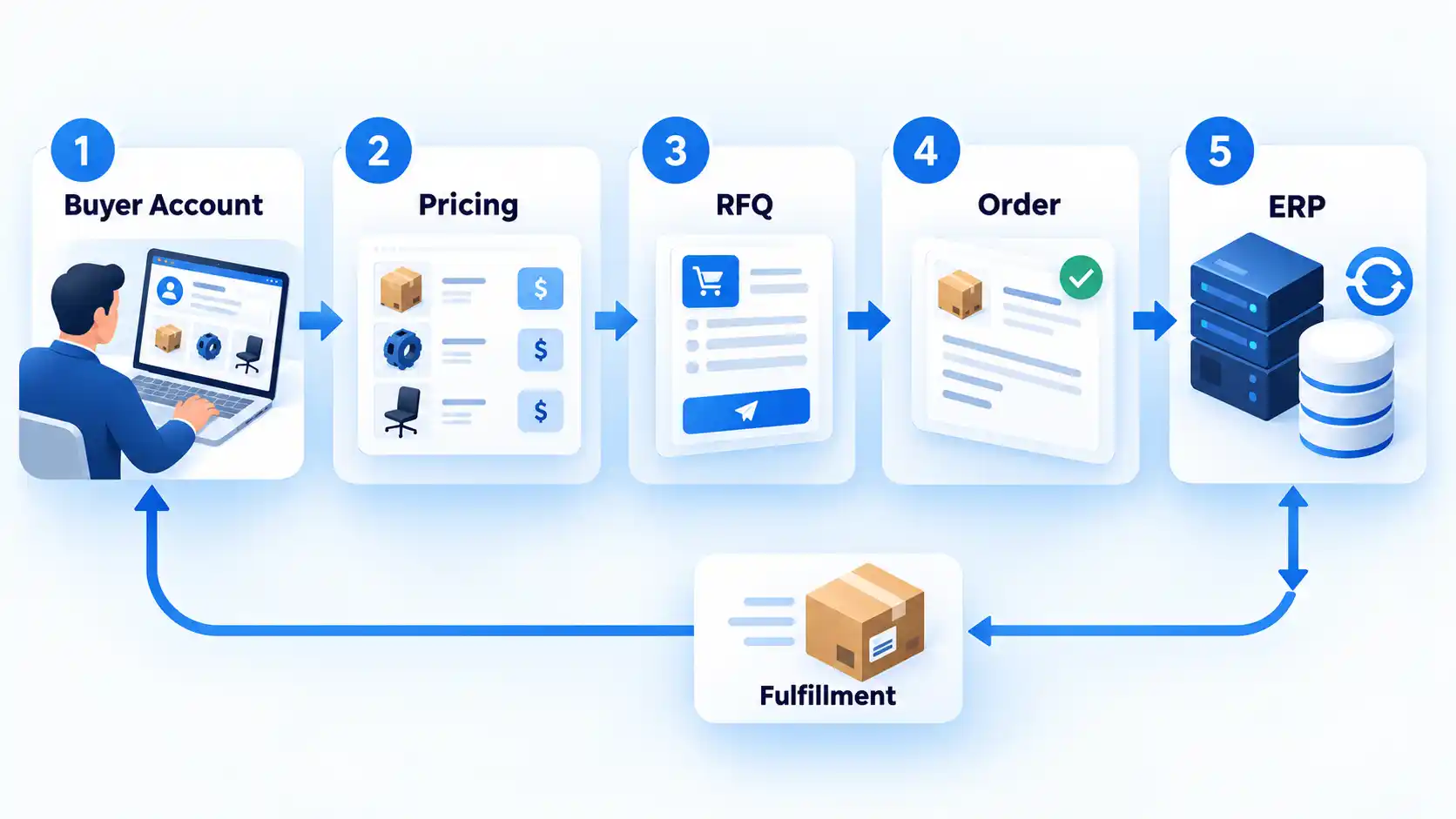
OroCommerce is most distinctive when several B2B requirements must work together. None of the individual functions is unusual in isolation. The value lies in running account structure, pricing, quoting, workflows, sales context, and integrations inside one commerce environment.
- Corporate accounts and permissions: Parent and child accounts represent a customer’s organizational structure, while roles determine what individual buyers or employees see and do.
- Customer-specific catalogs and prices: Each account may receive its own products, price lists, discounts, and purchasing terms instead of sharing one public catalog.
- RFQs and quoting: Buyers submit a request for quote, or RFQ, when an order needs negotiated pricing or conditions rather than immediate checkout.
- Quick orders and repeat purchasing: High-frequency buyers work from shopping lists, order history, and reorder tools instead of browsing the storefront from scratch.
- Sales and CRM context: OroCommerce keeps account, lead, opportunity, quote, and order information close to the commerce workflow, while still allowing an external CRM.
- Multi-site and multi-organization operations: Enterprise deployments support multiple brands, divisions, regions, catalogs, and websites from a shared environment.
- ERP and application integration: The integration architecture connects commerce records to ERP, PIM, warehouse, payment, analytics, procurement, and other business systems.
Consider a hypothetical industrial supplier selling the same component to three corporate customers. One customer may have contract pricing and a purchase-order workflow, another may require a quote above a certain quantity, and a third may allow only designated employees to order for particular branches. OroCommerce’s current account hierarchy, price-list, RFQ, role, and workflow features are designed to model those differences rather than force every buyer through the same checkout path.
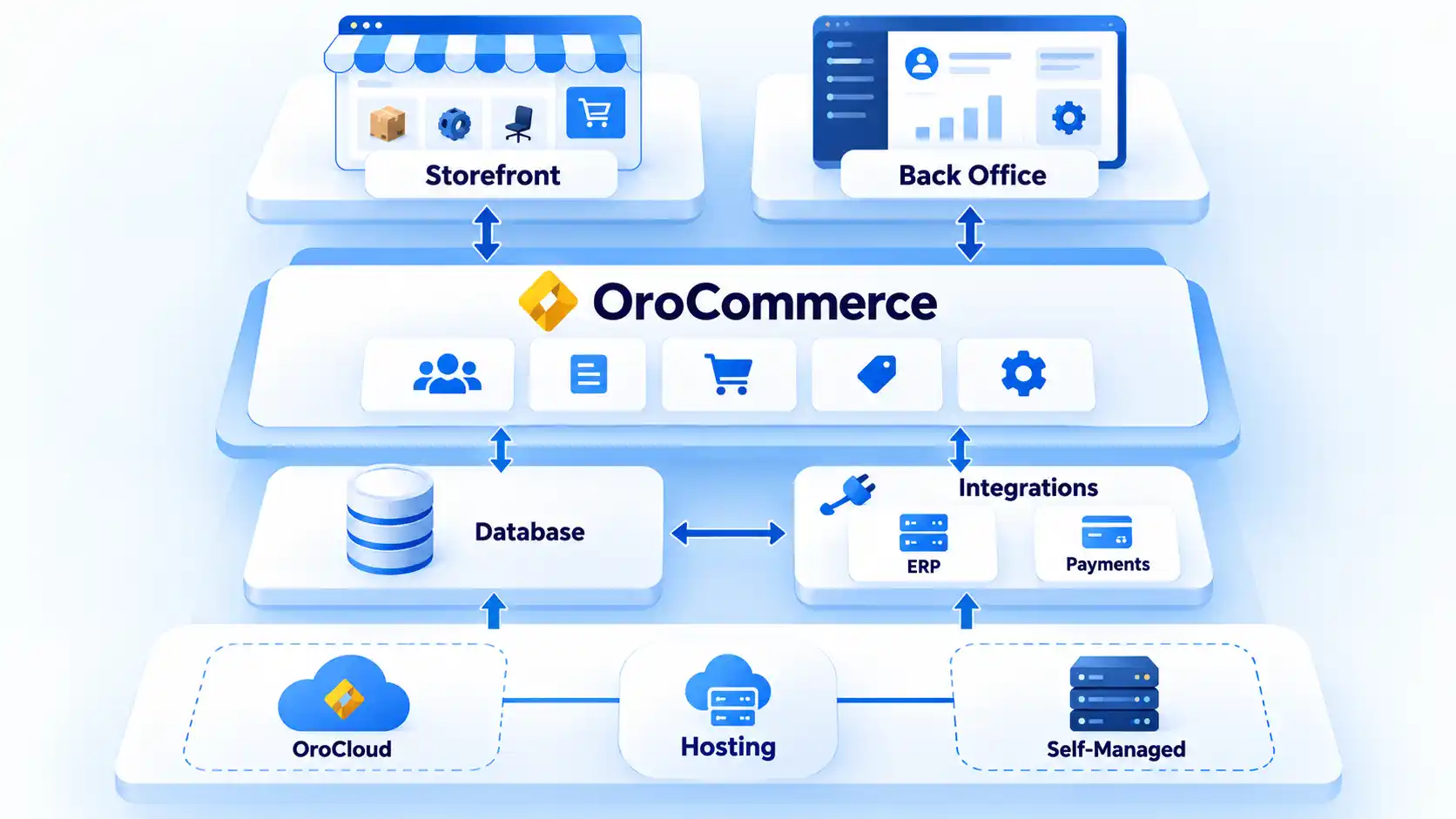
Integration is equally important. Oro describes an API-first architecture and ERP integration support for connecting commerce with external operational systems. A company already running finance, warehouse, product-information, or procurement software must decide which records move between systems and which platform remains the authoritative source for each record type.
A typical e-commerce tool stack spreads inventory, payments, analytics, merchandising, support, and other jobs across separate applications. OroCommerce brings several business functions into the platform while allowing specialist systems to remain in place. Prospective buyers should compare those bundled functions with the tools they already depend on instead of assuming that consolidation is automatically better.
Setup, deployment, and technical requirements
OroCommerce is not desktop software that you install on a Windows PC or Mac and use as a production store. The current technical documentation describes it as a web application that runs on a server; users reach it through a browser.
Production deployment is oriented toward Linux. The current 7.0 requirements recommend Red Hat, Ubuntu, Debian, or Oracle Linux for production, while Windows and macOS are documented as development-environment options.
The application stack is substantial. Current 7.0 requirements include PHP, PostgreSQL, process control, Node.js, PNPM, and a supported web server. Enterprise deployments may add Elasticsearch and RabbitMQ for search and job-queue capabilities. Exact supported versions change over time, so the deployment team should follow the requirements for its precise OroCommerce release instead of copying version numbers from an older installation article.
Organizations may deploy through OroCloud, their own cloud environment, or on-premises infrastructure. A managed cloud route reduces some infrastructure responsibility. A self-managed deployment provides more control but leaves more operational work with the internal team or implementation partner.
Flexibility therefore has an operational cost. Custom workflows, business-system integrations, application changes, and hosting choice are valuable when they solve real requirements. Otherwise, they add engineering, testing, upgrade, monitoring, and governance work without a corresponding benefit.
Where OroCommerce is strong
OroCommerce’s strongest case is not the length of its feature list. Several functions that commonly become custom projects on simpler commerce platforms are first-class parts of its B2B model: company accounts, granular buyer permissions, negotiated prices, quotes, purchasing workflows, sales activity, and multi-organization operations.
Native B2B depth reduces workarounds when a company’s sales rules already resemble those concepts. A manufacturer with contract pricing and dealer hierarchies, for example, starts closer to its real operating model than it would on a platform built around one shopper, one public price, and one checkout flow.
Integration flexibility also matters for complex organizations. Oro’s current feature set includes an API-first architecture and ERP integrations, while its deployment options span cloud, on-premises, and OroCloud environments. Integrations are not effortless, but they are an expected architectural job rather than an edge case.
Pros
- Native support for corporate accounts, role-based purchasing, customer-specific catalogs, pricing, quotes, and B2B workflows.
- Deployment choices include OroCloud, private cloud infrastructure, and on-premises environments.
- Built-in commerce, CRM, workflow, content, invoicing, and related functions may reduce dependence on separate systems where consolidation makes sense.
- Integration-oriented architecture supports connections to existing ERP and operational software.
Cons
- Enterprise pricing requires a sales quote, making early budget comparison less straightforward than a public fixed-price plan.
- Deep configuration and customization may demand more technical resources than a simpler hosted commerce service.
- User-review evidence includes complaints about setup complexity and a learning curve for less technical teams.
- The platform may be excessive for businesses whose purchasing process needs little more than standard catalog, cart, checkout, and payment functions.
Limitations and implementation trade-offs
The hardest part may be deciding how much of the platform to use. OroCommerce exposes many ways to model customers, organizations, websites, catalogs, price rules, workflows, integrations, and permissions. Those options pay off only when the implementation team turns real business rules into a maintainable configuration.
Independent user feedback supports that caution. Recent OroCommerce reviews on G2 report setup and onboarding friction, particularly for users without strong technical backgrounds. The evidence is anecdotal rather than a controlled usability test, so it does not establish that the software is difficult for every organization.
Implementation costs vary too widely for a simple estimate. Oro says project timelines depend on customization and reports an average implementation time of about six months, but a vendor-reported average cannot predict a particular project. Data migration, ERP integration, storefront design, custom workflows, testing, training, hosting, and upgrades all affect the effort.
Enterprise budgeting starts with uncertainty because buyers must request a commercial quote. The published pricing model explains which factors shape the license, but it does not reveal enough to calculate a final bill without speaking to sales. Community Edition offers a clearer free-license entry point, although implementation and operating costs still apply.
The roadmap needs a separate check during evaluation. Oro explicitly distinguishes recently released capabilities from short-term and longer-term work. Buyers interested in AI, payment, automation, or commerce features should confirm that each capability ships in the version they plan to deploy instead of treating roadmap items as current product features.
Who OroCommerce is and isn’t for
The strongest candidates have B2B complexity as a core requirement rather than an occasional exception. Common signs include negotiated or account-specific pricing, corporate account hierarchies, quoting, approval workflows, repeat purchasing, multiple brands or regions, ERP-dependent product and order data, and sales teams that need shared account context.
Deep customization also requires technical resources, either internally or through an implementation partner. A company choosing OroCommerce for its flexibility needs a credible plan to maintain customizations through testing, upgrades, integrations, and changing business requirements.
By contrast, a straightforward direct-to-consumer store, a small catalog with uniform prices, or a team seeking the fastest hosted launch with minimal technical ownership may pay for capabilities it rarely uses.
Do not stop at the demo. Use practical software evaluation questions to test how the platform fits existing workflows, how data moves between systems, who owns security and administration, what implementation really costs, and how difficult a later migration would be.
For the shortlist, document the B2B rules that the current platform struggles to represent and map each one to a verified OroCommerce capability. A business case built mostly on hypothetical future customization is uncertain. A close match with the pricing, account, quote, approval, and integration patterns that already define the sales operation warrants a deeper technical and commercial evaluation.
OroCommerce verdict
OroCommerce is a credible B2B commerce platform for organizations whose online sales process has outgrown the assumptions of a basic retail storefront. Its strongest areas are corporate account structures, pricing control, quoting and workflows, multi-organization commerce, and integration with operational systems.
The same depth raises implementation and governance demands. Enterprise buyers also need a custom quote before they can compare licensing with platforms that publish fixed prices.
Our Verdict
OroCommerce suits established B2B manufacturers, distributors, wholesalers, and mixed-channel businesses that genuinely need account-specific commerce rules and have the resources to implement them properly. It is harder to justify for a simple store where rapid setup and low operational complexity matter more than deep B2B configuration. Confidence in this verdict is moderate to high for product fit and current feature scope, but lower for cost and implementation effort because those depend heavily on each organization’s architecture, integrations, customization, and commercial quote.

💬 Comments