Outbound predictive dialer software is an automated contact center dialing system that uses statistical algorithms to place multiple calls per agent simultaneously, screen out non-live connections like voicemails and busy signals, and immediately connect live answers to available reps. By calculating real-time metrics such as Average Handle Time (AHT) and current contact rates, predictive dialers eliminate manual dialing delays and maximize active agent talk time.
Quick Take: Outbound Predictive Dialer Software
For high-volume outbound contact centers handling cold outreach, sales prospecting, or collection campaigns, predictive dialers offer the highest dialing throughput of any outbound mode. By over-dialing phone numbers based on mathematical probability, the software can elevate agent occupancy from 30–40% up to 80–85%. However, predictive dialing introduces strict regulatory requirements, including the FTC and FCC 3% call abandonment ceiling, and requires a minimum concurrent team size of 8 to 10 agents to maintain algorithmic stability without risking compliance violations.
What Is Outbound Predictive Dialer Software?
Outbound predictive dialer software is an automated calling technology designed to optimize large-scale telephone outreach by removing the manual work of searching contact records, dialing numbers, and listening to unanswered rings. Historically deployed as expensive on-premise hardware units in early call centers, modern predictive dialers operate as cloud-based software integrated directly into customer relationship management (CRM) systems and voice protocols.
The primary function of a predictive dialer is to ensure that agents spend the maximum possible proportion of their working shift engaged in live conversations with real prospects. In traditional manual dialing environments, reps spend up to 70% of their time listening to ringtones, encountering disconnected lines, hitting answering machines, or waiting for calls to be answered. Predictive dialer software automates this entire background process, launching outbound attempts automatically and transferring only live human respondents to reps who are finishing their previous interactions.
Predictive dialers serve high-density outbound environments where contact lists are large and speed-to-connect is critical. While highly efficient for cold calling, debt recovery, and wide-net lead qualification, predictive dialers are distinct from single-line dialers because they dial numbers before an agent officially becomes free.
How the Predictive Dialing Algorithm Works
At the core of any predictive dialer is a real-time statistical algorithm. Rather than placing one call per available agent, the predictive algorithm dynamically calculates an over-dial ratio—placing multiple phone calls per active agent simultaneously based on continuous operational metrics.
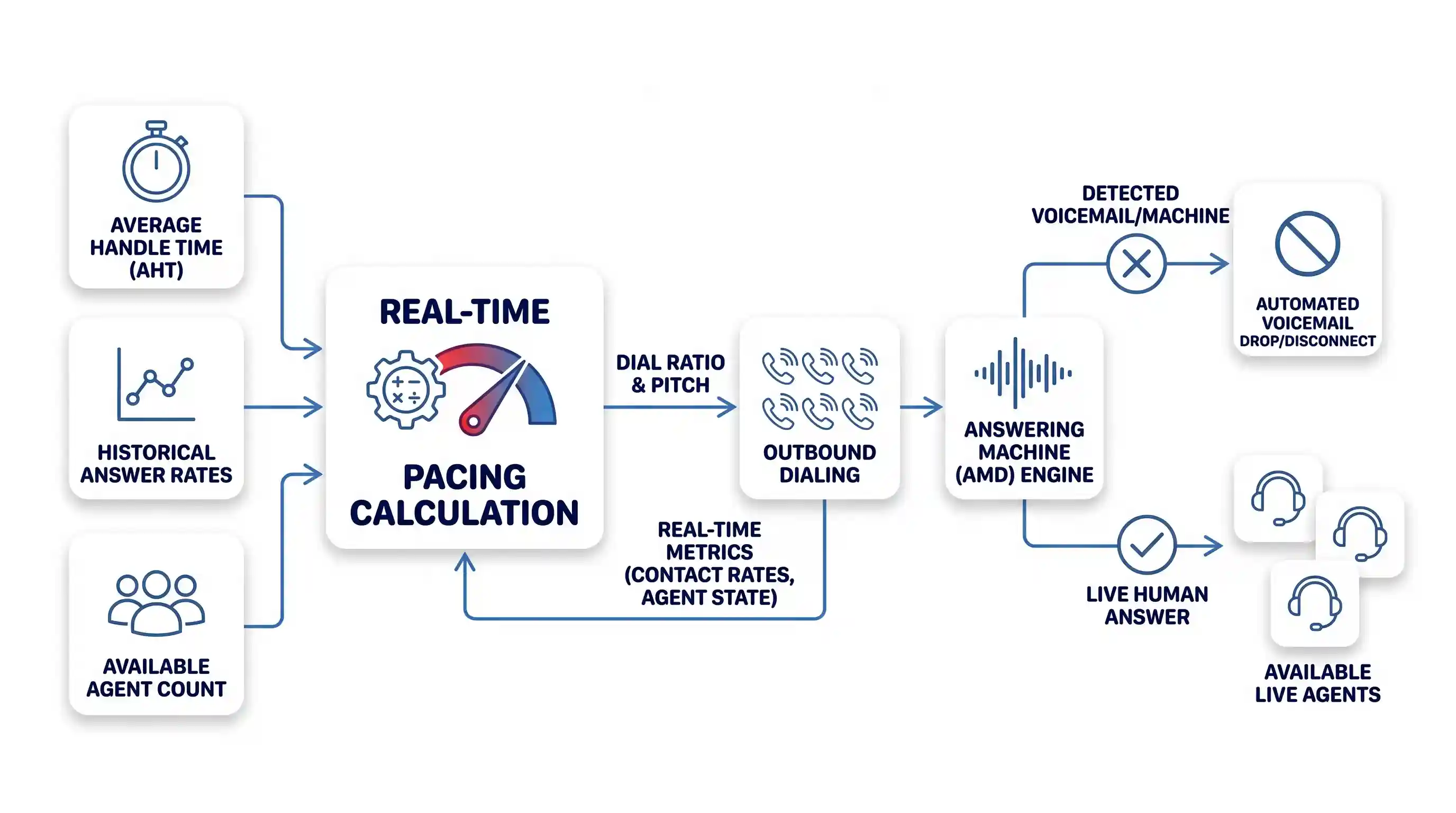
The pacing algorithm monitors three main operational variables continuously:
- Average Handle Time (AHT): The average duration an agent spends on a live call, including talking time and post-call administrative wrap-up.
- Live Answer Rate: The percentage of placed call attempts that result in a human pick-up during the current time block or campaign window.
- Agent Availability: The exact count of agents currently on calls, how many seconds each agent has been on their current call, and when the next rep is statistically expected to disconnect.
By constantly processing these variables, the dialer predicts the exact second an agent will complete their current conversation. According to the Genesys contact center platform documentation, predictive algorithms adjust pacing dynamically to launch automated calls in advance, matching line connections to rep availability so the next customer is on the line right as the agent becomes free.
Answering Machine Detection (AMD) Mechanics
To avoid routing recorded messages to live agents, predictive dialers rely on Answering Machine Detection (AMD). When a call is picked up, the AMD engine analyzes the incoming audio frequency pattern during the first 1 to 2 seconds of connection.
Human greetings are typically short and concise (e.g., a 1-second “Hello?”), followed by silence as the person waits for a response. In contrast, recorded voicemail greetings consist of longer, continuous audio streams (e.g., “Hi, you have reached John, please leave a message…”). The AMD algorithm evaluates these initial spectral signatures, routing human responses to agents while automatically dropping or leaving voicemails for recorded lines. As detailed in the Voiptime Cloud technical dialer guide, configuring AMD sensitivity balances detection speed against false positives, preventing brief customer greetings from being mistakenly categorized as answering machines.
Outbound Dialer Modes Comparison: Predictive vs. Power vs. Progressive vs. Preview
Selecting the right dialing software requires understanding how predictive dialing differs from alternative outbound modes. Each mode manages agent allocation and pacing ratios differently depending on campaign goals and team sizes.
| Dialing Mode | Dialing Ratio (Calls : Agent) | Average Dials / Hour / Agent | Call Abandonment Risk | Minimum Team Size | Ideal Use Case |
|---|---|---|---|---|---|
| Predictive | Variable (1.5:1 to 4:1+) | 100 – 150+ | Moderate to High (Requires strict algorithmic monitoring) | 8 – 10 Agents | High-volume cold outreach, telemarketing, collections |
| Power | 1 : 1 (Sequential) | 60 – 80 | Zero Risk | 1 Agent | Targeted sales outreach, warm lead follow-up |
| Progressive | 1 : 1 (Automated upon wrap-up) | 50 – 70 | Zero Risk | 1 Agent | Regulated customer outreach, compliance-sensitive campaigns |
| Preview | 1 : 1 (Manual trigger after review) | 20 – 40 | Zero Risk | 1 Agent | High-value B2B enterprise sales, account-based outreach |
While power and progressive dialers eliminate call abandonment by waiting until an agent is fully idle before placing a single call, predictive dialing accepts calculated over-dialing risk to achieve maximum volume. Preview dialers prioritize research over speed, allowing reps to inspect CRM notes before initiating a connection.
Key Capabilities and Features to Look For
When evaluating enterprise or cloud-based predictive dialer solutions, contact center operations managers should assess several functional capabilities beyond raw dialing speed:
- CRM and Cadence Integration: Native data syncing with systems like Salesforce, HubSpot, or custom databases ensures customer records populate on screen the moment a call connects, alongside dynamic call scripting software tailored to specific lead segmentations.
- Local Presence Dialing: Automatically displaying local area codes (Direct Inward Dialing numbers) matching the prospect’s geographic region increases connection rates, though it requires underlying local caller ID reputation management to prevent numbers from being flagged as spam.
- Flexible Answering Machine Detection: Configurable AMD settings allow teams to switch between dropping voicemails automatically, routing voicemails to reps for custom drops, or turning off detection entirely for specialized campaigns.
- Real-Time Pacing Controls: Administrative dashboards should allow managers to adjust aggressive dial ratios manually or set strict caps on call attempt speeds during fluctuating agent staffing levels.
- Omnichannel Escalation: Modern systems link dialing queues with SMS or email triggers, enabling automated multi-channel follow-ups when outbound calls go unanswered. Teams seeking dedicated calling architecture can evaluate specialized software like predictive dialer software built for high-occupancy contact center operations.
Legal Compliance and the 3% Call Abandonment Rule
Because predictive dialers place calls based on statistical estimates, situations inevitably arise where the algorithm dials multiple lines, several prospects answer simultaneously, but fewer agents are free than answered calls. When a live human answers and no agent is available to handle the call within a specific timeframe, an abandoned call (or “dropped call”) occurs.
Telemarketing regulations enforce strict limits on call abandonment to protect consumers from unwanted dead air and silent calls. Under the Federal Trade Commission (FTC) Telemarketing Sales Rule (16 CFR § 310.4) and Federal Communications Commission (FCC) rules (47 C.F.R. § 64.1200), contact centers operating predictive dialers must adhere to the following legal boundaries:
- The 3% Abandonment Cap: Telemarketers are legally prohibited from abandoning more than 3% of live-answered calls per campaign over a rolling 30-day period. As explained in the SIPNEX breakdown of call abandonment rules, exceeding this 3% threshold exposes organizations to statutory penalties under the Telephone Consumer Protection Act (TCPA), ranging from $500 to $1,500 per willful violation.
- The Two-Second Greeting Rule: Legally, a call is classified as abandoned if a live human recipient is not transferred to a live agent within two seconds after completing their initial greeting. The ActiveProspect call center regulatory guide highlights that delay beyond two seconds constitutes a legal drop, even if an agent eventually connects three or four seconds later.
- Mandatory Safe Harbor Recorded Messages: If an agent is unavailable within two seconds of a live answer, safe harbor provisions require the system to play an automated recorded message stating the seller’s name and telephone number, along with an opt-out prompt. The system must not drop the call abruptly without playing this identification prompt.
- Single-Ring Line Disconnection: Unanswered lines must ring for at least 15 seconds or 4 rings before disconnecting, ensuring consumers are given adequate time to answer.
Maintaining regulatory compliance requires contact centers to review their compliance logs alongside an updated TCPA compliance checklist, ensuring pacing engines dial within legal limits.
Operational Trade-Offs: When Not to Use a Predictive Dialer
Despite their efficiency, predictive dialers are not universally suited for every outbound sales or support team. Applying predictive dialing to inappropriate operational scenarios leads to poor customer experiences and legal exposure.
The primary constraint of predictive dialing algorithms is minimum pool size. According to the Automated Telemarketing field compliance guide, predictive algorithms rely on the law of large numbers; deploying a predictive dialer with fewer than 8 to 10 active agents introduces severe statistical volatility. In small queues, slight variations in call duration cause the algorithm to miscalculate availability, resulting in sudden spikes in call abandonment above legal limits.
Furthermore, AMD processing introduces a brief delay—often called the “predictive pause” or “dead air”—of 1 to 2 seconds after a prospect says hello. In high-value B2B sales or Account-Based Marketing (ABM) campaigns where personal rapport is critical, this brief delay can signal to buyers that they are receiving a automated telemarketing call, causing them to hang up before the agent speaks.
Contact centers should avoid predictive dialers when:
- The active dialing queue consists of fewer than 8 concurrent agents.
- The lead database contains low-volume, high-value enterprise contacts requiring pre-call research.
- Campaign goals prioritize relationship building over high connection volume.
- Integrating complex workflows across interactive voice response system paths where handle times vary wildly between reps.
Key Takeaways
- Predictive dialer software uses statistical pacing algorithms to place multiple calls per agent concurrently, driving agent talk-time occupancy up to 80–85%.
- The technology is designed for high-volume cold calling, telemarketing, and collections campaigns where list sizes are large and speed-to-connect is paramount.
- Federal compliance under FTC and FCC regulations caps campaign call abandonment at 3% over a rolling 30-day window, requiring connection to an agent within 2 seconds of the recipient’s greeting.
- Predictive pacing engines require a minimum pool of 8 to 10 active agents to maintain algorithm accuracy; smaller teams should utilize power or progressive dialers instead.
- Connecting dialing tools with automatic call distribution routing and CRM platforms ensures seamless lead delivery to reps as soon as connections are confirmed.
Frequently Asked Questions
How many agents are needed to run a predictive dialer effectively?
A contact center typically needs a minimum pool of 8 to 10 active agents logged into the same dialing queue simultaneously. With smaller agent pools, the statistical variance of Average Handle Time becomes too unstable for the predictive algorithm, leading to frequent call drops that violate regulatory abandonment caps.
What is the difference between a predictive dialer and a power dialer?
A power dialer places outbound calls sequentially on a strict 1-to-1 ratio, dialing a single phone number only when an agent becomes fully available. A predictive dialer over-dials multiple phone numbers per agent simultaneously based on mathematical predictions of when current calls will end, achieving higher call volume but carrying a risk of abandoned calls.
How does Answering Machine Detection affect call connect time?
Answering Machine Detection analyzes audio frequency signals during the initial 1 to 2 seconds after a call is picked up to distinguish human greetings from recorded messages. This spectral analysis introduces a slight pause—known as the predictive pause—before the live prospect is transferred to an agent’s headset.
What happens if a contact center exceeds the 3% call abandonment limit?
Exceeding the 3% legal call abandonment limit over a rolling 30-day campaign period violates FTC and FCC rules. Under the Telephone Consumer Protection Act (TCPA), non-compliant contact centers face potential legal enforcement and statutory fines ranging from $500 to $1,500 per willful violation.

💬 Comments