PowerPoint failing to open is rarely one problem. On a Windows PC it usually means one of two things: the application itself crashes or hangs at launch, or the file opens but arrives locked in a read-only view. Those are different failures with different fixes, and treating them as the same thing is why so many people waste an afternoon reinstalling software that was never broken.
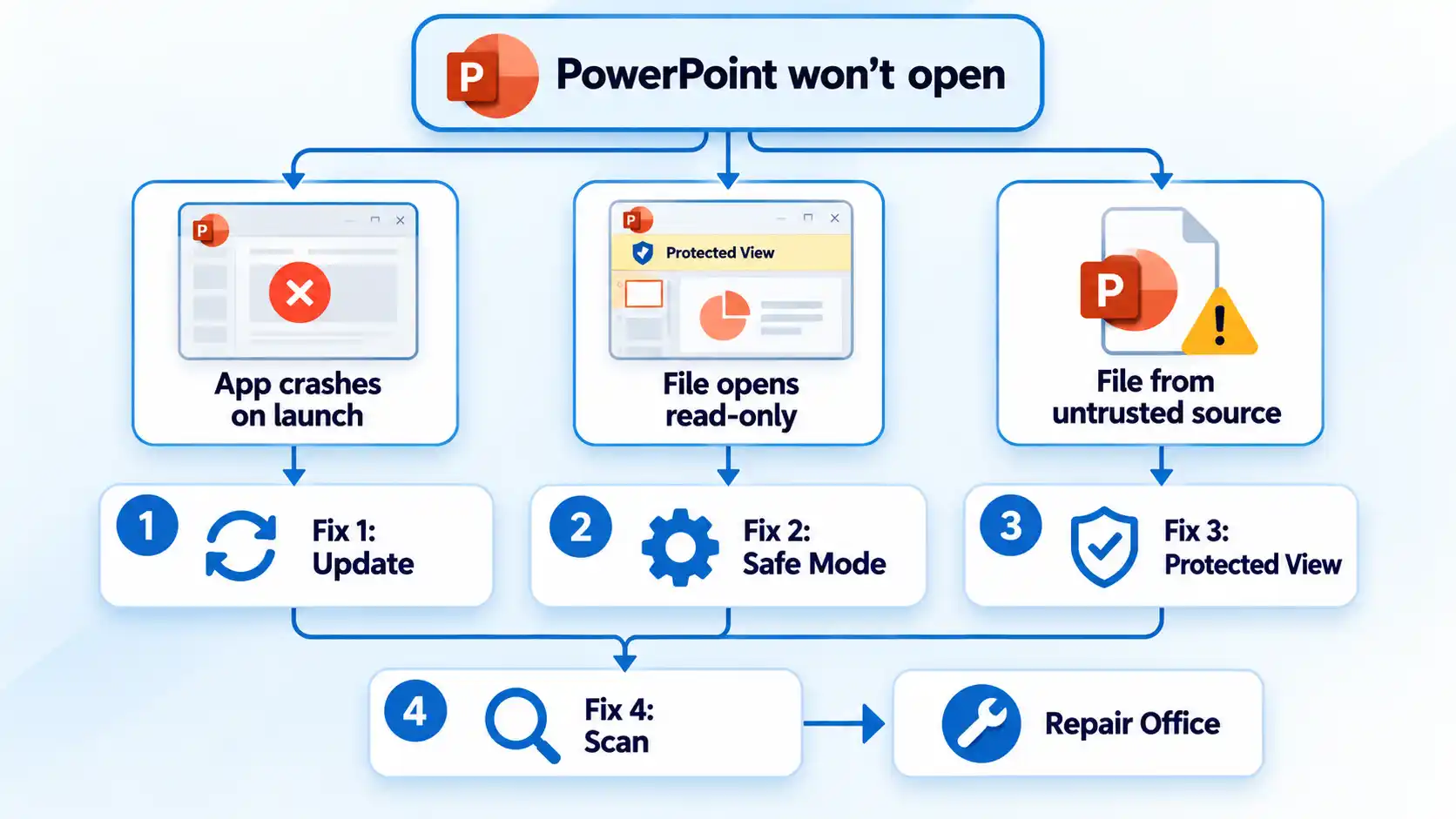
Here’s the short version. If the app won’t start, update Microsoft 365 first, then use Safe Mode to find out whether an add-in is dragging it down. If the file opens but you can’t edit it, you’re looking at Protected View doing its job, and the answer is to verify the file, not to switch the protection off. If the file came from somewhere you don’t trust, scan it before you do anything else.
The four fixes below run from least to most disruptive, and each one tells you what success looks like so you’re not guessing. All steps are written for Windows. If you’re chasing a broader symptom set, our guide to PowerPoint not opening covers related scenarios.
Quick Take
Diagnose before you repair. A crashing app points to updates or a rogue add-in; a read-only file points to Protected View; a file from an unknown sender points to a malware scan. Work the four fixes in order and stop as soon as PowerPoint behaves. Most cases resolve at the update or Safe Mode stage.
First, decide which failure you actually have
Two questions settle it. Does PowerPoint fail to launch at all, or does it launch fine and then refuse to let you edit a specific file? Answer that and you’ve already skipped half of the troubleshooting tree.
- The app crashes, freezes, or hangs on launch. Nothing to do with any particular file. Go to Fix 1, then Fix 2.
- The app opens, but a file appears read-only or shows a warning banner. The application is healthy; the file is being quarantined. Go to Fix 3.
- The file came from an email attachment, a download, or a shared drive you don’t control. Scan it before you enable anything. Go to Fix 4 first, then Fix 3.
Info
PowerPoint ships as part of Microsoft 365, and the desktop app is what these fixes target. If you only need to view a presentation, PowerPoint for the web runs in a browser and sidesteps local launch problems entirely. It’s a useful stopgap while you troubleshoot.
Fix 1: Update Microsoft 365 to clear launch faults
An out-of-date build is a common and undramatic cause of a PowerPoint that won’t start. Updates ship fixes for exactly this kind of startup failure, and checking takes under a minute. Do this before anything more invasive.
Prerequisites
- An active internet connection on the Windows PC.
- At least one Microsoft 365 app that will open. Word works fine for this even if PowerPoint won’t.
How to check for and install Office updates on Windows
You can trigger the update check from any Microsoft 365 app, so a broken PowerPoint doesn’t block you.
- Open any Microsoft 365 app and start a new document. Launch Word (or another app that opens) and create a blank document so the File menu is live.
- Go to File > Account. In Classic Outlook the same option appears as Office Account. This opens your product and update settings.
- In the Product Information section, choose Update Options > Update Now. If you don’t see Update Now straight away, click Enable Updates first, then try again.
- Wait for the check to finish and close the confirmation window. Dismiss the “You’re up to date!” or “Updates were installed” message once Office has finished checking and installing.
- Relaunch PowerPoint normally. Close and reopen the app to see whether the launch failure is gone.
Verify the result
- The update check reports that you’re up to date or that updates were installed.
- PowerPoint opens to a normal start screen without crashing.
Update Options is missing and there’s only an About button
That means you have a volume-license install, or your organization manages Office updates through Group Policy. Try Microsoft Update, or contact your company help desk, because you likely can’t update from inside the app.
The update won’t download or install
Confirm the PC is connected to the internet and retry. If you can’t open any Office app at all, the next step is repairing Office rather than updating it.
Fix 2: Start PowerPoint in Safe Mode to isolate the culprit
Safe Mode is a diagnostic, not a cure. It launches PowerPoint with add-ins and extensions stripped out, which tells you something valuable: if the app opens cleanly in Safe Mode, a third-party add-in is almost certainly what’s crashing it in normal mode. That’s a finding, and it points you at the add-in to disable.
How to open PowerPoint in Safe Mode on a Windows PC
Two methods work on most Office versions. Use whichever is easier.
- Method A: hold CTRL and double-click the shortcut. Find the PowerPoint shortcut icon, press and hold the CTRL key, and double-click it.
- Confirm the Safe Mode prompt. When a window asks whether you want to start the application in Safe Mode, click Yes.
- Method B: use the Run box instead. Right-click the Start button and choose Run, or press the Windows logo key and R together.
- Type the PowerPoint Safe Mode command and click OK. Enter
powerpnt /safein the Run box and confirm. - Exit Safe Mode by restarting the app. Close PowerPoint and open it normally. It will start in normal mode unless a problem persists.
Verify the result
- PowerPoint opens in Safe Mode, confirming the app itself is intact.
- On a normal restart, the app opens without crashing, or the crash returns, which tells you an add-in is responsible.
Info
If PowerPoint won’t even start in Safe Mode, or normal-mode problems keep coming back, move to repairing Office rather than repeating the Safe Mode test.
Fix 3: Get a read-only file out of Protected View
If PowerPoint opens but your file is locked in a read-only view, nothing is broken. Protected View is a security feature, and it’s working exactly as designed. Files from the internet, attachments your policy flags as unsafe, and files that fail validation all open this way, with most editing functions disabled until you decide the file is safe.
The fix is to verify the file and then trust it, not to disable the protection. That distinction matters, because turning Protected View off permanently removes a real defense against malicious content embedded in presentations.
Warning
Only enable editing on a file after you trust its contents. Files from the internet can carry viruses and other harmful content, and Protected View exists to keep that content contained. Don’t switch off Protected View as a blanket fix.
How to exit Protected View and edit a trusted file
Do this only once you’ve confirmed the file is from a source you trust.
- Read the banner before you act. Protected View shows a message explaining why the file is restricted: internet location, unsafe attachment, or a detected problem. That reason tells you how much caution is warranted.
- Choose Enable Editing. If you trust the file’s contents, select the enable-editing option in the banner to leave read-only mode and work with the file normally.
- If you see a “problem detected” message, treat it as a red flag. A file-validation failure means Microsoft 365 has flagged an issue with the file itself. Don’t force it open. Scan it first (Fix 4) and consider requesting a fresh copy.
Verify the result
- The yellow Protected View banner disappears and the editing ribbon becomes active.
- You can save and print the file normally.
Info
If your machine has Application Guard for Microsoft 365 enabled, files that would normally open in Protected View open in Application Guard instead. The read-only behavior is similar, and the same trust decision applies.
Fix 4: Scan the file or device for malware
When a presentation won’t open and it arrived from an untrusted source, assume the file is the problem until a scan says otherwise. Windows Security includes Microsoft Defender Antivirus, and you can scan a single file or the whole device without installing anything.
How to scan a suspicious file or folder with Windows Security
Start with the specific file. Escalate to a device-wide scan if you’re still concerned.
- Right-click the file or folder in File Explorer. Select Scan with Microsoft Defender. On Windows 11 you may need to choose Show more options first to reveal it.
- Let the scan complete and read the result. Defender reports whether it found a threat and takes action if it did.
- Run a quick scan of the device if you’re still worried. Open Windows Security from the Start menu, go to Virus & threat protection, and select Quick scan.
Verify the result
- The scan completes and reports no threats found.
- With the file cleared, you can return to Fix 3 and enable editing on it.
Danger
Don’t leave real-time protection switched off. It can be paused briefly, but it turns back on automatically, and while it’s off, files you open or download aren’t scanned for threats. Treat any “just disable it” advice as a temporary measure at most.
When none of the four fixes work
If PowerPoint won’t open even in Safe Mode, or the same launch failure keeps returning after an update, the application installation itself is the suspect. Repairing Office is the supported next step, and it’s the same path Microsoft recommends when you can’t open any Office app at all.
For corporate machines, the Group Policy and volume-license case from Fix 1 is worth flagging to your help desk early, since they can push updates you can’t trigger yourself. And if the file itself is damaged rather than blocked, a dedicated repair tool is a reasonable last resort; PowerPoint not responding is one option to explore, and Wondershare Repairit File Repair handles broader file-corruption cases. Try the four fixes above first, since they resolve the majority of launch and read-only problems without third-party software.
PowerPoint still crashes after updating and testing Safe Mode
Repair Office. If Safe Mode also fails to launch the app, the installation is the problem rather than an add-in or a file.
The file opens read-only even after you enable editing
Check whether the file is marked read-only in its own properties, or whether it’s stored in a location your organization restricts. A “problem detected” banner means the file failed validation, so scan it and request a clean copy.
You can’t update because Update Options is missing
Your install is volume-licensed or managed by Group Policy. Try Microsoft Update, or contact your company help desk to have updates applied for you.
The bottom line
Most PowerPoint launch failures on Windows are solved by an update, and most read-only files are solved by trusting a file you’ve verified. Safe Mode tells you whether an add-in is responsible, and a malware scan is the safety net when a file’s origin is unclear. Work the four fixes in order, stop when the app behaves, and keep Protected View and real-time protection switched on, because they’re doing their job.
Key Takeaways
- Separate app crashes from read-only files before you touch anything, since they need different fixes.
- Update Microsoft 365 first. It’s the fastest fix and the least disruptive.
- Safe Mode is a diagnostic that identifies a problem add-in, not a permanent solution.
- Protected View is a feature, not a bug. Verify the file, then enable editing.
- Scan files from untrusted sources, and never leave real-time protection off.

💬 Comments