The biggest misconception surrounding social media marketing is that it operates as a free, instant sales machine where posting daily updates guarantees business growth. In reality, modern social platforms function as paid and algorithmic distribution networks that require clear business goals, audience targeting, and consistent operational management.
Many business owners start their social media journey with false expectations. They set up profiles on five networks at once. They post random product pictures. When direct sales do not appear within thirty days, they assume social marketing does not work for their industry. Understanding the real mechanics of social media prevents wasted labor and helps you build a profitable marketing channel.
Quick Take: What Beginners Get Wrong About Social Media
Before examining each myth in detail, review these core operational facts:
- Organic reach is limited: Social networks prioritize user retention over unpromoted business posts. Reaching a broad audience usually requires paid ad testing.
- Audience fit beats follower count: A small group of qualified buyers delivers more commercial value than thousands of unengaged followers.
- Consistency beats volume: Publishing three helpful posts per week outperforms publishing five rushed updates every day.
- Tools cannot replace human care: Automation tools help schedule posts, but real people must handle customer questions, trust building, and escalation issues.
How Modern Social Media Distribution Actually Works
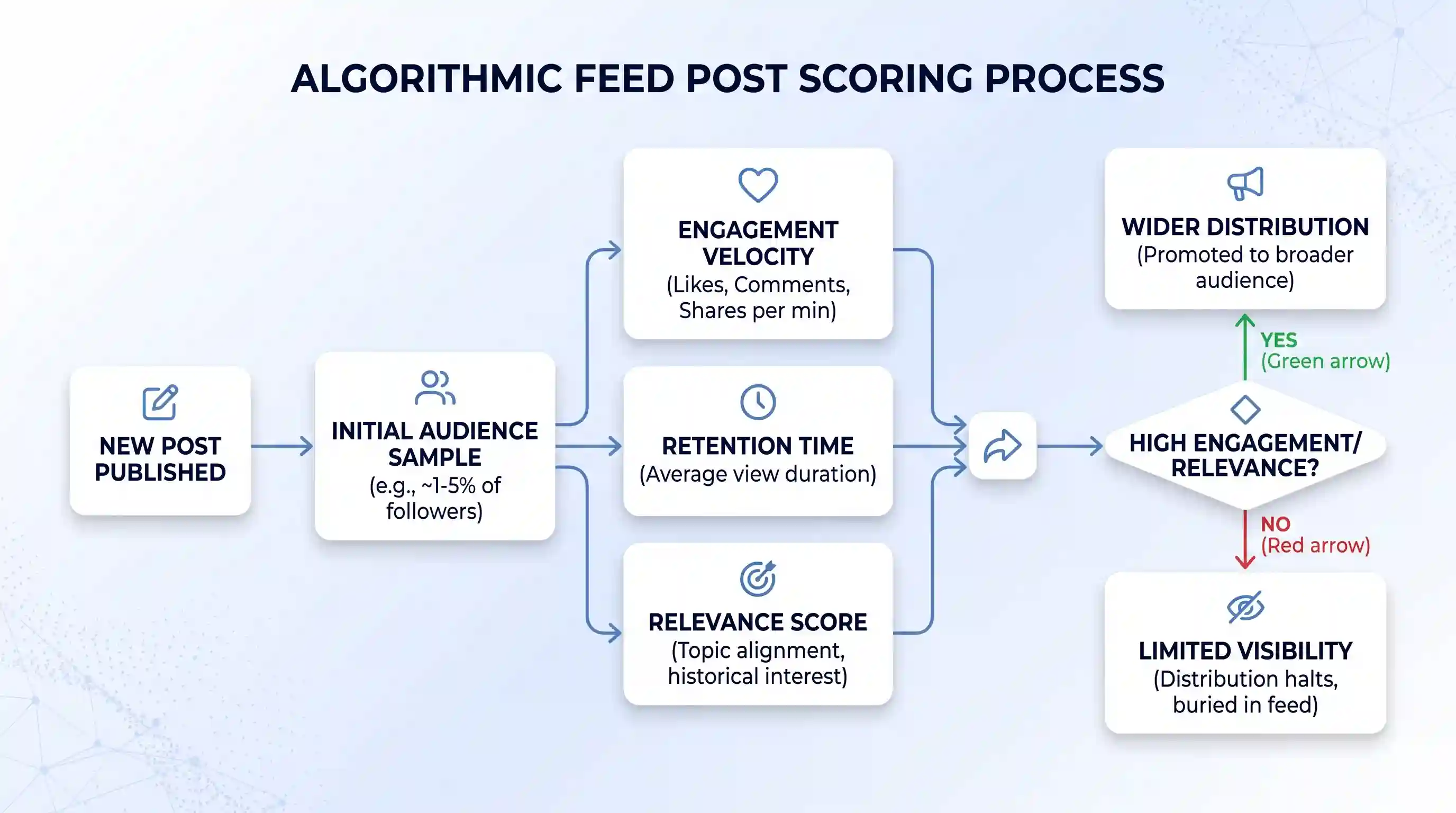
Social networks do not show your content to all of your followers in a simple chronological timeline. Instead, every major platform uses mathematical ranking systems called algorithms to sort user feeds.
When you publish a post, the platform shows it to a small sample of your audience. If those initial users stop scrolling, click your link, or leave a response, the platform distributes your post to a wider audience. If users scroll past your post quickly, the platform stops showing it. The platform wants to keep users inside its app for as long as possible. It rewards engaging content and filters out repetitive sales pitches.
According to DataReportal’s global social media overview, over 5.7 billion user identities exist across social platforms worldwide. Because millions of businesses compete for user attention in the same feed space, unpromoted visibility has dropped steadily. Research from HubSpot’s organic reach research shows that unpaid business posts reach only a small fraction of a page’s total followers. Treating social media as an effective business channel means understanding both free community engagement and paid promotion. Many growing brands manage this balance by working with a digital marketing agency to structure their publishing workflows.
The 7 Biggest Social Media Marketing Misconceptions
Let us break down the seven most common myths that lead beginner marketers and small business owners astray.
Misconception 1: Social Media Marketing Is Completely Free
Creating a social media profile on Facebook, Instagram, LinkedIn, or TikTok costs nothing. This zero-dollar startup cost convinces many founders that social marketing is an entirely free distribution channel.
While account setup is free, building a reliable channel requires real resources. You must invest labor hours into writing, graphic design, and video production. Furthermore, because organic feed reach remains in the low single digits for business accounts, reaching new buyers requires budget testing. A basic paid social advertising strategy lets you show key messages directly to your exact customer demographic without relying on algorithm luck.
Misconception 2: You Must Build a Presence on Every Single Platform
Beginners often believe they must maintain active accounts on every new network. They create profiles on Facebook, Instagram, X, TikTok, LinkedIn, Pinterest, and YouTube all in the same week.
Spreading your attention across six networks causes operational burnout. It leads to abandoned profiles, irregular posting schedules, and shallow content. A business-to-business software consultancy gains little value from short-form dance trends on TikTok. Similarly, a local ceramic studio will struggle to find qualified buyers on corporate text forums. Success comes from focusing on the one or two platforms where your actual buyers spend their daily time. Establishing a structured social media content strategy on two core channels delivers far better business results than maintaining six weak profiles.
Misconception 3: Massive Follower Counts Guarantee Commercial Success
Many business owners treat follower count as the main scorecard for their marketing health. They assume that having 50,000 followers automatically leads to strong product sales.
Follower counts are vanity metrics. A vanity metric is a number that looks impressive on a screen but does not correlate with revenue. An account with 2,000 targeted, local followers who trust your recommendations will generate far more revenue than an account with 100,000 disengaged global followers. In fact, GoCardless audience behavior research shows that up to 90% of social media users read posts silently without ever liking or commenting. These quiet observers evaluate your brand credibility over weeks before making a purchase. Some creators test temporary impression tools or choose to buy Instagram views to explore visual delivery patterns, but sustained customer discovery always relies on genuine audience trust.
Misconception 4: Social Channels Only Work for Massive Global Brands
Small business owners often look at global consumer brands and assume social marketing only works for companies with million-dollar production budgets.
In practice, local companies and niche businesses hold a unique structural advantage on social platforms. Global brands often struggle to connect directly with individual consumers. A local boutique, specialty contractor, or neighborhood bakery can reply personally to direct messages, share behind-the-scenes updates, and tag neighboring businesses. Furthermore, platform ad managers allow precise geographic targeting down to a single postal code. Small shops can also integrate e-commerce business management tools to sell directly to local customers within their delivery radius.
Misconception 5: Social Media Only Reaches Young Demographics
A persistent myth claims that social media audiences consist entirely of teenagers and young adults. Business owners selling high-ticket services or retirement products often dismiss social channels because of this belief.
Demographic data disproves this assumption. According to Pew Research Center demographic data, 75% of American adults aged 30 to 49 use Facebook, and 94% use YouTube. Furthermore, a substantial majority of households earning over $100,000 per year use platforms like Instagram and LinkedIn regularly. Older demographics represent the fastest-growing user groups on visual and video networks. They also possess higher disposable income than teenage audiences, making them prime buyers for high-value services.
Misconception 6: Posting Multiple Times Every Day Is Mandatory for Growth
Some marketing advice suggests that posting five to ten times every day is the only way to beat platform algorithms. Beginners push themselves to create constant updates, sacrificing quality for pure volume.
Flooding user feeds with low-effort posts damages your account standing. When your followers repeatedly scroll past unhelpful posts without engaging, platform algorithms interpret your account as low value. This reduces the reach of your future posts. According to a Sprout Social content benchmark study, overall audience response rates depend on post relevance rather than aggressive posting frequency. Publishing three thoughtful, well-produced posts per week builds stronger brand affinity than posting several rushed graphics every afternoon.
Misconception 7: Automation and AI Can Run Your Marketing Without Humans
With the rise of automated scheduling platforms and generative text tools, some founders believe they can automate their entire marketing workflow. They set up automated feeds to publish generic articles and auto-reply to comments without human review.
Automation handles repetitive administrative tasks well, such as scheduling posts for optimal time zones or formatting image dimensions. However, automated systems cannot build real human trust. According to Social Factor’s community management analysis, robotic and canned responses during customer service complaints alienate buyers and escalate reputation damage. Deploying smart advertising technology workflows helps optimize ad bidding, but human judgment remains mandatory for authentic customer conversations.
Organic vs. Paid Social Media: Choosing the Right Focus
Deciding how to split your time and budget between unpaid organic content and paid campaigns is a common challenge. Use this comparison table to choose the right strategy for your current business stage:
| Strategy Type | Core Objective | Direct Cost | Time to Impact | Primary Advantage | Main Limitation |
|---|---|---|---|---|---|
| Organic Social | Brand loyalty & community retention | Free (time investment only) | 3 to 6 months | Builds deep trust and long-term customer relationships | Unpredictable reach due to feed algorithm changes |
| Paid Social Ads | Direct lead capture & immediate sales | Flexible ad spend budget | 1 to 7 days | Guarantees exact audience targeting and fast traffic | Traffic stops the moment your daily ad budget ends |
| Hybrid Model | Audience retention & scalable customer growth | Moderate ad spend + creative labor | 2 to 4 weeks | Validates content freely before spending ad money | Requires clear weekly reporting and campaign tracking |
For most small businesses, a hybrid approach works best. Publish educational content organically to see which topics generate real questions from your followers. Once a specific post demonstrates strong organic engagement, put a modest ad budget behind it to show it to thousands of local prospective buyers. This framework prevents you from wasting ad dollars on untested messaging while measuring social media ROI accurately.
Operational Limits and Where Social Media Falls Short
Social media is a powerful marketing channel, but it is not a complete business solution. Understanding its structural limits protects your brand from severe operational risks.
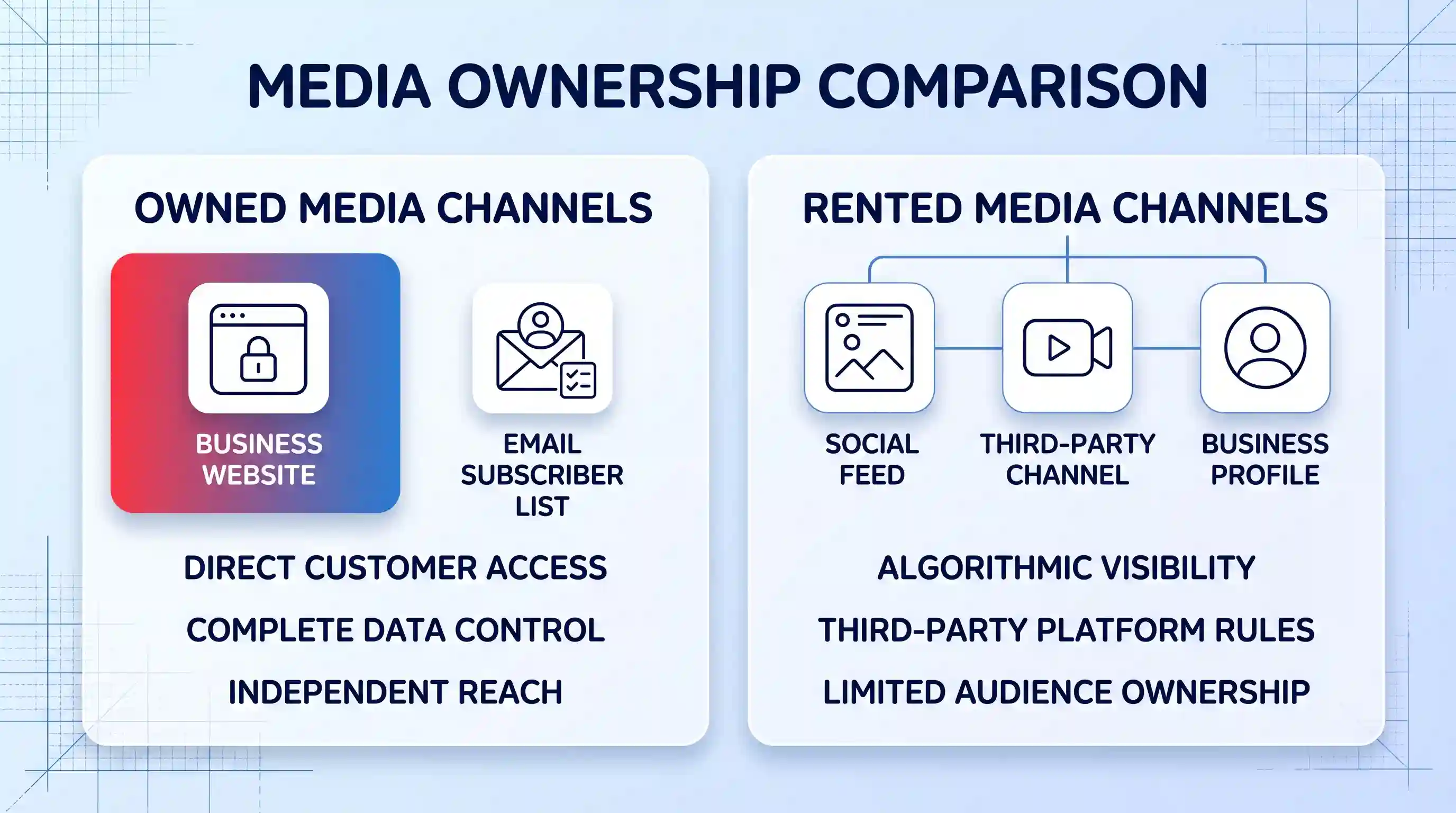
First, you do not own your social media audience. You are building on rented digital land. If a platform alters its feed algorithm, changes its commercial terms, or experiences a service outage, your audience access disappears overnight. Always use social media to direct followers toward owned assets, such as your business website and email subscriber list.
Second, public social platforms do not capture private buying conversations. A large portion of modern product recommendations occurs across private messaging apps, direct messages, and private group chats. This behavior is called dark social. Because public social metrics cannot track these private shares, relying solely on public comments will give you an incomplete picture of your marketing influence. Pairing social content with structured community management workflows ensures your team captures customer inquiries across both public and private channels.
Key Takeaways
- Social media marketing requires intentional planning, creative labor, and occasional ad testing rather than zero-cost effort.
- Focus your limited time on the one or two platforms where your ideal buyers spend their daily attention.
- Prioritize qualified audience engagement over inflated follower counts and vanity metrics.
- Post consistent, high-value updates a few times per week instead of flooding user feeds with daily filler content.
- Use automated tools for scheduling and data tracking, but preserve human management for customer conversations.
- Direct your social followers toward owned marketing assets like your email newsletter and business website.
Frequently Asked Questions
How much time should a small business spend on social media each week?
A solo operator or small business owner should dedicate four to six focused hours per week to social media marketing. Spend two hours outlining and producing your weekly posts. Spend another hour scheduling them through a publishing tool. Use the remaining time in fifteen-minute daily blocks to respond to incoming comments, answer customer direct messages, and interact with complementary local business accounts.
If you find yourself spending more than ten hours per week on social media without seeing measurable customer leads, simplify your workflow. Cut your active platforms down to one core channel and focus strictly on publishing high-quality educational posts.
What is the difference between a vanity metric and an actionable metric?
A vanity metric is a surface-level number that looks positive but does not reflect commercial health. Examples include total follower counts, post impressions, and general video views. These numbers can increase dramatically without bringing a single paying customer to your store or website.
An actionable metric measures a specific behavior that moves a user closer to a purchase. Examples include link clicks to your product page, direct message inquiries about pricing, email newsletter sign-ups, and coupon code redemptions. Track actionable metrics to evaluate whether your social media efforts are generating real business value.
Can a B2B business generate qualified leads on social media?
Yes, business-to-business companies generate qualified sales leads on social platforms by focusing on educational content and professional networks. Platforms like LinkedIn and YouTube allow B2B companies to share case studies, technical breakdowns, and executive commentary directly with industry decision-makers.
Instead of posting broad promotional discounts, B2B companies should publish solutions to common operational bottlenecks. When an executive reads a clear breakdown of a problem they currently face, they are likely to reach out for a consultation.
How long does it typically take to see measurable results from social marketing?
An organic social media strategy typically takes three to six months to build consistent momentum. During the first two months, platform algorithms learn what your content is about and test it with small audience samples. Your initial focus should be on refining your message and learning what your audience prefers.
If your business needs customer inquiries immediately, combine your organic publishing with targeted paid advertising. Paid ad campaigns can generate direct website traffic and customer leads within their first week of active distribution.

💬 Comments