Replacing all your windows at once is almost always the better financial and practical choice if your budget allows it — but replacing just one or two makes sense when the rest of your windows are still in good shape and only a specific one has failed.
Home maintenance is one of the biggest recurring costs you’ll face as a homeowner, and windows are one of the more expensive line items when they finally need attention. The question isn’t really “should I replace my windows” — it’s whether to do the whole house in one project or handle it piece by piece as your budget allows.
Quick Take
If most of your windows are aging out together, a whole-house replacement will almost always cost less per window, look more consistent, and deliver more energy savings than doing it in stages. Partial replacement makes sense when only one or two windows have actually failed — a broken seal, rotted frame, or a window that won’t open — while the rest are still sound. The right call comes down to three things: how many windows are actually failing, how long you plan to stay in the house, and whether your budget gap is temporary or permanent.
Signs Your Windows Actually Need Replacing
Before weighing one window against all of them, it’s worth confirming the decision even applies to you yet. A few reliable signals: fogging or a hazy film between the panes of a double-pane window (a sign the seal has failed and the insulating gas has escaped), persistent drafts you can feel near a closed window on a windy day, frames that have started to soften, crack, or show visible rot, and windows that stick, won’t stay open, or won’t lock properly. If you’re only seeing one or two of these across the whole house, you’re likely looking at a partial-replacement situation. If it’s showing up in most rooms, that’s usually a sign the whole set is reaching the end of its useful life together.

Should You Replace Just One or a Few Windows, or All of Them?
In most cases, it’s better to replace all your windows at once. There are a few concrete reasons a total replacement tends to outperform a piecemeal approach.
Curb Appeal
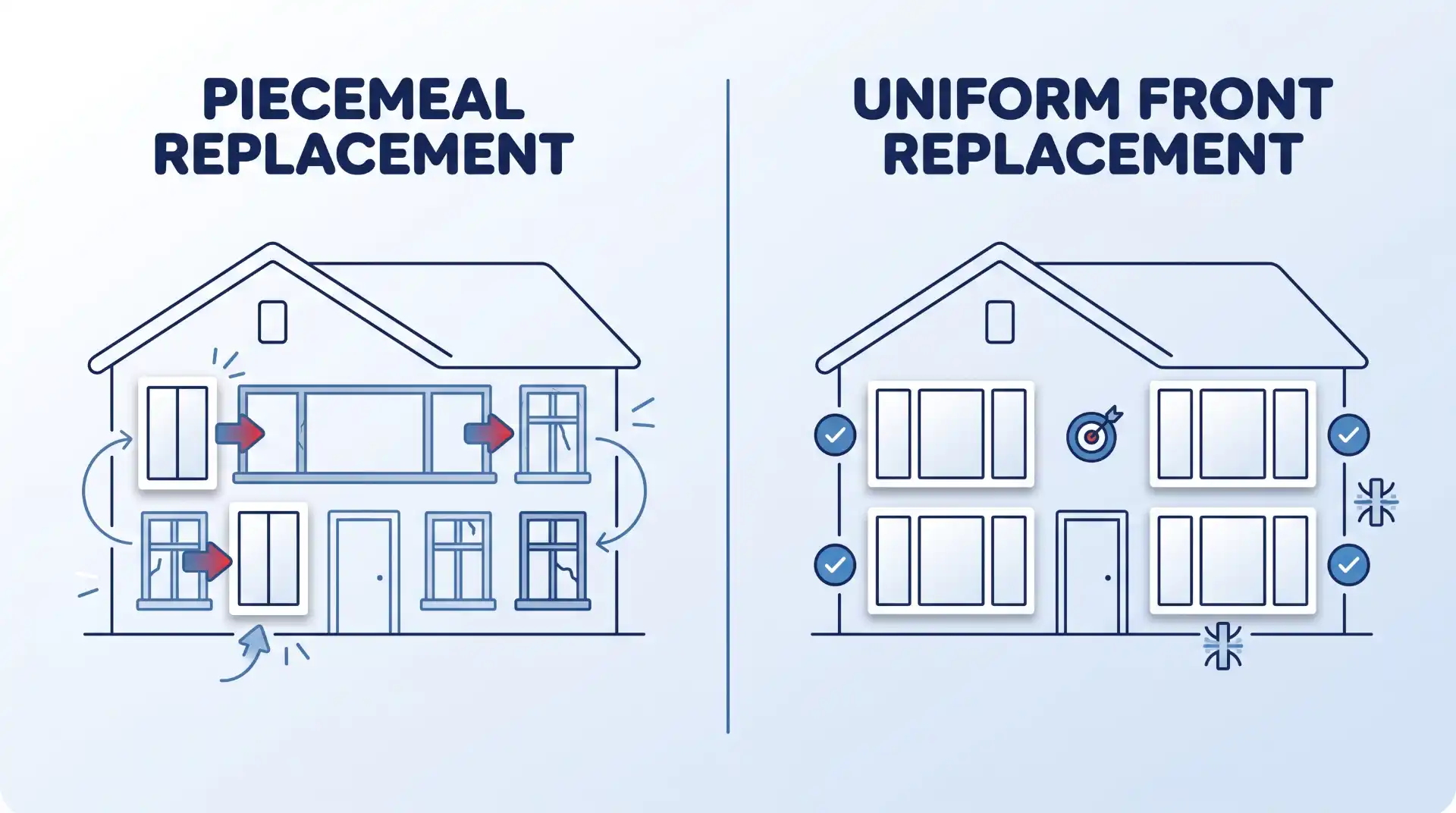
One of the biggest paybacks of a window replacement is the curb appeal it adds to a property, which also helps a home sell faster if you’re planning to list it. But there’s often a visible mismatch when some windows look newer and more polished than others sitting right next to them. If you replace just one window or a few, you risk creating exactly that mismatch.
If the budget genuinely won’t stretch to a full-house project, a more strategic approach is to replace an entire visible set at once — the whole front-facing row, for example — rather than scattering new windows randomly across the house. That keeps the mismatch contained to areas buyers and visitors don’t see as directly.
Energy Efficiency
Window replacement is one of the home improvement projects homeowners lean on to cut both energy costs and improve indoor air quality. According to ENERGY STAR, replacing old single-pane windows with certified models lowers household energy bills by an average of up to 13% nationwide, with the exact figure depending on climate zone and the type of window being replaced.
That savings figure is a whole-house average, not a per-window one — which is the practical catch with partial replacement. A single new, well-insulated window still sits in a house where the rest of the envelope is leaking heat, so the overall improvement to comfort and energy cost is smaller than the marketing math for that one window suggests. Manufacturer guidance on high-performance window systems makes the same point: the insulation gains from double- or triple-pane glass, low-E coatings, and tighter frames compound across the whole set, not window by window.
Replacing everything together also takes more pressure off your HVAC system, which is doing less work to compensate for drafts and heat loss once every window is sealed to the same standard.
Project Cost and Resale Value
Homeowners on a tight budget often weigh disposable income today over the larger savings available from doing the whole project at once — which is a reasonable instinct, but it’s worth getting real numbers before deciding. According to the 2025 Cost vs. Value Report, a full vinyl window replacement project typically recoups roughly two-thirds to three-quarters of its cost at resale, with wood window replacement recouping somewhat less. Contractors also tend to price whole-house projects more efficiently per window than a series of small one-off jobs, since a lot of the labor cost — scheduling, setup, disposal — is fixed regardless of how many windows are on the job that day.
The best way to see this for your specific house is to get quotes for both scopes side by side — a few windows, and the full set — from the same contractor. Companies like Maverick Windows and similar regional installers will typically walk through financing options if the whole-house number is the better deal but the upfront cash isn’t there. It’s also worth checking whether the project fits into a broader home renovation budget you’re already planning, since window replacement is one of several home improvement projects that pay off long-term, and bundling it with other exterior work can sometimes improve contractor pricing further.
When Replacing Just One or a Few Windows Actually Makes Sense
None of this means partial replacement is always the wrong call. It genuinely makes sense in a few specific situations. If only one window has a failed seal, storm damage, or a broken mechanism while the rest of the house is still performing well, replacing that single window is the right, proportionate fix — there’s no reason to redo windows that aren’t causing a problem. It also makes sense if you’re renting the property out or planning to sell within a year or two and don’t expect to recoup a larger investment before the sale. And if the budget gap is genuinely temporary — a bonus coming in a few months, a loan approval pending — it can be worth waiting and doing the whole project properly rather than starting a phased approach you’ll regret matching later.
Where partial replacement stops making sense is when it becomes a habit rather than a plan — replacing “just one more” every year or two, at a higher per-window cost each time, while the rest of the house keeps losing energy through the windows you haven’t gotten to yet.
A Quick Decision Framework
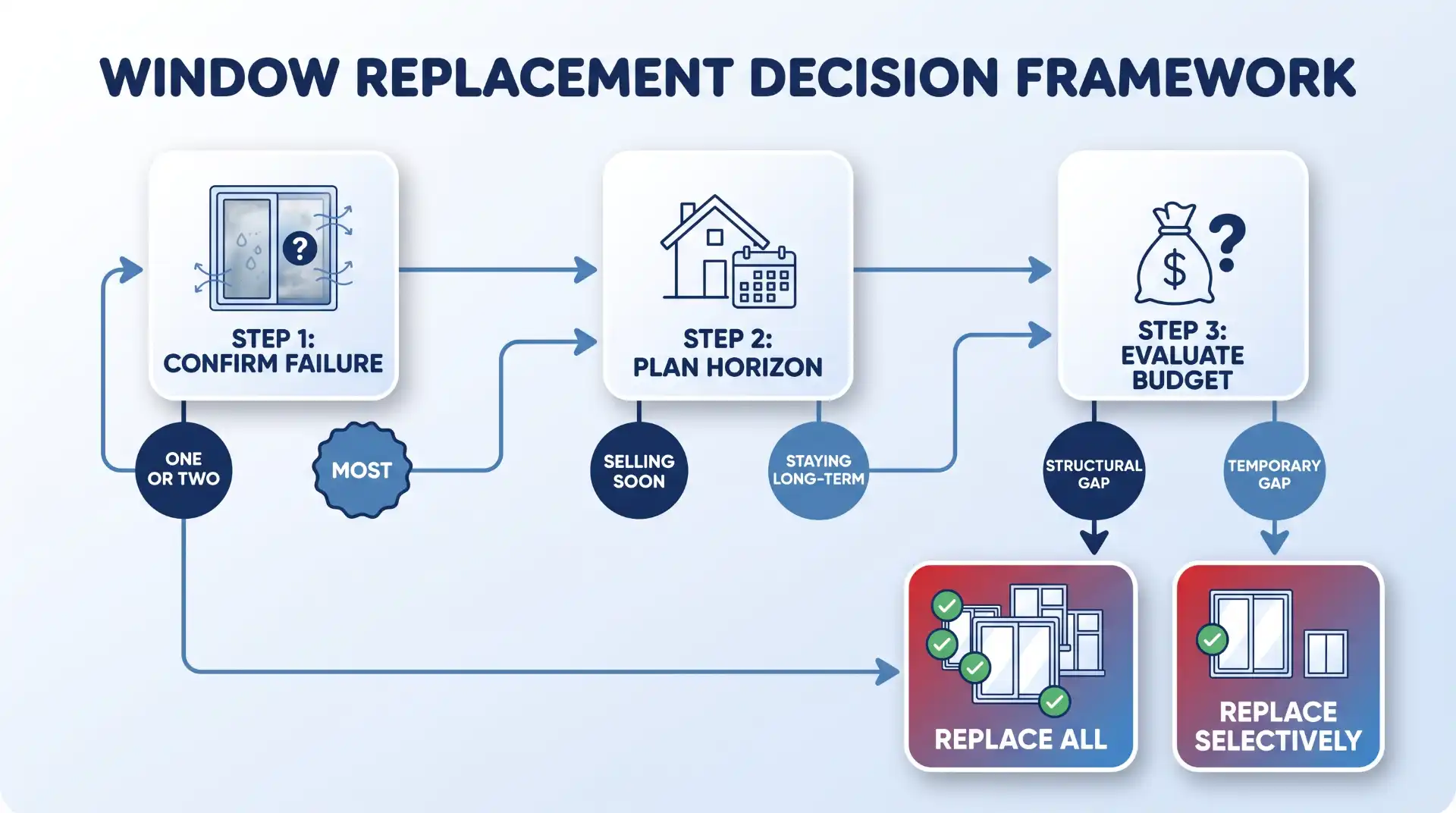
Three questions tend to settle this fairly quickly. First, how many of your windows are actually showing failure signs — condensation, drafts, sticking frames — versus just cosmetically dated? If it’s one or two, partial replacement is defensible. If it’s most of the house, the case for going all at once gets much stronger. Second, how long do you plan to stay in the home? A longer horizon makes the energy-savings math favor a full replacement sooner, since those savings compound every year you’re still living there. Third, is your budget shortfall temporary or structural? A temporary gap is worth waiting out for the better whole-house deal; a structural one means a phased, prioritized approach — starting with the draftiest or most visible windows first — is the realistic path forward.
Hiring a Professional Window Replacement Contractor
Once you’ve decided on scope, working with the right company matters as much as the decision itself. A few practical steps for finding a window replacement professional if you don’t already have one:
- Ask for recommendations. As with any contractor, friends and family who’ve had windows replaced recently are a good first stop. If you don’t have that network locally, neighbors and online reviews are the next best source.
- Read reviews and check services. Validate any recommendation before hiring — read reviews and confirm what’s actually included. A contractor who also handles stucco or siding repair can be a practical choice if your project touches more than just the window opening itself.
- Request quotes and compare. A legitimate contractor will offer a physical inspection and a written, itemized quote — this is also your chance to ask how they’ll sequence the work if you’re going the whole-house route. Pella notes that reputable installers typically work one window opening at a time even on a full-house project, so the home isn’t fully exposed to the elements at once — worth confirming with any contractor you’re considering.
- Hire and review the contract. After comparing quotes, review payment terms, warranty coverage, and timeline before signing anything.
Finding a trustworthy general contractor for larger home projects follows a similar process if the window work is part of a bigger renovation.
Key Takeaways
Whole-house window replacement usually wins on cost-per-window, appearance, and energy savings, but it isn’t automatically the right call for every situation. Confirm your windows are actually failing before deciding scope at all. Partial replacement is a legitimate choice for isolated failures, rental properties, or a short remaining time in the home — not just a fallback for tight budgets. Get quotes for both scopes before committing, since the per-window math often favors going bigger than expected. And if you do go partial, treat it as a deliberate, prioritized plan rather than a one-window-at-a-time habit.
FAQ
How long does a whole-house window replacement take?
This varies by the number of windows and installer availability, but most full-house projects are completed within a few days to about a week once work begins, with each window opening typically handled in sequence rather than all at once.
Can I mix window brands or styles if I replace in phases?
You can, but it increases the risk of a visible mismatch in color, grille pattern, or hardware finish — especially if you wait long enough that your original model or finish gets discontinued. If you’re planning a phased approach, ask your contractor to document the exact model and finish so later phases can match.
Do I need a permit to replace windows?
Many jurisdictions require a permit for window replacement, particularly if the new opening size changes or the work affects a load-bearing wall. This varies by city and county, so check with your local building department or ask your contractor to confirm before work begins — reputable installers will typically handle this as part of the project.





💬 Comments