Five European development firms, shared self-reported hourly bands, and very different amounts of agriculture work you can open and inspect. That gap is the shortlist, and it is what the first call should be about.
Start with the artefact: the modem, the field gateway, the sync engine, the terminal integration. Ask which device it ran on, what broke in the field, and what the team changed afterwards. A firm with real agriculture deliveries answers in specifics. A firm without one answers in adjectives. Comparing listed hourly rates alone will not tell you who to hire. The real differentiators are minimum project thresholds, delivery models, and whether an engineering team has actually deployed code into real fields.
Quick Take
- Rate parity kills the easy answer. The shortlisted firms list comparable hourly bands on their directory profiles, so “who is cheaper per hour” does not sort this list.
- The entry requirement is the real budget variable. What each firm will accept as a first engagement differs sharply, and that floor decides whether a modest pilot is in scope at all.
- One inspectable agriculture delivery. While firms like Beetroot and Intelliarts maintain dedicated agritech service lines, Lemberg highlights a client-reviewed embedded engagement on an NTRIP modem.
- Law covers data, not code. EU rules give users access to data from connected equipment and a route to switch providers; who owns your source code stays a negotiated clause.
- Sequence the pilot around the crop calendar. Fix the release window against harvest and planting before signature, not after the build slips.
What actually decides this hire
Three things sort this shortlist. The first is the smallest engagement a firm will take: a partner with a high floor will either decline a modest pilot or stretch it until the scope arguments begin, and a stretched pilot is the most expensive kind. The second is where the engineers sit, because delivery locations decide how much of your working day overlaps with theirs. The third is agriculture evidence, meaning whether anyone on the team has already argued with a field device about reconnects.
The size and rate descriptions in this comparison are the firms’ own directory claims, self-reported and undated, so treat them as an opening position for the first call rather than a market benchmark.
On agriculture evidence the five do not line up. Lemberg has a client-reviewed engagement involving embedded firmware and connectivity hardware. Beetroot maintains dedicated GreenTech and agritech engineering squads. Intelliarts runs an agriculture service line and names an agricultural client. Intellias and N-iX bring deep enterprise engineering scale. Use that gap to focus your discovery calls. If you are building a pure web platform that handles agribusiness invoicing, an enterprise generalist works fine; if your software needs to talk to a combine harvester, you need a partner with field hardware experience.
The five partners at a glance
| Partner | Delivery base | Team scale (self-reported) | Agriculture evidence | Adjacent technical depth | Trade-off to plan for |
|---|---|---|---|---|---|
| Beetroot | Stockholm, Sweden; Kraków, Poland; Kyiv, Ukraine | Mid-size (500+ specialists) | Dedicated GreenTech and agritech engineering teams, crop management and precision farming software | IoT data pipelines, cloud backends, dedicated product teams | Focuses on dedicated product teams rather than fixed-scope turnkey projects |
| Lemberg Solutions | Lviv, Ukraine | Small-to-mid, engineering-heavy | Client-reviewed embedded engagement on an NTRIP modem, with Starlink Wi-Fi and a captive portal | Embedded engineering, IoT, cloud | One reviewed agriculture project and a narrow specialism |
| Intelliarts | Lviv, Ukraine | Small-to-mid | Published agriculture service line; Indigo Ag named as a client | Sensor analytics, IoT monitoring, data engineering, machine learning | A reviewer cites a thin bench and a slow ramp for new joiners |
| N-iX | Valletta, Malta; Sofia, Bulgaria; Warsaw, Poland; Bucharest, Romania; London, UK | Enterprise | No agriculture case published | Embedded software, IoT, cloud, data analytics; Bosch and Siemens named as clients | Highest entry requirement of the four; support documentation flagged by reviewers |
| Intellias | Kraków, Poland; Lisbon, Portugal; Guildford, UK | Enterprise | No agriculture case published | Custom software development, BI and big data, managed services, staff augmentation | Reviewers report retention departures causing occasional delays |
Before you draft an RFP, compare the public track records, core engineering focus, and commercial engagement models of each shortlisted vendor side by side to see how closely their strengths align with your operational needs.
Profiles: what each firm can show you
Beetroot: Dedicated Engineering Squads for GreenTech and Agritech
Founded in Sweden with delivery hubs across Poland, Ukraine, and Bulgaria, Beetroot places GreenTech and agritech at the core of its development practice. Rather than positioning itself as a transactional, project-by-project outsourcer, the firm builds dedicated product teams that integrate directly into an agritech company’s internal software organization.
Their technical competencies center on cloud backends, precision agriculture tools, IoT data ingestion pipelines, and crop management applications. For agritech startups and mid-market agricultural businesses that need continuous engineering support without the prohibitive overhead of Nordic in-house salaries, Beetroot’s agriculture software development services offer stable development squads backed by notably low developer turnover.
The primary consideration here is engagement structure. Beetroot specializes in persistent product teams that integrate into your technical roadmap over the long haul. If your project is a quick, two-month turnkey build with no ongoing maintenance, a fixed-bid agency is a more practical fit; if you need an engineering engine that iterates alongside seasonal farm demands, Beetroot’s dedicated model shines.
Lemberg Solutions: Embedded Firmware and Agricultural Hardware Prototyping
Lemberg is the one entry here with an agriculture engagement described in reviewable detail. The work was embedded software for an NTRIP modem—the specialized receiver that pulls real-time cellular correction signals so agricultural GPS systems can steer tractors with centimeter-level precision. The team added Wi-Fi so the modem could reach Starlink when fitted to a vehicle, refactored the web interface, and built a captive portal so the user lands on that interface as soon as they join the network.
That is a narrow slice of agriculture, and it is precisely the slice that matters to one kind of buyer. Correction data, data links and machine control put the work where a modem has to handle radio behaviour, reconnect logic and firmware updates. If your deliverable is firmware plus connectivity, you are hiring a team that has already argued with a field device about reconnects.
The firm presents itself as engineering-heavy, holding ISO certification alongside verified embedded firmware credentials.
Keep project scope firmly in perspective: while Lemberg’s embedded hardware work is technically solid, a single reviewed agricultural deployment makes them a specialized technical boutique rather than a large consultancy you hand a multi-team enterprise roadmap to.
Intelliarts: Dedicated Farm Data and Remote Sensing Service Line
Intelliarts runs a published agriculture page rather than a single case study, and the list maps closely onto the data side of farming: sensor data collection and analysis, IoT crop monitoring, equipment tracking, remote sensing and aerial imaging analytics, historical data autofill for grower records, carbon-credit tooling, and predictive analytics for smart farming. Indigo Ag is named among its clients, with data-entry automation and land-sampling process automation described as the work.
Read that list as a commercial claim, since it is the vendor’s own catalogue. For a data-heavy agronomy platform it is still the closest fit on this shortlist to the shape of the job: ingest sensor readings, reconcile them against grower records, and produce an analytics layer someone will act on.
The main operational question to test is team ramp-up speed. Client feedback notes that onboarding new engineers can take time, which becomes a bottleneck when code releases are tied to rigid planting calendars. Ask upfront how many agritech-experienced developers are unallocated before setting sprint commitments.
N-iX: Enterprise Data Engineering and IoT at Industrial Scale
N-iX is the enterprise-scale option: a Malta headquarters with delivery in Bulgaria, Poland, Romania and London, a large bench, and named industrial clients including Bosch and Siemens. Capability areas cover embedded software, IoT, cloud, data analytics, and machine learning.
Nothing agriculture-specific appears among the material the firm publishes. That matters less than it sounds if your requirement is a platform build with mixed hardware and cloud components, and more if you need a team that already understands telemetry across a mixed machinery fleet.
Their scale brings two distinct hurdles: project minimums start high, and reviewers occasionally flag support documentation gaps. If you plan to transition code to an internal team down the road, write comprehensive technical documentation directly into your contract as a milestone deliverable with acceptance criteria.
Intellias: Large-Scale European Delivery Hubs for Enterprise Systems
Intellias offers two EU delivery centres, Kraków and Lisbon, plus Guildford in the UK. Its service categories run through custom software development, BI and big data consulting and IT managed services, and staff augmentation is among the models it sells, which tells you it is comfortable placing people inside your team rather than owning a fixed-scope build.
For an enterprise product organisation that wants a large bench and European working hours, that is a direct fit. Its entry requirement matches Intelliarts’ entry requirement.
Their main delivery caveat is staff turnover. Client reviews cite occasional developer departures that created temporary onboarding delays. For multi-year platform contracts, ensure your agreement includes explicit resource-continuity guarantees and structured knowledge-transfer protocols.
Rates, entry points and what a rate card hides
The shortlisted firms list competitive hourly bands on their directory profiles, typically spanning the $25–$49/hr to $50–$99/hr brackets depending on seniority and role complexity. Directory rate ranges rarely predict your final invoice. A $45/hour developer who takes three weeks to decipher an agricultural telemetry log costs substantially more than a $65/hour specialist who integrates the protocol on day one.
What differs sharply is the entry point and engagement model. Lemberg lists the lowest starting project minimum, Intelliarts, Beetroot, and Intellias operate with mid-level engagement thresholds suited to dedicated squads, and N-iX states the highest enterprise entry point. On a first farm pilot, that floor decides whether your project is in scope at all.
Ask for a written rate card before you compare anything. It should split the blended rate into role rates, state the team mix assumed, count the person-days in the pilot, and price the non-labour lines: devices, SIMs, gateway hardware, field travel and any conformance testing. A blended hourly figure hides whether you are buying senior engineers or a pyramid.
Engagement model matters as much as the number. Intellias highlights staff augmentation, Intelliarts lists IT staff augmentation among its services, and N-iX lists managed services and support. Ask each firm whether the first engagement will be a dedicated team, staff augmentation or a fixed-price milestone. Fixed price works on a bounded deliverable such as a firmware feature or an ingestion pipeline, and badly on anything that depends on how a specific machine behaves in a specific field.
If you are still weighing in-region partners against offshore delivery, comparing outsourcing software development companies covers the structural trade-offs before you narrow the field further.
Four interfaces your partner has to own
Farm software is mostly integration. The features are straightforward; the connecting is where schedules die, which is why common software development challenges surface hardest on connectivity and legacy equipment. Put these four questions to a shortlisted team before any contract exists.
Offline-first sync that survives conflicting edits
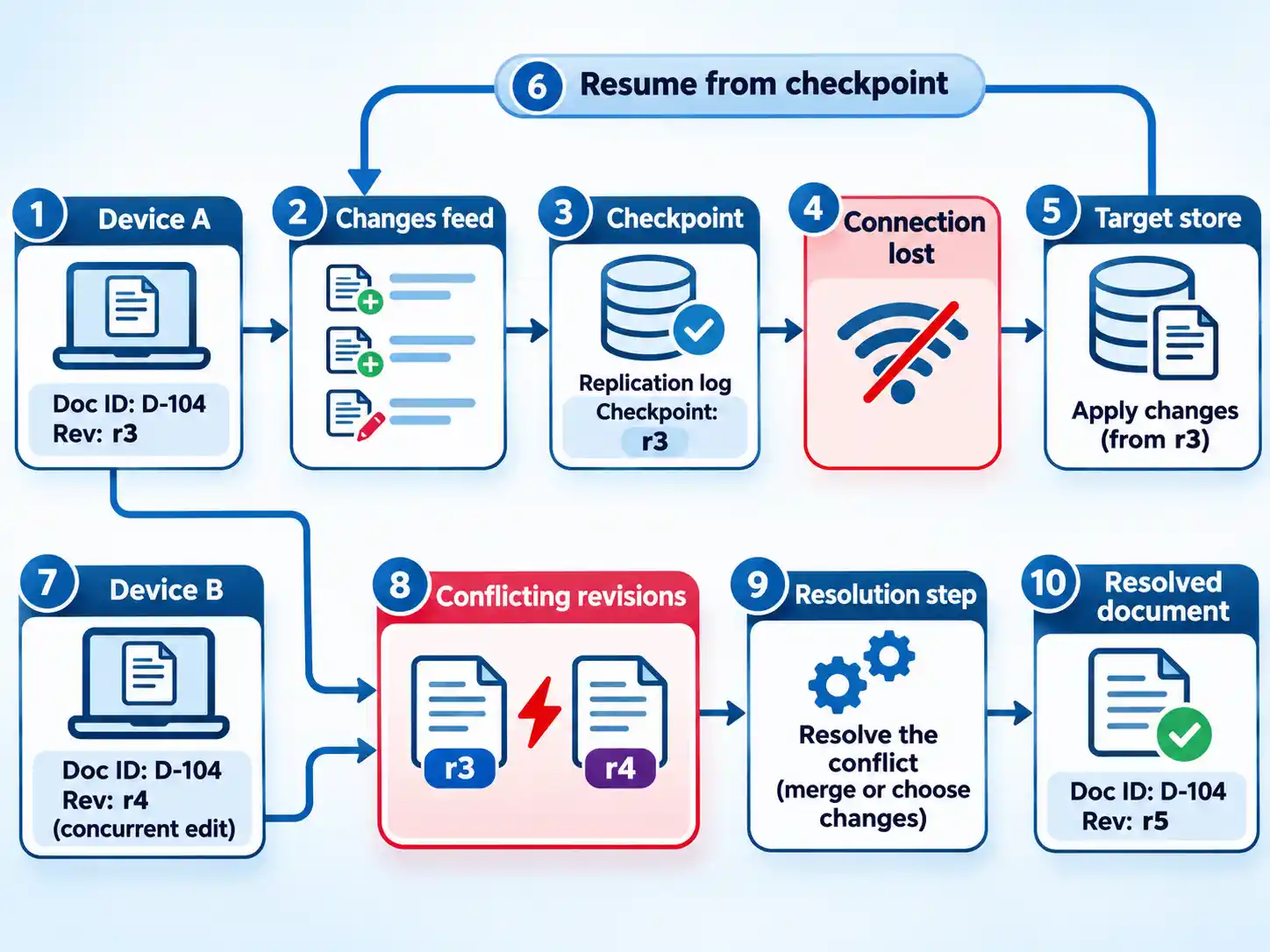
Offline mode is easy to claim. Conflict-tolerant replication is the part that gets tested in the field. The CouchDB replication protocol shows the shape of the real work: documents carry unique identifiers and revision tokens, replication runs over HTTP, and concurrent edits leave multiple leaf revisions that someone has to resolve deliberately. The replication log records checkpoints so an interrupted transfer resumes rather than restarting, and continuous replication stays alive on periodic heartbeats.
Ask the vendor to walk you through two agronomists editing the same field record in a dead zone on the same afternoon. If they can describe the conflict, the resolution rule and who sees what when connectivity returns, they have shipped this. If they describe a retry queue, they have shipped offline mode.
ISOBUS and CAN-bus telemetry
Warning
An ISOBUS-ready badge tells you little on its own. ISOBUS (governed by ISO 11783) is the universal tractor-to-implement plug standard that lets tractor cab displays communicate with hitched seeders, balers, and sprayers. Conformance is verified function by function by the Agricultural Industry Electronics Foundation (AEF), an industry consortium rather than an EU regulator. Always ask which specific conformance tests a developer has passed on real machinery.
The AEF runs ISOBUS conformance testing, including a Universal Terminal conformance test and a Minimum Control Function test environment, and is phasing out its File Server test. High-Speed ISOBUS is targeted at version 1.0 in 2028, which matters if you are writing a multi-year roadmap. A wireless in-field communication project is releasing a minimum control function, and the AgIN data space aims at brand-independent agricultural data sharing.
A mixed fleet is the real test. Ask what your software does when it meets a terminal that conforms to the baseline but not to the extension you built against, and who pays for the adapter work when it does.
LoRaWAN field networks
Field equipment like soil moisture probes and weather sensors rarely have cellular access. The LoRaWAN specification solves this by using low-power radio frequencies (868 MHz across Europe) to beam telemetry up to 15 kilometers back to a central farm gateway on small batteries that run for years. The architecture runs from end devices through gateways and network servers to application servers, and private deployments are supported. Treat that range as a best case and budget for a coverage test.
Ask how the partner has handled gateway placement on undulating ground and what the system does when a node drops off for a week. Battery life depends on how often a node transmits, so the data model decides the hardware spec.
Sentinel-2 satellite pipelines
The European Space Agency’s Sentinel-2 constellation beams free multispectral satellite imagery across Europe every five days. Agritech platforms ingest these optical bands to calculate NDVI—a vegetation health index that spots crop stress, nitrogen deficits, and irrigation leaks days before damage becomes visible to the human eye. The Copernicus Data Space Ecosystem provides free and open access, with a browser for quick looks, an openEO API for cloud processing, a Data Workspace for on-demand products, and STAC, openEO and Sentinel Hub APIs for automation.
Ask how the team handles cloud cover, revisit gaps and the cost of reprocessing a season when a model changes. Satellite pipelines fail on storage and recompute budgets, not on API access.
Contract terms to settle before the pilot
The EU Data Act has applied since 12 September 2025. It gives users of connected devices a right to access the data those devices generate and to share it with third parties, and the Commission names agriculture among the sectors that can use equipment performance data. It prohibits unfair contracts that impede data sharing and sets a framework for switching between providers of data-processing services. Model contractual terms are published as non-binding recommendations under the EU Data Act framework, with an advisory helpdesk behind them.
All of that covers data. None of it settles code. Source-code ownership, audit rights and escrow are clauses you write yourself, and they are easy to leave to the last week. Decide who owns the repositories, what happens to them on termination, how you verify quality before acceptance, and when escrow releases. An audit right with no defined scope turns into an argument; an escrow agreement with no update obligation turns into a stale snapshot.
Six steps from shortlist to a pilot you can exit
Run these in order. Each step changes what the next agreement has to say, and the last three are tied to the crop calendar rather than the project plan.
- Map the devices, the data and the rights.List every connected machine, sensor and gateway the pilot touches, then name the data each one generates and who is entitled to it. This inventory is what the rest of the contract hangs on.The data-access right attaches to connected products placed on the EU market, so a software-only tool with no device behind it needs separate contractual treatment. Get the inventory wrong here and every later clause covers the wrong thing.You should end with a table of devices, data types and rights holders that both sides have signed off in writing.
- Fix the data-access and portability clauses.Write down the export format, the frequency, and what happens to the data when the contract ends. Include the switching path if the partner also hosts your processing.EU rules set a framework for switching providers, so use it as a floor and specify the mechanics your operations team will actually need. A portability clause without a named export format is a promise rather than a procedure.Ask for one sample export before signature. If the partner cannot produce it on day one, the clause is theoretical.
- Settle code ownership, audit and escrow.Decide who owns the repositories, what happens to them on termination, and how you verify quality before you accept delivery. Put escrow in place if you depend on the code continuing to run without the partner.None of this is statutory, so the clause is the only protection you have. An audit right with no scope becomes an argument, and escrow with no update obligation becomes a stale snapshot.Your acceptance pack should be a signed schedule listing repository ownership, audit frequency and scope, and the escrow release conditions.
- Choose pilot fields against the season.Pick fields that represent your hardest case, not your friendliest, and confirm which crop stage is running when the software lands. A field that floods teaches you more than one that drains.Measure connectivity on those fields before deployment instead of trusting a coverage map, and confirm the machinery mix the software will meet.Tie the deployment date to a specific crop stage and write down what happens if that stage passes before the build is ready.
- Define acceptance criteria and rollback.Write acceptance as observable behaviour: what a field operator sees, what a supervisor sees, what happens when a sensor disappears for a week. Add a rollback plan with a named person who can trigger it.Vague criteria turn a fixed-price milestone into a negotiation, and a failed release can cost a spray window.Both documents should be signed before the first line of pilot code is written.
- Schedule the release outside peak harvest.Put the release window in the contract as a date range rather than a target date, and check it against harvest and planting for the crops on your pilot fields.A team that ships on time into the wrong week has still failed. Ask how the partner handled this constraint on previous agriculture work and listen for whether they have met it before.The signed plan should show a release window, a rollback deadline and a named on-call contact for each.
Which firm fits your situation
You are an equipment OEM or machine-control business
You are building a data-heavy agronomy platform
You are an enterprise cooperative or OEM group
You are an enterprise product team that wants EU-based delivery
You are an agritech startup or scale-up building a long-term product team
If none of those descriptions fit, the shortlist is the problem rather than the choice. A buyer whose requirement is a long-running platform with no hardware component sits closer to a general product engineering comparison than to this one.
The next thing to do
Send two shortlisted firms the same package this week: a one-page brief covering your four interfaces, the device and data inventory behind your data clauses, and the crop-calendar window you need to hit. Ask each to respond with a named team, a walkthrough of the conflicting-record scenario, and conformance evidence for the terminals on your fleet. Two responses will teach you more than another week of directory reading.
What moves a firm up this shortlist is an agriculture case you can open with a named technology and a date. What moves one off is silence on the conflict question, an entry requirement that forces your pilot to grow, or a refusal to put code ownership in writing. Hold the shortlist open until you have both answers.

💬 Comments