Virtual reality (VR) technology and adult entertainment intersect through high-resolution stereoscopic 3D rendering, real-time spatial motion tracking, micro-latency haptic telemetry synchronization, and interactive artificial intelligence character models. This technical convergence shifts digital media consumption from passive video playback to active, multisensory presence within immersive virtual environments.
Quick Take
- Visual Fidelity and Frame Rates: Modern 180-degree stereoscopic VR video targets 90Hz to 120Hz refresh rates at 6K to 8K resolutions, using 6 Degrees of Freedom (6DoF) tracking to eliminate simulator sickness while preserving spatial depth.
- Haptic Telemetry Synchronization: Motorized peripherals and full-body suits utilize timecoded telemetry scripts (such as
.funscriptfiles) delivered via Bluetooth Low Energy (BLE) and Open Sound Control (OSC) protocols to mirror on-screen movement in real time. - AI-Driven Interactivity: Real-time Computer-Generated Imagery (CGI) engines combined with Large Language Models (LLMs) allow users to engage in dynamic, prompt-responsive conversations with virtual avatars rather than following linear pre-rendered video paths.
- Privacy and Biometric Vulnerabilities: Advanced spatial hardware captures sensitive biometric data, including eye gaze, pupil dilation, and physiological exertion, raising significant cybersecurity and data encryption concerns for connected hardware.
The Visual Engine: Creating the Illusion of Presence
The transition from traditional flat-screen media to virtual reality relies on psychological presence—the subjective sensation of physically existing inside a computer-generated space. Achieving presence requires precise spatial optical alignment, low-latency motion tracking, and high pixel density to bypass the human brain’s instinctual recognition of artificial imagery.
Stereoscopic 3D and Field of View (FOV)
Early virtual reality experiences experimented with 360-degree monoscopic recording formats. However, 360-degree captures spread pixel resolution across an entire spherical field, resulting in low pixel-per-degree (PPD) density and a lack of true optical depth. As a result, modern adult VR platforms have largely standardizing on 180-degree stereoscopic 3D formats.
Stereoscopic capture uses dual-camera rigs spaced at an average human interpupillary distance (IPD) of 63 to 65 millimeters. This configuration records two distinct video streams—one for each eye—allowing headset optics to deliver realistic parallax and spatial depth. By restricting the field of view to 180 degrees directly in front of the user, producers concentrate rendering resources on the visible canvas, significantly boosting PPD and image sharpness. You can explore broader technical adoption data regarding telemetry sync and motion-tracking hardware across consumer VR platforms.
Frame Rates, Latency, and Spatial Tracking
Visual immersion breaks immediately if rendering latency causes a mismatch between physical head movement and display adjustments. Standard video runs at 24 to 30 frames per second (FPS), but VR displays require a minimum baseline of 90 FPS—with 120 FPS preferred on modern standalone and PC-tethered headsets. Dropping below 90 FPS causes micro-stuttering, triggering vestibular discordance and nausea.
Motion-to-photon latency—the time delay between a user moving their head and the screen updating its pixels—must remain strictly under 20 milliseconds. Advanced displays achieve this through asynchronous timewarp (ATW) and space-warp algorithms, which generate synthetic intermediate frames when rendering drops below target rates. Furthermore, tracking hardware has evolved from 3 Degrees of Freedom (3DoF), which only tracks head rotation, to 6 Degrees of Freedom (6DoF). 6DoF allows users to move laterally, vertically, and forward/backward within the virtual scene, providing realistic spatial agency.
Hardware and Software Integration: Haptics, Teledildonics, and AI
While visual display hardware provides spatial presence, multisensory feedback bridges the gap between sight and physical touch. Modern adult VR environments link visual media directly with physical hardware via standardized software pipelines.
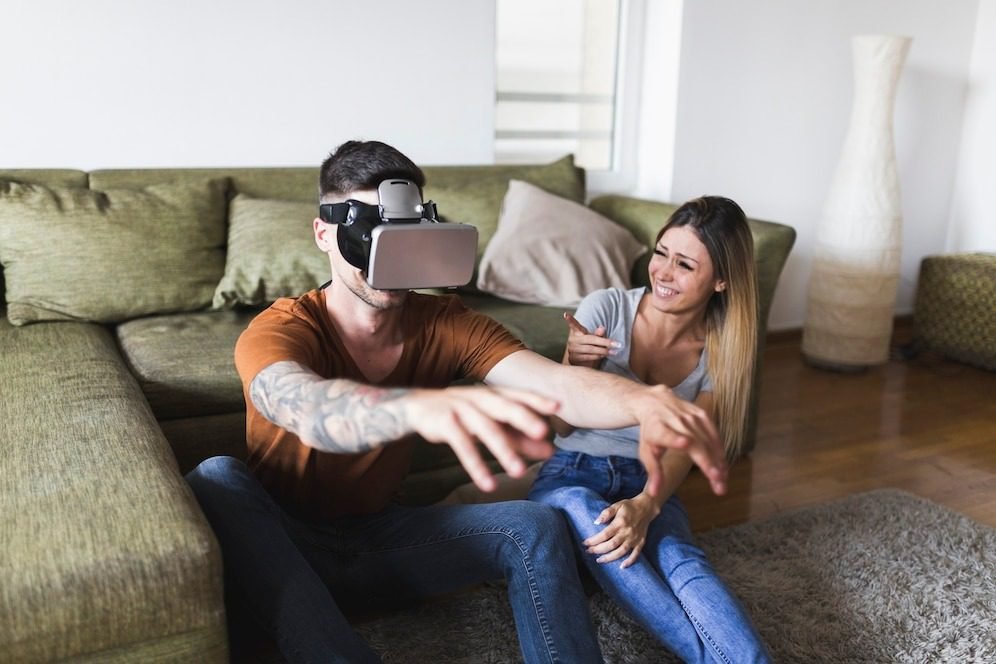
Teledildonics and Telemetry Synchronization
Teledildonics refers to connected physical hardware capable of executing motorized movements controlled by external software. In a VR setup, physical peripherals connect to media players via Bluetooth Low Energy (BLE) peripheral profiles. The software reads dedicated telemetry files alongside the video track, translating spatial movements on screen into physical actions.
The industry baseline format for haptic telemetry is the open-source .funscript standard. A .funscript file is a JSON data structure containing precise timestamp millisecond values mapped to physical position coordinates ranging from 0 to 100 percent of the device’s stroke length. Media players such as DeoVR, XBVR, and Stash execute these scripts alongside the video playback stream. When configuring these setups, users often benefit from configuring haptic telemetry drivers locally to resolve latency offsets between video decoding and motor response. Hardware manufacturers rely on these standardized protocols to provide real-time stroke and movement synchronization directly through native companion applications.
Full-Body Haptics and OSC Protocols
Beyond single-point motorized devices, modern VR adult setups increasingly utilize full-body haptic equipment, including vests, sleeves, and gloves equipped with arrays of eccentric rotating mass (ERM) motors or linear resonant actuators (LRAs). These garments distribute localized touch feedback across the torso and limbs.
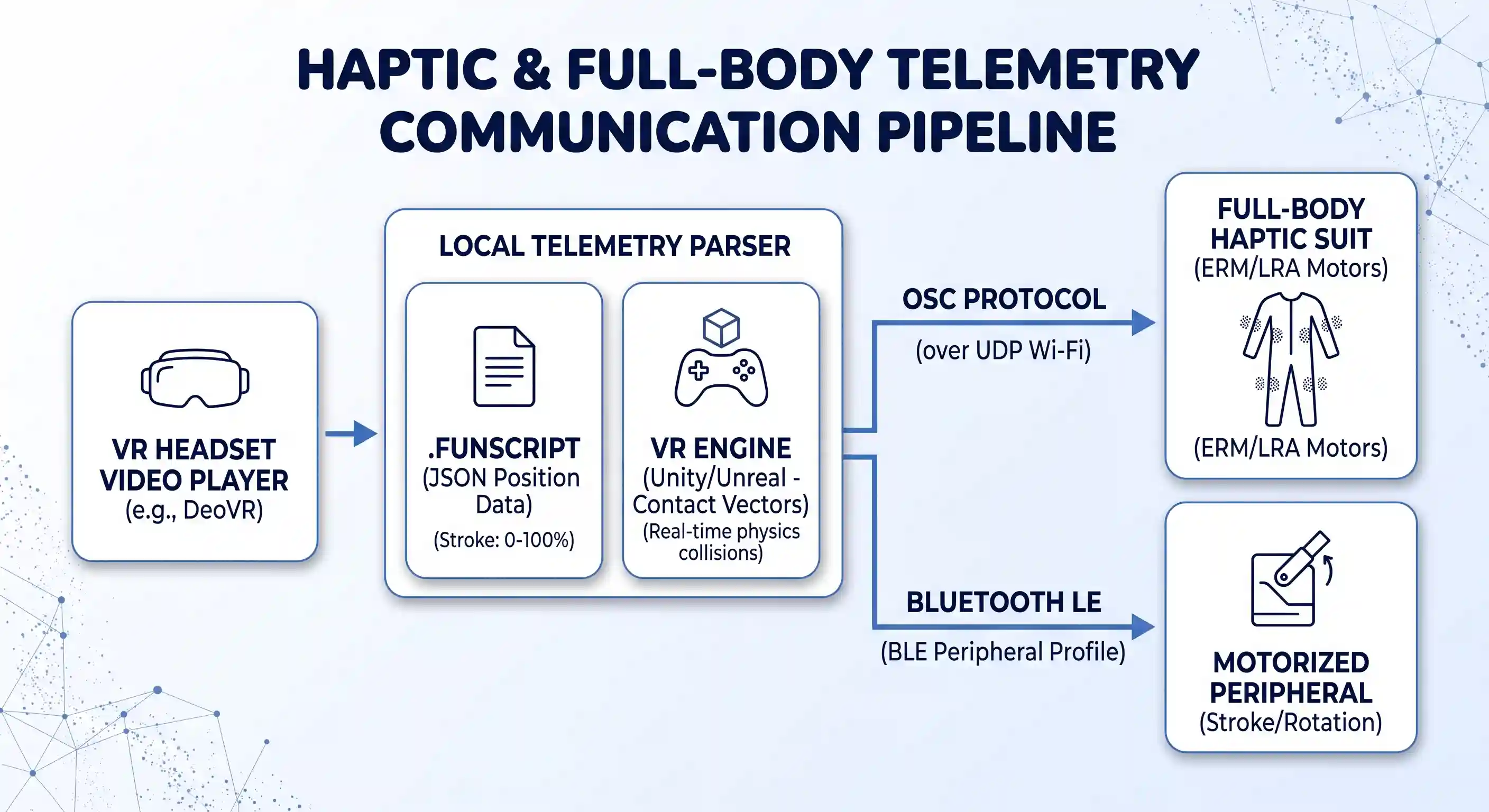
To pass complex positional haptic data to full-body suits without latency, developers rely on the Open Sound Control (OSC) protocol running over local UDP connections. Software decodes positional contact vectors from the VR engine and broadcasts OSC packets to the haptic suit controller, triggering localized vibrations that correspond directly to visual contact points. Specialty media software relies on timecoded haptic tracks for full-body suits to deliver accurate intensity maps across multiple body zones simultaneously.
AI Personalization and Dynamic Environments
Linear pre-rendered VR video limits the user to a fixed perspective with pre-recorded dialogue. To increase agency, developers are building interactive environments using real-time Computer-Generated Imagery (CGI) engines like Unity and Unreal Engine.
By shifting from pre-rendered video to real-time 3D rendering, developers can integrate Large Language Models (LLMs) directly into character AI pipelines. Virtual avatars process voice input from the headset microphone, generating context-aware dialogue in real time while neural text-to-speech (TTS) engines output natural voice audio. Lip-sync algorithms parse the audio stream into real-time facial visemes, allowing AI-driven interactive virtual avatars to respond dynamically to user prompt cues. Running these environments smoothly requires significant local processing capability or dedicated cloud infrastructure, drawing heavily on high-performance AI hardware acceleration to maintain stable frame rates during complex physics rendering.
Comparative Architecture: Pre-Rendered Video vs. Real-Time CGI Engines
Choosing between high-resolution stereoscopic video and real-time CGI environments involves structural trade-offs across visual realism, computational overhead, and user agency.
| Architectural Feature | 180° / 360° Pre-Rendered VR Video | Real-Time CGI Game Engines |
|---|---|---|
| Visual Realism | Photorealistic (Live-action camera capture) | Stylized to Semi-Photorealistic (Shader dependent) |
| User Agency | Passive (Fixed spatial camera track) | Active (6DoF movement and physical interaction) |
| Hardware Demand | Low-to-Moderate (Hardware video decoding) | High (Requires dedicated GPU processing) |
| Haptic Synchronization | Pre-scripted (.funscript / static timeline) |
Procedural (Physics engine impact collision) |
| Interactivity & AI | None (Linear branching choices at best) | High (LLM voice dialogue & real-time response) |
| Bandwidth Requirements | High (Large 6K/8K video file storage) | Low (Local asset rendering after app install) |
The Psychological Dynamics of Digital Intimacy
The immersive nature of VR technology engages human cognitive pathways differently than traditional media, creating distinct psychological advantages alongside emerging interpersonal challenges.
Safe Spaces for Personal Discovery
Because VR provides convincing spatial presence within a private, self-contained digital environment, users can explore personal fantasies and boundary preferences without fear of social judgment or real-world physical risk. The non-judgmental nature of digital environments makes VR a valuable tool for sexual self-discovery and fantasy exploration.
Additionally, VR technology offers significant accessibility benefits for individuals with physical mobility limitations, chronic pain, or social anxiety. By reducing physical barriers to intimate experiences, virtual spaces enable broader participation for user demographics that face challenges in traditional social settings. The core driver behind this psychological engagement is the headset’s head-tracking illusion of presence, which convinces the nervous system that virtual encounters carry personal weight. Optimizing comfort for extended sessions requires attention to overall vr headset ergonomic design to reduce neck strain and facial pressure.
The Risk of Relational Displacement
While VR provides novel avenues for personal agency, hyper-realistic immersive content carries potential psychological drawbacks. The primary concern among behavioral researchers is relational displacement—the replacement of real-world interpersonal effort with optimized, friction-free digital intimacy.
In real-world relationships, intimacy requires vulnerability, compromise, and mutual effort. Conversely, AI-powered VR partners offer unconditional validation and customized interaction without requiring interpersonal compromise. Over time, heavy reliance on hyper-customized virtual environments can distort expectations regarding real-world partners, occasionally leading to parasocial attachment or intimacy avoidance. Maintaining long-term relationship health often involves establishing boundaries around usage habits and actively managing digital consumption habits to prevent emotional withdrawal from offline relationships.
Ethical Boundaries, Biometric Privacy, and Data Security
The hardware capabilities required to deliver immersive VR environments introduce sensitive ethical and cybersecurity challenges that differentiate spatial computing from traditional digital media consumption.
Consent, Identity, and Digital Avatars
The rise of generative AI combined with high-precision 3D scanning has introduced complex consent issues regarding avatar creation. Non-consensual deepfake generation—mapping a real person’s facial features or body geometry onto a virtual avatar without explicit consent—represents a major ethical and legal concern within virtual spaces.
Protecting personal image rights requires establishing robust legal frameworks and digital identity verification protocols. Platforms operating in the spatial computing sector must adopt enforceable content creation policies and establish standardized biometric content licensing standards to ensure all digital avatars are built with verifiable performer consent.
Biometric Data Harvesting Risks
Modern high-end VR headsets contain advanced sensor arrays designed to track user physiological signals. Internal eye-tracking cameras monitor pupil dilation, gaze vector, and blink rates to handle foveated rendering. Meanwhile, external controllers and haptic suits record heart rate, muscle tension, and motion telemetry.
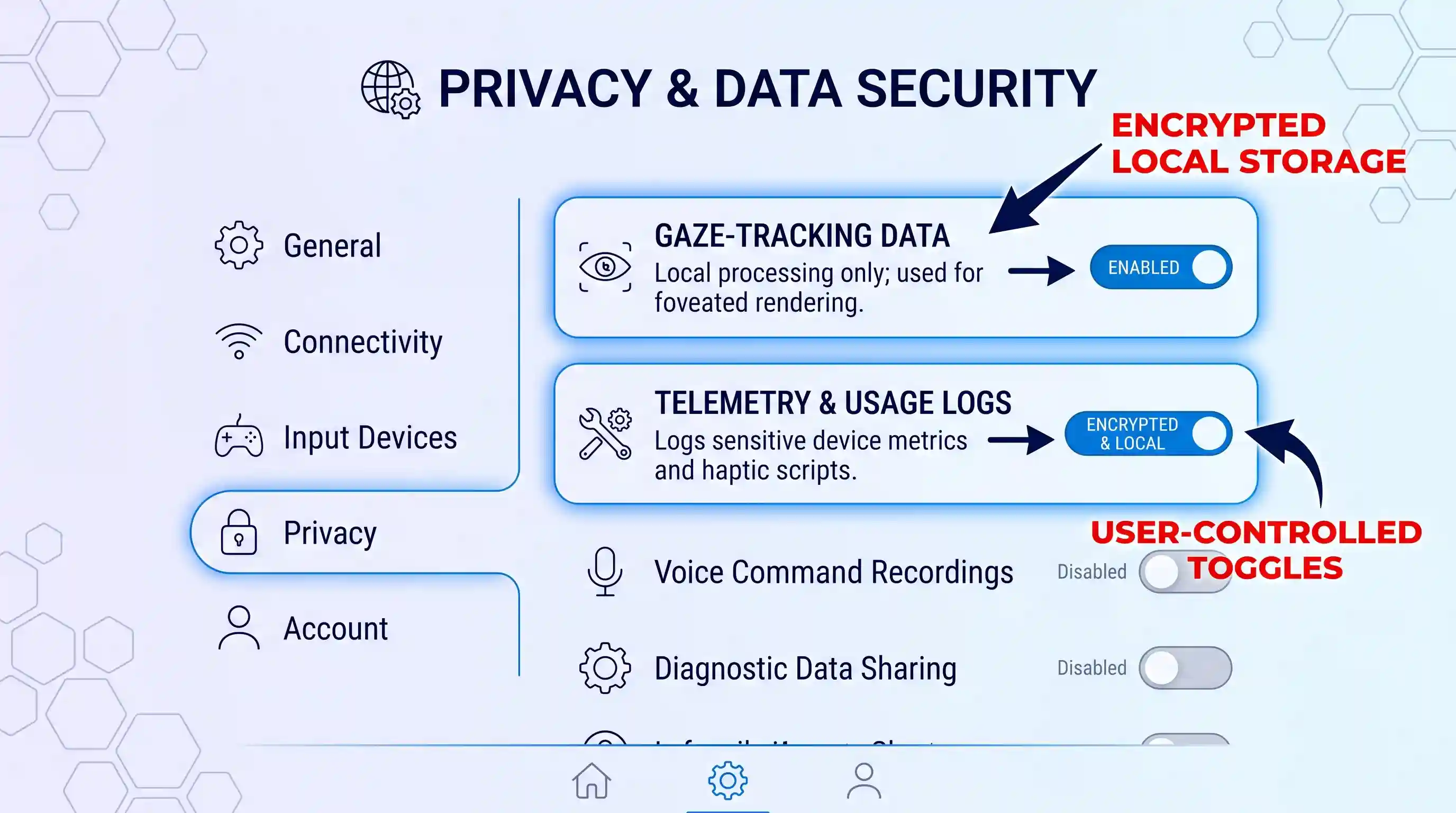
While these sensors optimize rendering performance and haptic responsiveness, eye-tracking data contains highly sensitive physiological markers. Pupil dilation and involuntary gaze persistence serve as direct indicators of physiological arousal and personal preference. If telemetry logs are transmitted to cloud servers without robust client-side encryption, third parties could harvest biometric data profiles to infer private user preferences. Maintaining user privacy requires vendor transparency, localized telemetry processing, clear opt-in permissions, and user education around securing local telemetry logs against unauthorized app access.
Key Takeaways
- Stereoscopic Optimization: 180-degree stereoscopic 3D at 90Hz to 120Hz provides the ideal balance of spatial depth, pixel density, and rendering smoothness without inducing motion sickness.
- Standardized Telemetry Protocols: Motorized peripherals rely on JSON-based
.funscripttracks delivered over Bluetooth LE and OSC network packets to synchronize physical movement with visual cues. - Generative AI Integration: CGI game engines combined with Large Language Models enable interactive, dynamic conversations and real-time avatar reactions, moving past linear pre-rendered video.
- Biometric Privacy Imperatives: Eye-tracking, pupil dilation, and motion telemetry record sensitive physiological responses, requiring localized data isolation to protect consumer privacy.
Frequently Asked Questions
What hardware is required to experience interactive VR adult content?
Experiencing basic 180-degree stereoscopic VR video requires a standalone VR headset (such as a Meta Quest or Pico device) or a PC-tethered headset (such as a Valve Index) running compatible video player software like DeoVR. To add physical feedback, users require Bluetooth-enabled haptic hardware capable of receiving telemetry scripts, along with a smartphone or PC to host peripheral connectivity drivers.
How do motorized sex toys synchronize with VR video content?
Motorized devices synchronize with VR video through specialized telemetry files, most commonly formatted as .funscript files. These scripts contain millisecond-accurate timestamps linked to physical stroke positions (from 0 to 100 percent). When a video plays inside a compatible VR media application, the software reads the script file in real time and sends motor position instructions to the peripheral device via Bluetooth Low Energy (BLE).
What is the difference between 180-degree and 360-degree VR content?
360-degree VR content captures an entire spherical environment surrounding the viewer, but it spreads pixel resolution across a wider canvas, resulting in lower image sharpness and generally lacking true 3D optical depth. 180-degree content focuses visual capture strictly on the hemisphere in front of the viewer, allowing dual stereoscopic camera lenses to record native 3D depth at significantly higher pixel density per degree.
What privacy risks exist when using haptic VR applications?
Primary privacy risks center on the harvesting of biometric telemetry data, including eye-gaze tracking, pupil dilation, and physiological heart rate metrics recorded by headset sensors and haptic peripherals. If application developers log this telemetry on remote cloud servers without strong end-to-end encryption, it creates potential vectors for data breaches or unauthorized behavioral profiling based on intimate physical responses.

💬 Comments