Low Instagram engagement does not have one universal cause. Your content may be reaching fewer people, reaching people who do not respond, losing non-follower discovery, or attracting an audience that no longer matches what you post.
The useful first step is not to post more, change every hashtag, or blame the algorithm. Separate the reach problem from the response problem, then fix the part your own account data points to.
Quick Take
- If reach falls but the people you do reach still interact at a similar rate, investigate distribution and recommendation eligibility.
- If reach stays fairly normal but likes, sends, saves, or other interactions fall, investigate the content and audience response.
- If both fall, check for a broader change in subject matter, content quality, audience fit, recommendation eligibility, or audience quality.
- Do not try to repair weak engagement by buying followers, likes, or other artificial activity.
What Low Instagram Engagement Actually Means
Engagement is the response your content gets after people encounter it. Depending on what you are measuring, that response may include likes, comments, saves, shares, replies, or other interactions.
A raw interaction count does not tell the whole story. Imagine that one post gets 100 interactions after reaching 2,000 people, while another gets the same 100 interactions after reaching 20,000. The visible interaction count is identical, but the audience response is very different.
Engagement rate can be calculated in more than one way, so check the denominator before comparing two numbers. For example, a reach-based engagement rate compares interactions with the people reached, while Buffer’s current Instagram benchmark calculates its displayed engagement rate against impressions. Mixing formulas can make two percentages look comparable when they are not.
Benchmarks need context too. Buffer’s September 2026 Instagram benchmark says its dataset includes more than 27 million posts from 273,000 active accounts, and it lets readers filter by follower tier because account size affects a useful comparison. Comparing accounts of a similar size is more informative than treating one percentage as a universal pass-or-fail score.
Your own recent history is usually the best starting point. If an account that normally reaches a certain type of audience suddenly performs differently across several comparable posts, that change tells you more about the problem than an industry-wide number does.
Diagnose Why Your Engagement Dropped
Start with a few recent posts that performed normally and compare them with the posts where engagement fell. Change one question at a time so that you can identify whether exposure, response, or both changed.
- Open the performance data available for the post. Instagram provides Insights and a professional dashboard for professional accounts. On an eligible creator or business account, open the individual post or Reel and use its insights view, or open the professional dashboard to review account-level performance. Instagram changes interface placement over time, so use the app’s settings or dashboard search rather than relying on an old menu path if a control has moved.
- Compare similar content over the same kind of period. Do not compare one new Reel after a few hours with an older post that has collected interactions for several days. Choose posts with similar age, purpose, and format where possible.
- Separate exposure from response. Check how many people viewed or were reached, then compare that with interactions such as likes, comments, saves, and shares. If exposure fell while interaction relative to exposure stayed similar, the first problem is likely distribution. If exposure stayed similar while interaction weakened, the content is reaching people but producing less response.
- Check watch time, likes, and sends where they apply. Instagram chief Adam Mosseri identified watch time, likes, and sends as especially important ranking signals and suggested looking at average watch time, likes per reach, and sends per reach. Those signals do not form a guaranteed reach formula, but they help show how people responded after seeing the content.
- Look at follower and non-follower discovery where your Insights provide it. If existing followers continue responding but discovery outside that audience has fallen, investigate recommendation eligibility, originality, topic fit, and how shareable the content is before changing the entire account strategy.
- Match the symptom to one likely cause before changing anything. A reach problem, retention problem, audience-fit problem, and recommendation restriction need different responses. Make one meaningful adjustment, then compare later content with the same baseline instead of changing topic, format, posting frequency, caption style, and timing all at once.
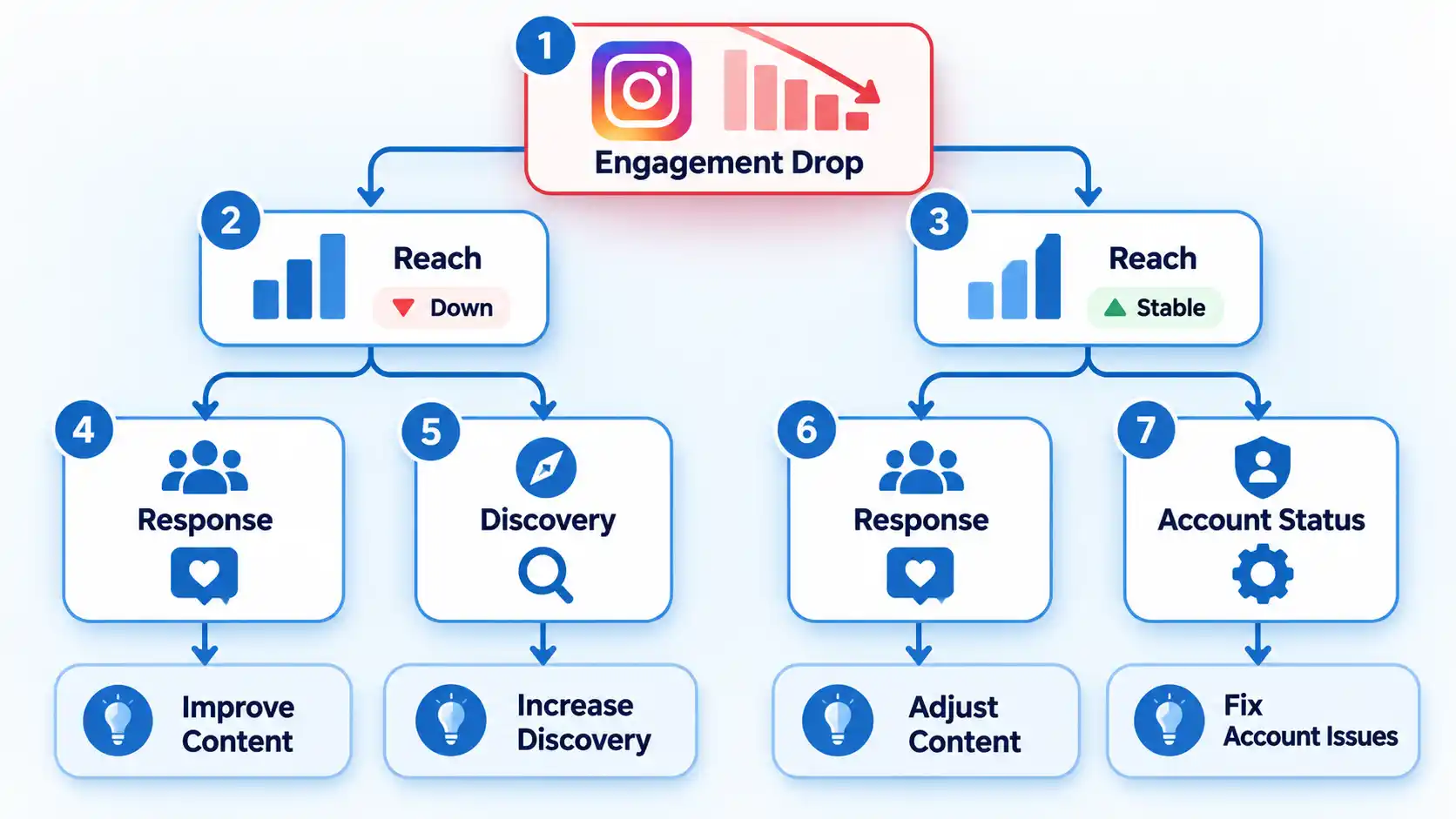
The purpose of this process is to narrow the problem, not to prove that one metric controls Instagram. Different recommendation surfaces use different signals, so how the Instagram algorithm works is broader than any single engagement-rate formula.
What Usually Causes Low Instagram Engagement
Once you know whether the main weakness is exposure or response, the possible causes become easier to separate.
The content no longer matches the audience that followed you
An account can grow around one subject and later shift toward another. The follower number remains, but many of those people may have little reason to interact with the new material.
This is more useful than saying a whole niche is “wrong for Instagram.” Almost any subject can have a relevant audience. The real question is whether your current content matches the people the account has attracted and gives those people a reason to watch, save, share, comment, or return.
People see the post but do not stay or respond
For video, weak watch time can reveal a retention problem. A Reel may earn an initial view but lose attention before the useful part arrives. For other formats, reach may be acceptable while likes, saves, shares, or comments weaken.
Watch time, likes, and sends are among the signals Instagram leadership has publicly highlighted. Mosseri has also distinguished their roles somewhat: likes can matter more for connected audiences, while sends can be especially useful for reaching people beyond the existing audience. The practical point is to inspect how reached viewers behave, not merely how many followers the account has.
Your posts have become repetitive or mainly promotional
A follower may care about your product or subject without wanting every post to be an advertisement. If most content asks people to buy, sign up, click, or admire a promotion, there may be little reason to save or send it.
Useful variation can come from answering recurring questions, demonstrating something, showing a process, explaining a decision, addressing a problem, or adding timely context. The goal is not variety for its own sake. Each post should give the intended audience a clear reason to spend time with it.
Your account depends heavily on recycled material
Originality has become more prominent in Meta’s recommendation systems. In January 2026, Meta reported that original posts made up 75% of Instagram recommendations in the United States after the company increased their prevalence by 10 percentage points during Q4 2025. That 75% figure describes U.S. recommendations at that time; it does not mean an original post is guaranteed a particular amount of reach.
Original does not have to mean inventing an entirely new topic. Your own explanation, footage, demonstration, example, analysis, or point of view can add value without simply reposting material that already exists elsewhere.
Your visible follower count overstates the active audience
An account can have many followers and still have weak engagement if a large share of that audience is inactive, uninterested, poorly matched to the current subject, or artificial.
Artificial engagement is especially poor as a repair strategy. Meta has taken enforcement action against services that used bots and automation to inflate Instagram likes and followers, describing the practice as fake engagement. A larger displayed number does not establish genuine audience interest.
What matters for diagnosis is how the audience was acquired and whether the people currently seeing the content actually respond to it.
The account has lost a clear content direction
If one week focuses on one audience, the next on an unrelated subject, and the next on another, both people and recommendation systems have less consistent evidence about who may value the account.
This does not mean every post must look or sound the same. A clearer approach is to keep a recognizable subject or audience promise while varying examples, formats, angles, and depth. Current strategy analysis also emphasizes that simply increasing publishing volume will not repair weak audience-content fit. Reconsidering what the account gives people a reason to follow and share is more useful than treating frequency as the only variable.
Check Whether Your Content Can Be Recommended
A post can be allowed to remain on Instagram without being eligible for broad recommendation. Meta’s Recommendation Guidelines apply additional standards to content that may be shown to people who did not choose to follow the account. Some content can therefore remain available while being excluded from recommendation surfaces. Being allowed on Instagram and being eligible for recommendations are different questions.
That distinction matters when non-follower reach falls sharply. Instead of assuming that every decline is a hidden “shadowban,” check the account information Instagram provides about restrictions and recommendation eligibility.
For professional accounts, Instagram uses Account Status to surface account or content issues that can affect recommendation eligibility and to provide available correction or review options. Meta changes settings organization over time, so if Account Status is not where an older tutorial says it should be, search Instagram’s settings for Account Status or use the in-app support tools rather than following an unverified menu path.
If Instagram identifies a specific post, profile element, or restriction and offers an edit, removal, or review option, deal with the stated issue rather than deleting unrelated content at random.
If Account Status does not show a recommendation problem that explains the drop, return to your Insights and investigate reach, watch time, interaction rates, audience fit, and recent changes to the content itself. A clear status removes one possible cause; it does not guarantee high reach.
When non-follower exposure falls unusually fast, a structured Instagram reach check should separate a stated recommendation restriction from ordinary performance changes before you start rebuilding the content strategy.
Verify the result
- Account Status does not show an unresolved recommendation restriction that explains the drop in non-follower discovery.
- If Instagram identified specific content or a profile issue, you reviewed the exact item and used the available correction or review option instead of removing unrelated posts.
- If recommendation eligibility is clear, you return to performance data rather than continuing to diagnose the account as restricted without evidence.
Fix the Problem Your Data Points To
The same “post better content” advice does not solve every engagement problem. Match the change to the symptom you actually found.
| Symptom | What it suggests | First response |
|---|---|---|
| Reach falls but interaction relative to reach is similar | Distribution or discovery changed more than audience response. | Check Account Status, non-follower discovery, originality, and recent changes to topic or format. |
| Reach is similar but interactions fall | People are still seeing the content but responding less. | Review topic fit, usefulness, opening, clarity, and whether the post gives people a reason to save, send, comment, or act. |
| A Reel gets views but weak watch time | The opening or pacing may not hold attention. | Reach the useful point sooner, remove slow setup, and compare later Reels against similar-length content. |
| Followers respond but non-follower discovery weakens | Existing audience fit may still be healthy while discovery is weaker. | Check recommendation eligibility, originality, topical consistency, and the signals associated with sharing beyond the current audience. |
| Follower count is high but engagement is chronically weak | The visible audience size may not reflect an active or well-matched audience. | Review how followers were acquired and focus future growth on people who genuinely want the subject rather than increasing the count itself. |
| One format repeatedly underperforms another | The format may not suit that message or audience behavior. | Compare equivalent content goals and keep the format-message combinations your own results support. |
Do not change several variables at once unless there is an obvious account-wide problem. If you simultaneously switch topics, format, posting frequency, caption style, and publishing time, a later improvement will not tell you which change helped.
Format should also be judged against the job of the content. A Reel built to demonstrate movement and a carousel built to explain several points may produce different kinds of response. When the choice itself becomes important, compare Reels and carousels for engagement against the same audience goal instead of declaring one format universally better.
What Not to Do When Engagement Drops
Do not buy followers or engagement to repair the number
Purchased or automated activity can increase a visible count without showing that real people value your content. Meta has repeatedly acted against services built to distribute fake likes and followers on Instagram. Artificially inflating engagement is therefore not a sound response to weak audience quality.
Do not call every reach decline a shadowban
A decline can come from weaker audience response, changing content, ordinary ranking competition, recommendation eligibility, or a shift in who the content reaches. Check Account Status and your performance data before assigning one explanation.
Do not chase one universal engagement-rate target
Industry benchmarks can provide context, but account size, content format, audience, subject, and calculation method affect the comparison. Buffer’s current Instagram benchmark separates follower tiers instead of treating all accounts as equivalent. Use benchmarks as context and your own recent baseline as the main diagnostic comparison.
Do not increase posting volume before you know what is failing
More posts can give you more data, but they can also repeat the same weak content-audience match. If reached viewers are not responding, publishing the same kind of post more often does not identify the reason.
Do not treat hashtags or one posting time as guaranteed reach formulas
Instagram uses multiple ranking and recommendation systems, and performance depends on more than one publishing choice. Test timing or discovery tactics against your own audience where useful, but do not treat a single hashtag count, posting hour, or engagement trick as a guaranteed distribution switch.
When a Strategy Reset Makes More Sense
Sometimes individual posts are not the main problem. The account itself may no longer have a clear job.
A broader reset makes sense when posts repeatedly reach people who have little interest in the subject, the account jumps between unrelated audiences, the content has become mostly promotional, or the metrics you are chasing have little connection to what the account is supposed to accomplish.
For a business, engagement is especially easy to overvalue in isolation. A post with fewer likes can still be useful if it generates qualified profile visits, inquiries, bookings, or sales. A post with many likes can be less valuable if none of that attention supports the business objective.
When the problem extends beyond a few weak posts, rebuild the Instagram marketing strategy around a clear goal, a defined audience, repeatable content themes, appropriate formats, genuine interaction, and measurements that connect attention with the result the business actually wants.
Low engagement becomes easier to fix when you stop treating it as one mystery metric. First identify whether fewer people are seeing the content, whether reached viewers are responding less, or whether Instagram has identified a recommendation issue. Then change the specific part supported by the evidence and compare the result against the same baseline.

💬 Comments