Sports betting attracts substantial attention in Florida because compact-authorized statewide mobile access now overlaps with a large, year-round sports culture and increasingly visible sportsbook branding. Those conditions help explain the interest, although there is no authoritative Florida-specific study showing that any one factor caused sports betting to become popular.
Quick Take
- Sports betting is legal in Florida under the state’s gaming compact with the Seminole Tribe, including qualifying mobile wagers placed by people physically located in the state.
- Florida has professional football, baseball, basketball, hockey and soccer teams, along with spring training and other sporting events throughout the year.
- Legal mobile access reduces the need to visit a physical sportsbook, while team and venue partnerships have made sportsbook branding more visible.
- Not every sportsbook accessible from Florida is legal there. State regulators caution that online sports wagers outside the Seminole-authorized structure are most likely illegal.
Is Sports Betting Legal in Florida Today?
Yes. Florida law authorizes sports betting conducted under the gaming compact between the state and the Seminole Tribe of Florida. Florida Statute 285.710 specifically includes sports wagers placed by people physically located anywhere in the state using a mobile or other electronic device.
The legal mechanism is unusual. Under the compact framework, a qualifying mobile wager is deemed to take place where the Tribe’s servers or other wagering devices are located on Indian lands, even when the person placing the wager is elsewhere in Florida. The statute also sets the minimum sports-betting age at 21.
Florida’s general gambling prohibitions contain a corresponding exemption for gaming activities authorized under the compact. That exemption appears in Florida Statute 849.142.
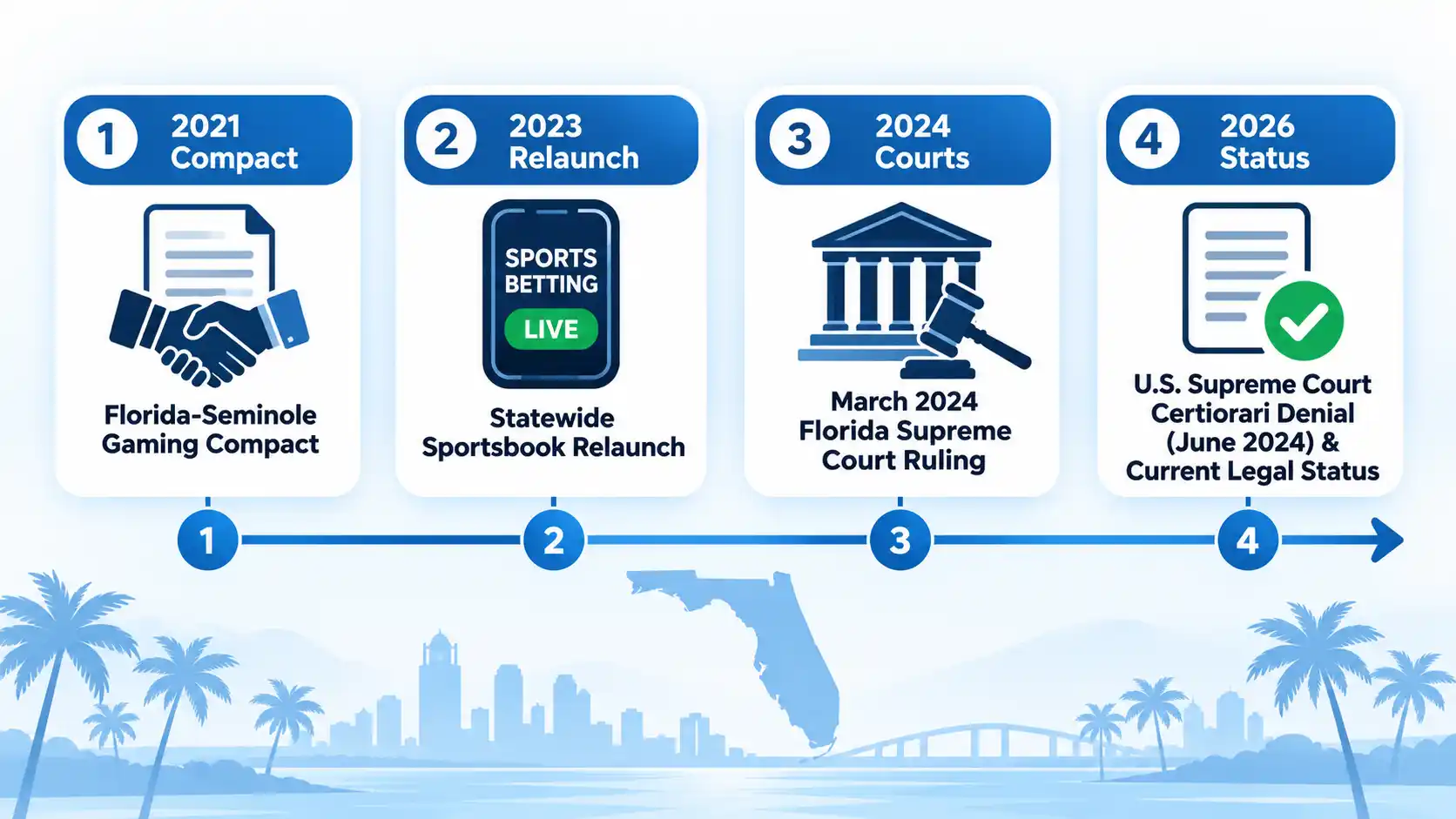
The present system followed several years of litigation. In March 2024, the Florida Supreme Court rejected a challenge to the compact because a writ of quo warranto was not the proper procedure for testing the substantive constitutionality of the enacted law. The court therefore did not resolve the underlying constitutional argument on its merits. The federal litigation reached another endpoint on June 17, 2024, when the U.S. Supreme Court denied the petition for certiorari.
The practical situation today is much clearer than it was while the major challenges to Florida’s sports-betting framework were still pending.
| Attribute | Current position |
|---|---|
| Legal status | Sports betting is authorized when conducted pursuant to Florida’s gaming compact with the Seminole Tribe. |
| Minimum age | 21 or older for sports betting under the compact. |
| Online and mobile betting | Authorized mobile wagers may be placed by eligible users physically located within Florida under the compact framework. |
| Regulated online structure | The statewide legal framework is built around sportsbooks operated by or in conjunction with the Seminole Tribe. |
| Retail betting | Compact-authorized sports wagering may also take place at qualifying tribal gaming facilities. |
| Other online sportsbooks | Florida regulators warn that wagers placed outside sportsbooks operated by or in conjunction with the Seminole Tribe are most likely illegal. |
Florida’s compact therefore creates a distinctive framework for legal sports betting in Florida. It is not an open market in which every sportsbook licensed elsewhere in the United States can automatically operate.
Why Sports Betting Gets So Much Attention in Florida
There is no single verified statistic or Florida-specific study that proves exactly why residents are interested in sports betting. A better way to understand the subject is to look at several observable conditions that make sports wagering highly visible and relatively accessible.
These include Florida’s extensive professional-sports landscape, major events throughout the year, legal mobile wagering and sportsbook marketing around teams and sporting venues. They provide reasonable explanations for interest, but they should not be confused with proof that every Florida sports fan bets or that one factor directly caused participation.
Florida Has a Large Year-Round Sports Ecosystem
Florida does not depend on a single league or season to keep sports fans engaged. The Florida Sports Foundation’s professional-team directory lists teams such as the Jacksonville Jaguars, Miami Dolphins, Tampa Bay Buccaneers, Miami Marlins, Tampa Bay Rays, Miami Heat, Orlando Magic, Florida Panthers, Tampa Bay Lightning, Orlando City, Orlando Pride and Inter Miami CF, along with major golf, tennis and motorsports organizations.
That variety matters because major sports calendars overlap. NFL games occupy the fall and winter while NBA and NHL seasons continue through much of the same period. Baseball then moves from spring training into the regular MLB season, while soccer, golf, tennis, motorsports and college competitions add more events during other parts of the year.
Spring training expands that calendar further. Major League Baseball’s Grapefruit League has 15 teams playing in Florida, giving fans additional baseball events before the regular season begins.
This steady supply of competitions creates repeated occasions for fans to follow teams, scores and matchups. It is reasonable to see that environment as one factor supporting interest in sports wagering, but sporting attendance or fandom alone does not demonstrate that someone participates in betting.
Mobile Access Removes Much of the Physical Friction
Legal mobile betting changes the practical effort required to place a wager. Someone who meets the legal requirements and is physically located in Florida does not have to travel to a casino each time because the compact specifically provides for wagers transmitted through mobile and other electronic devices.
This reflects a wider shift in mobile and online sports betting technology. Instead of requiring an in-person visit for every wager, online systems can make betting accessible through phones and computers, subject to the legal and geographic restrictions that apply in the user’s location.
Florida’s system remains more restricted than that convenience may suggest. Legal statewide mobile access does not mean residents can simply choose among every sportsbook operating elsewhere in the country. The Florida Gaming Control Commission says that unless an online sports wager is placed through a sportsbook operated by or in conjunction with the Seminole Tribe, it is most likely an illegal wager.
Teams, Venues and Sportsbook Marketing Increase Visibility
Sportsbook branding has also become more visible around mainstream Florida sports. In October 2025, the Orlando Magic announced an official sportsbook partnership that included branding and a sportsbook destination space inside Kia Center. In July 2026, the Miami Marlins announced a multi-year sportsbook partnership involving promotions and activations at loanDepot park and across the team’s digital and broadcast platforms.
Those partnerships show that sports-betting brands are appearing in places where fans already interact with professional teams. They do not prove that advertising causes people to bet, but they do demonstrate greater sportsbook visibility within the broader spectator-sports environment.
Florida’s Large Visitor Market Expands the Potential Audience
Florida also has an unusually large flow of visitors. VISIT FLORIDA reported 143.33 million visitors in 2025 and an estimated 39.88 million visitors during the first quarter of 2026.
That does not mean those visitors are sports bettors. Tourism statistics measure visits, not wagering behavior. They are relevant only because they show the scale of the transient audience moving through a state that also hosts professional teams, spring training, major sporting events and legal mobile sports wagering.
For that reason, tourism is better understood as part of Florida’s broader sports and entertainment environment rather than direct evidence of sports-betting participation.
What the Old Offshore Betting Advice Got Wrong
Older discussions of Florida sports betting sometimes described offshore sportsbooks as a simple legal alternative when regulated wagering was unavailable. That is not an accurate description of the current Florida regulatory position.
An offshore gambling operator is generally based or licensed outside the jurisdiction where a customer is located. Foreign licensing, however, does not automatically give that operator authorization to take sports wagers from someone in Florida.
Some commercial guides covering Florida sports betting sites and apps discuss both regulated and offshore options, but a site’s availability on the internet does not establish that it is authorized under Florida law.
The Florida Gaming Control Commission says that unless an online sports wager is placed through a sportsbook operated by or in conjunction with the Seminole Tribe of Florida, it is most likely illegal. Accessibility, a foreign gambling license or operation in another U.S. state does not establish Florida authorization.
The regulator makes the distinction explicit in its guidance on legal online sports wagering. It notes that many sportsbook websites may be accessible to Florida residents and may even hold licenses elsewhere, but that fact does not determine whether the wager is legal in Florida.
This is also why descriptions such as “safe” or “legal” should not be applied broadly to offshore sportsbooks. A regulated Florida sportsbook and an offshore operator may be subject to different oversight and player-protection requirements.
Popularity Does Not Remove Gambling Risk
Easy access and a busy sports calendar do not eliminate the financial or behavioral risks associated with gambling. The Florida Council on Compulsive Gambling publishes state HelpLine reports, including a report specifically focused on sports-betting impacts from 2023 through 2025.
Anyone concerned about their own gambling or a loved one’s gambling can contact Florida’s 888-ADMIT-IT Problem Gambling HelpLine. The service is available 24 hours a day and is confidential and multilingual.
The important distinction is that popularity, convenience and legality do not make wagering financially harmless. Sports betting involves the risk of losing money, and legal availability should not be interpreted as a guarantee that participation is appropriate for every person.
Bottom Line
Florida now combines legal statewide mobile sports wagering under the Seminole compact with a broad professional-sports ecosystem, year-round events and increasingly visible sportsbook partnerships. Together, those conditions help explain why sports betting receives considerable attention in the state.
What the evidence does not establish is a simple causal formula for that popularity or a precise statewide participation rate. The clearest current picture is therefore one of access, sports culture and visibility operating together within a distinctive legal framework rather than proof that any single factor drives Floridians to bet.





💬 Comments