Amazon’s sponsored ad types are three different tools with three different jobs, and two of them sit behind an eligibility gate you can’t bid your way around. Sponsored Products puts individual products in front of shoppers and is open to the widest range of advertisers. Sponsored Brands builds the brand itself, with pricing models matched to what you’re trying to achieve. Sponsored Display now lives inside Amazon’s broader display offering within Amazon Ads Agent, which unifies sponsored ads and Amazon DSP workflows in one workspace.
This guide covers those three sponsored types only. Amazon Ads runs a much larger portfolio, including Amazon Attribution, Amazon Marketing Cloud, Marketing Stream, and newer AI-driven tools like Campaign Manager beta and Creative Agent, all of which appear in Amazon’s own product announcements feed. Those tools answer different questions. If you’re deciding where to put your first sponsored dollar, start here.
Quick Take
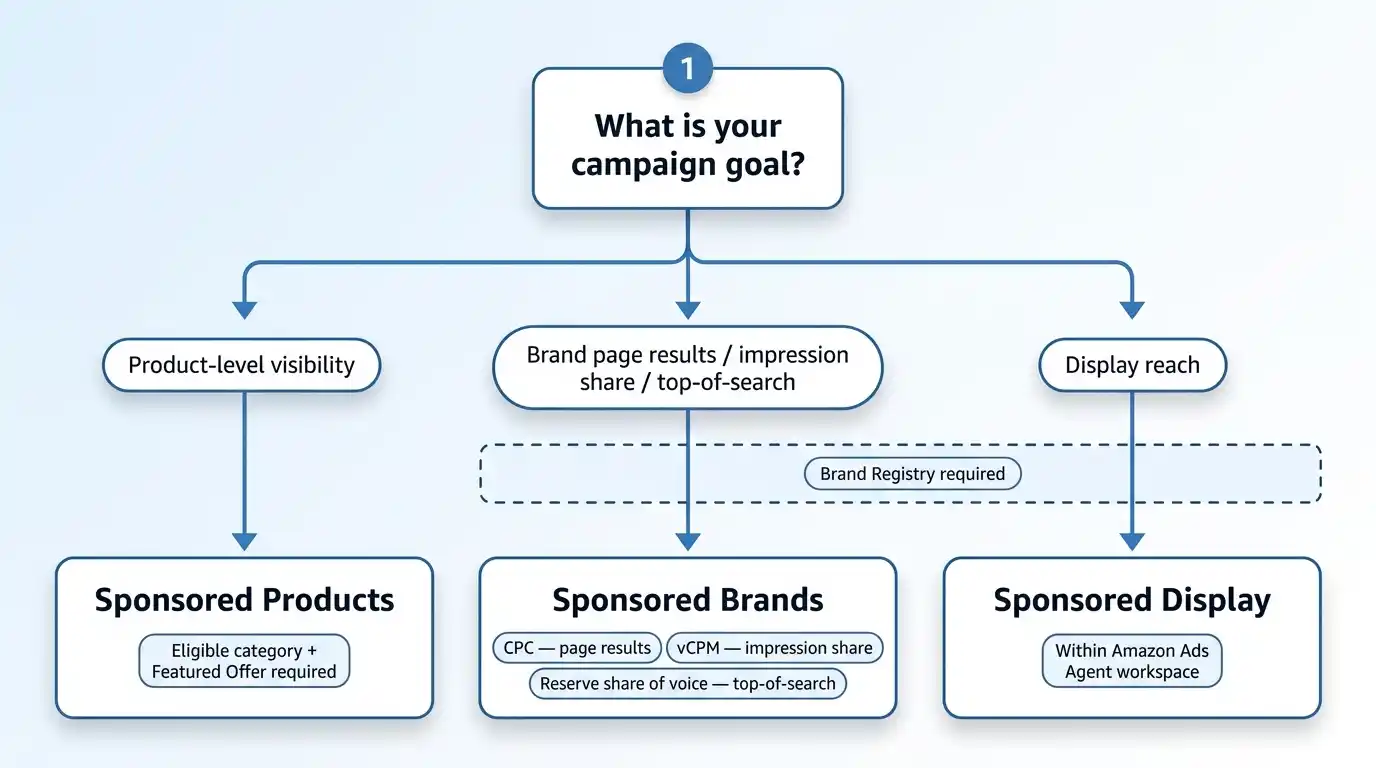
Match the tool to the outcome you want, then check whether you clear its gate. Product-level visibility in search and detail pages points to Sponsored Products, provided your account type qualifies, your products sit in eligible categories, and they hold the Featured Offer. Brand-level outcomes such as page visits, impression share, or the top-of-search slot on your branded keywords point to Sponsored Brands, and you’ll need Brand Registry first. Display reach points to Sponsored Display, now part of the unified Amazon Ads Agent workspace. Inside Sponsored Brands, the pricing model should follow the goal too: CPC for page results, vCPM for impression share, reserve share of voice for top-of-search.
The Three Sponsored Ad Types at a Glance
The fastest way to understand the difference is to look at what each type is built to do and who can actually run it. The access column is where most advertisers get surprised.
| Ad type | Who can use it | Primary goal | Pricing models |
|---|---|---|---|
| Sponsored Products | Professional sellers, vendors, book vendors, KDP authors, agencies | Product-level visibility in search and detail pages | Not specified on the product page |
| Sponsored Brands | Brands with Brand Registry access to brand-building tools | Page results, brand impression share, or top-of-search placement | CPC, vCPM, reserve share of voice |
| Sponsored Display | Advertisers within the Amazon Ads Agent workspace | Display reach across Amazon’s wider display offering | Not specified on the product page |
What the table doesn’t do is rank the three, and it shouldn’t. Amazon’s own product pages describe eligibility, pricing structure, and positioning, not comparative performance. Anyone telling you one type “outperforms” the others is selling something.
Sponsored Products: Who It’s For and Eligibility
Sponsored Products is the broadest-access entry point, and for most sellers it’s the natural first campaign. According to Amazon’s Sponsored Products page, Sponsored Products are available for professional sellers, vendors, book vendors, Kindle Direct Publishing (KDP) authors, and agencies. That’s a wide net, and it covers self-published authors alongside enterprise vendors.
The net has two holes in it, though, and both are hard requirements rather than preferences. The same page states that products must be in one or more eligible categories and be eligible for the Featured Offer in order to advertise.
Prerequisites
- You hold an eligible account type: professional seller, vendor, book vendor, KDP author, or agency.
- The product sits in one or more eligible categories.
- The product is eligible for the Featured Offer, the buy-box condition Amazon requires before you can advertise it.
That Featured Offer condition is the one that trips people up. It means Sponsored Products never guarantees placement on its own; the product has to clear Amazon’s own eligibility bar first. If a listing suddenly can’t be advertised, check the offer eligibility before you touch bids.
Sponsored Brands: Pricing Models and When to Use Each
Sponsored Brands is where Amazon gets useful about matching cost structure to intent. Instead of one billing model, the Sponsored Brands page lays out three, each tied to a stated campaign goal.
| Pricing model | Stated goal | Minimum spend | Bid and pause flexibility |
|---|---|---|---|
| Cost-per-click (CPC) | Driving page results | None | Adjust bids or pause at any time |
| Cost per 1,000 viewable impressions (vCPM) | Growing brand impression share | None | Adjust bids or pause at any time |
| Reserve share of voice | Securing the top-of-search placement for branded keywords | Minimum spend commitment required | Fixed, upfront pricing |
The flexibility split matters more than it looks. The same page confirms there’s no minimum spend for CPC or vCPM campaigns, and you can adjust bids or pause campaigns at any time. Reserve share of voice is the exception: it requires a minimum spend commitment, because you’re buying a fixed, upfront position rather than bidding into an auction.
So treat reserve share of voice as a commitment, not a trial. It’s the right tool when holding the top-of-search slot on your own branded keywords is the whole point, and the wrong tool when you’re still testing whether brand campaigns work for you. Start with CPC if you want page traffic, vCPM if you want presence, and reserve share of voice only once you know the branded keyword set is worth defending.
Sponsored Display: What It Is Now
Sponsored Display has changed shape, and the change is structural rather than cosmetic. Per Amazon’s Sponsored Display page, it is now part of Amazon’s wider display ads offering within Amazon Ads Agent, a platform that unifies access to all Amazon Ads products, bringing sponsored ads and Amazon DSP workflows together into a single workspace.
Amazon frames the shift as simplicity without loss: the new direction is meant to deliver a simpler experience while preserving the advertising features advertisers already rely on. For you, the practical takeaway is about where you work, not what you buy. Display campaigns and sponsored campaigns increasingly live in the same operational home, which changes how you plan and measure across them. It does not, on the evidence Amazon publishes, mean Sponsored Display has picked up a new feature set. Don’t assume capabilities the page doesn’t state.
Brand Registry: The Prerequisite for Brand-Level Ads
Here’s the gate that separates the two halves of this article. Amazon Brand Registry is the gateway to a suite of brand-building tools and protection benefits, and Amazon explicitly lists “access exclusive advertising opportunities” among what enrollment unlocks. If you want the brand-level side of Amazon advertising, this is the door.
Enrollment isn’t a formality. The requirements on Amazon Brand Services are specific, and Amazon states them plainly:
- You must have an active, registered trademark or a pending trademark application for your brand name or logo, issued by the designated government trademark office of a country with a corresponding Amazon store. In some cases, Amazon notes, you may enroll with a pending trademark registration.
- You must have a logo that includes your brand name permanently affixed to your products or packaging.
- During enrollment you must supply a standalone image of your logo plus an image showing the logo on your products or packaging.
- You must be the trademark owner. If you’re an authorized agent, the trademark owner enrolls the brand and then adds you as an additional Brand Registry account user.
The trademark must be a text-based word mark or an image-based design mark containing words, letters, or numbers, and the trademark text must match the brand name on your application. Amazon also advertises a 10% back on branded sales offer alongside enrollment, so check the current terms on the same Brand Services page rather than taking a blog’s word for it.
If you’re still building the brand side of your business, the broader patterns in these winning marketing strategies by popular brands are a useful frame for what Brand Registry is really protecting: a consistent, defensible identity across every touchpoint.
Choosing the Right Ad Type for Your Goal
Work backwards from the outcome. Each rule below maps a stated goal to the ad type Amazon associates with it.
- Goal: individual products appearing in front of shoppers. Choose Sponsored Products, provided your account type qualifies, the product is in an eligible category, and it holds Featured Offer eligibility.
- Goal: driving page results. Choose Sponsored Brands on CPC. No minimum spend, and you can adjust bids or pause whenever you like.
- Goal: growing brand impression share. Choose Sponsored Brands on vCPM. Same flexibility: no minimum spend, full bid and pause control.
- Goal: owning the top-of-search placement for your branded keywords. Choose Sponsored Brands reserve share of voice, and budget for the minimum spend commitment it requires.
- Goal: display reach. Choose Sponsored Display within the Amazon Ads Agent workspace, where sponsored ads and DSP workflows now sit together.
- Goal: any brand-level campaign at all. Confirm Brand Registry enrollment first. Without it, the brand-level options aren’t on the table.
Compliance Note: Honest Claims and Disclosures
Advertising rules apply to Amazon campaigns exactly as they apply everywhere else, and the Federal Trade Commission is direct about the standard. The FTC’s Endorsement Guides guidance states that endorsements must be honest and not misleading, that an endorsement must reflect the endorser’s honest opinion, and that it can’t be used to make a claim the marketer couldn’t legally make itself.
The disclosure rule is the one most advertisers miss. If there’s a connection between an endorser and the marketer that a significant minority of consumers wouldn’t expect, and it would affect how they evaluate the endorsement, that connection must be disclosed clearly and conspicuously. A relative or employee in your ad, or someone paid or given something of value to tout the product, changes how shoppers weigh the message. Say so.
Warning
Don’t let a strong campaign push you into a weak claim. Any review, testimonial, or creator content you amplify through Amazon ads must be honest, must not overstate what the product does, and must disclose material connections clearly and conspicuously. A misleading claim in a high-reach campaign is a bigger problem than a modest one in a quiet listing.
Next Steps
Start with the gate, then the goal. Confirm your account type and Featured Offer eligibility if Sponsored Products is your target; confirm Brand Registry enrollment if any brand-level campaign is on your roadmap. Then pick the pricing model that matches the outcome you actually want, and treat reserve share of voice as the commitment it is.
Once campaigns are live, the work shifts to reading results properly. A structured data analysis process will serve you better than reacting to single-day swings, and it’s the difference between adjusting bids on evidence and adjusting them on nerves.
Key Takeaways
- Sponsored Products is the widest-access type, but only for qualifying account types, eligible categories, and products that hold Featured Offer eligibility.
- Sponsored Brands pricing should follow the goal: CPC for page results, vCPM for impression share, reserve share of voice for top-of-search, and only the last one carries a minimum spend commitment.
- Sponsored Display now sits inside Amazon’s wider display offering within Amazon Ads Agent, unifying sponsored ads and DSP workflows.
- Brand Registry is the real dividing line for brand-level advertising, and it requires a registered or pending trademark, a logo affixed to product or packaging, and trademark ownership.
- Claims and endorsements in any campaign must be honest, non-misleading, and disclose material connections clearly and conspicuously.
The three sponsored ad types reward a goal-first approach. Decide what you’re trying to achieve, check whether you clear the eligibility gate for the tool that delivers it, and choose the pricing model that matches the outcome. Sponsored Products gets your products seen, Sponsored Brands builds the brand with a cost structure you can match to intent, and Sponsored Display now reaches shoppers from inside a unified workspace. Get the gate and the goal right, and the rest of the campaign setup follows.

💬 Comments