If you only need to divide a PDF into page ranges, several browser tools can handle the job. If you work with confidential files, large bookmarked documents, or repeated split jobs, processing location and the available split modes matter more than having the simplest interface.
Splitting creates two or more PDF files from one source document. That is different from extracting pages, which creates a new PDF from selected pages while leaving the rest of the source outside the new file. The seven tools below cover browser-based, desktop, basic, and more structured splitting workflows without assuming that one option is best for every use case.
How the tools were compared
This comparison is based on current product documentation rather than hands-on speed or output-quality testing. The main criteria are where the document is processed, which splitting methods are available, what restrictions affect free use, which platforms are supported, and whether a tool solves a meaningfully different workflow.
For example, dividing a 20-page handout after page 10 is a simple page-range job. Splitting a 500-page technical manual at chapter bookmarks or keeping a confidential contract off third-party servers requires a different set of capabilities.
The terminology matters too. splitting, extracting, and deleting PDF pages can produce similar-looking results, but they change the document in different ways.
Published deletion periods and security statements are treated as provider policies, not as independent proof that one online service is safer than another. No tool is ranked by speed, reliability, privacy, or output quality because no controlled comparative testing was supplied for those claims.
Quick comparison of the 7 PDF splitter tools
The biggest practical differences are processing location and how much control you have over the split. The table gives the scan-level facts; the sections below explain when those differences actually affect your choice.
| Tool | Processing | Notable split modes | Free or access constraint | Useful fit |
|---|---|---|---|---|
| PDF24 Tools | Remote server online; local with PDF24 Creator on Windows | Page-based splitting through its PDF tools | Online tools are published as free without artificial usage limits | Frequent general use, especially if Windows users also want an offline option |
| PDFsam Basic | Local desktop | Page numbers, every N pages, bookmarks, target file size | Free and open source; requires a desktop installation | Local processing and structured split jobs |
| Sejda | Remote server online; desktop option available | Ranges, every page, bookmarks, file size, text-based splitting | 200 pages or 50 MB and 3 free tasks per hour for its standard online splitter | Advanced browser splitting within defined free limits |
| Adobe Acrobat | Adobe cloud online; desktop application available | Web divider lines; desktop page-count, file-size, and bookmark splitting | Online Split PDF supports up to 1 GB, 1,500 pages, and 19 output files; free transactions are limited | Adobe users who need either a familiar web workflow or richer desktop controls |
| iLovePDF | Remote server online | Custom and fixed ranges, selected-page extraction, size splitting | Basic includes Split PDF with limited document processing | People already using a broader browser-based PDF toolkit |
| Smallpdf | Remote server online | Page extraction and manual document splitting | Free Split use is subject to a daily download limit | Cross-device browser workflows and occasional splitting |
| 2PDF | Cloud-based online processing | Manual break points between pages | Provider offers the splitter as a free web tool; a comparable numerical usage allowance is not clearly published | Basic visual page-break splitting |
PDF24 Tools
If you split PDFs often but do not want a subscription-style usage model, PDF24 is one of the broader free options in this group. Its online tools run in a browser and process uploaded files on PDF24 servers, while the provider says the service has no artificial usage restrictions.
Windows users have a materially different option in the same ecosystem. PDF24 Creator works offline and keeps files on the PC, while also providing split, merge, extract, reorder, rotate, and other page-management functions. Creator is Windows-only, so macOS and Linux users who want local processing need another tool.
The web and desktop versions should not be treated as equivalent from a document-handling perspective. A routine worksheet may be fine for a web workflow, while a contract or personnel file may justify keeping the job entirely on the computer.
PDFsam Basic
Keeping the source document on your own computer is the main reason to consider PDFsam Basic. The free, open-source application runs on Windows, macOS, and Linux and processes PDFs locally rather than requiring an upload to a web service.
Its splitting controls also go beyond selecting a few visual break points. You can split at specified page numbers, every N pages, bookmark levels, or a target file size. Bookmark splitting is useful when a long PDF already has navigation entries for chapters or sections because those bookmarks can become the boundaries for separate files.
For especially sensitive documents, splitting a PDF without uploading it reduces the number of third-party systems involved in the workflow. That does not remove the need to protect the computer, backups, and resulting files, but it changes where document processing occurs.
Practitioners handling large manuals or submission limits may also benefit from splitting a PDF by file size or bookmarks instead of manually selecting page ranges for every job.
Sejda
Sejda becomes more interesting when ordinary page ranges are not enough. Its browser tools cover conventional page splitting along with bookmark-based chapter splitting and splitting toward a specified file size.
The trade-off is its clearly defined free allowance. The standard online splitter is limited to documents up to 200 pages or 50 MB and 3 tasks per hour. Those limits are easy to understand before starting a job, but they make the free service less suitable for repeated high-volume work.
Sejda says uploaded files are automatically deleted after two hours. It also offers Sejda Desktop for people who would rather work offline. The deletion period is useful policy information, but it should not be interpreted as an independent security audit.
Adobe Acrobat
Adobe offers two substantially different splitting workflows. In Acrobat on the web, you upload a PDF, then place divider lines between page thumbnails before saving the resulting PDFs to Adobe cloud storage.
The web tool supports larger source documents than many lightweight browser services. Adobe states that Split PDF accepts a PDF up to 1 GB and 1,500 pages and can create up to 19 files. Adobe also applies free-transaction restrictions, so access should be checked before treating the browser tool as an unlimited recurring workflow.
Desktop Acrobat is more structured. It can split by maximum page count, maximum file size, or top-level bookmarks, and it can apply the operation to multiple PDFs. That makes the desktop workflow more relevant when document structure or repeatable output rules matter more than simple visual page breaks.
iLovePDF
If splitting is only one task in a larger sequence of browser-based PDF work, iLovePDF keeps it inside the same general toolkit as merging, compression, conversion, page organization, and other document functions.
The splitter supports custom or fixed page ranges and selected-page extraction. Its interface also lists size-based splitting as a Premium function, so the exact mode available to you depends on the service tier.
The free Basic plan includes Split PDF, but document processing is limited. That makes the service more straightforward for occasional jobs than for assuming unrestricted repeated splitting.
Smallpdf
Smallpdf is most relevant when you want the same browser-oriented workflow across several types of device. Its splitter runs across desktop and mobile platforms and can separate or extract selected pages without requiring a desktop installation.
Free use is not unlimited. Smallpdf’s plan comparison lists a daily download limit for Split, so repeated jobs can eventually require waiting or moving to a paid plan.
Smallpdf states that files processed through the splitter are protected during transfer and automatically deleted after one hour. As with other online services, that is the provider’s published handling policy rather than independent verification of its infrastructure.
2PDF
For a basic visual split, 2PDF uses a simpler model than tools built around bookmarks or target file sizes. Its current splitter asks you to place dotted break lines where the PDF should be divided, then generates separate output files.
If that manual workflow matches the job, the 2PDF split PDF tool provides the direct split interface. It is a less structured choice for documents where chapter bookmarks, repeatable every-N-page rules, or precise target file sizes are the deciding requirement.
Which PDF splitter fits your workflow?
PDFsam Basic
Avoid this if: you want a no-install browser workflow.
Main trade-off: local control in exchange for installing desktop software.
PDF24 Tools
Avoid this if: you need its offline Creator application on macOS or Linux.
Main trade-off: the web version uses remote processing, while local Creator is Windows-only.
Sejda
Avoid this if: you regularly exceed 200 pages, 50 MB, or 3 free tasks per hour.
Main trade-off: richer browser controls with relatively explicit free-use ceilings.
Adobe Acrobat
Avoid this if: you expect unrestricted recurring use from the free web tool.
Main trade-off: strong integration and desktop controls with account and plan considerations.
iLovePDF
Avoid this if: your required split mode falls behind a paid tier or you need unrestricted free processing.
Main trade-off: broad tool-suite convenience with tier-dependent processing limits.
Smallpdf
Avoid this if: you need repeated free downloads throughout the day.
Main trade-off: cross-device convenience with a daily free-use restriction.
2PDF
Avoid this if: you need bookmark-driven, target-size, or other structured split rules.
Main trade-off: a simple manual workflow with fewer documented advanced splitting controls.
If you later need to put separated files back together, compare PDF merger tools by processing location, free limits, and page controls rather than treating every browser service as equivalent.
What to know before uploading sensitive PDFs
An online splitter usually sends the document to a provider’s infrastructure for processing. A local desktop tool processes it on your own computer instead. That difference becomes more important when a PDF contains contracts, personnel records, financial information, identity documents, unpublished business material, or other information your organization restricts from third-party services.
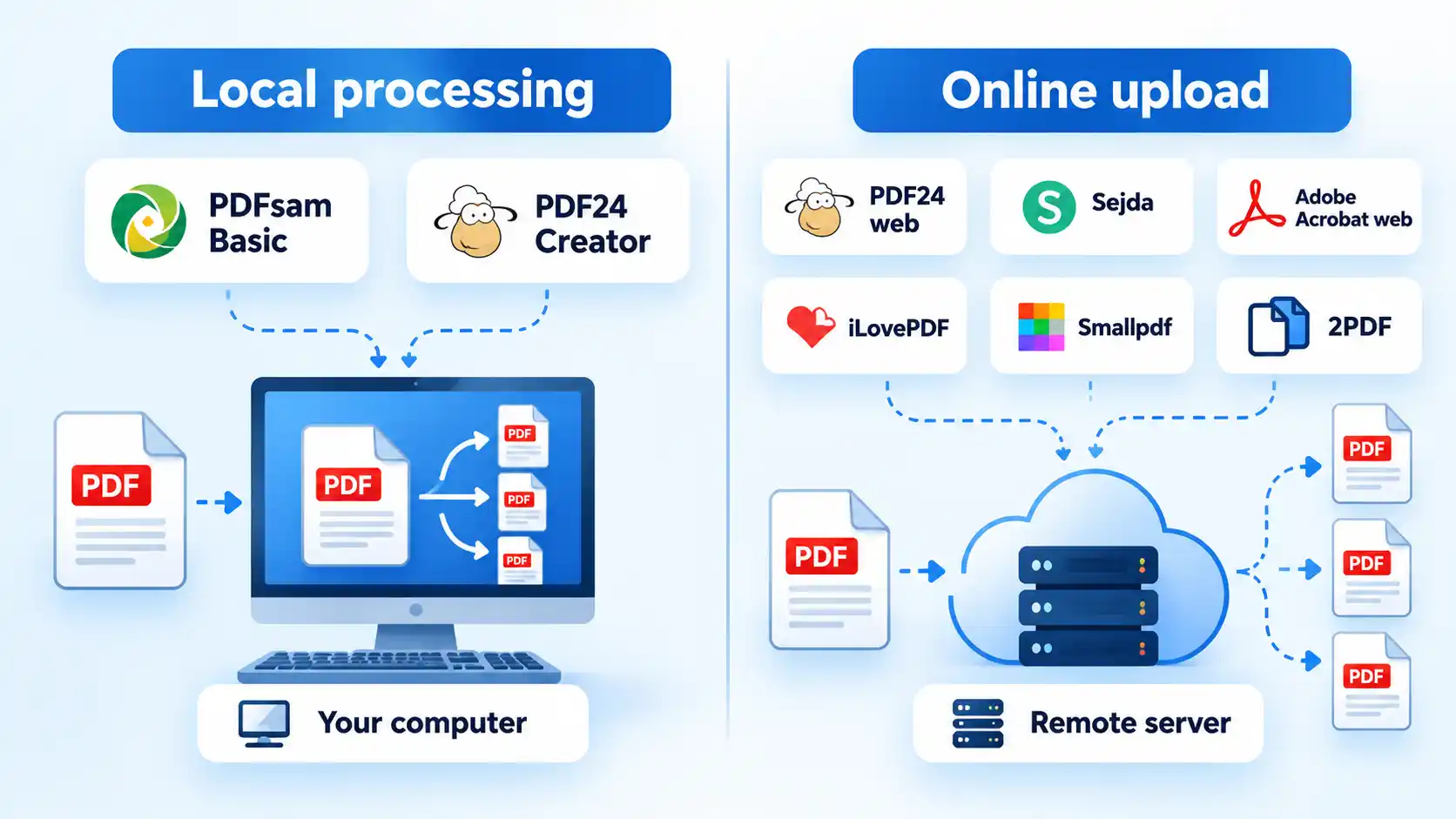
Provider deletion periods can still help you compare online workflows. Sejda states that online files are deleted after two hours, while Smallpdf states that its splitter deletes files after one hour. PDF24 says online files are removed after a short period and points privacy-sensitive Windows users toward Creator, where documents remain on the PC.
Those statements describe each company’s published handling policy. They do not establish that one service is independently more secure than another. For a sensitive file, first check whether uploading it is permitted at all. If local processing satisfies the task, it avoids sending the source document to a remote PDF processor.
Whichever tool you use, keep the original PDF until you have checked the split files for missing pages, wrong break points, lost bookmarks, unexpected naming, or sections placed in the wrong output document. The right splitter is the one whose processing model and controls match the document you actually have, not the one with the longest feature list.

💬 Comments