To build a taxi booking app like Uber, you need more than a rider-facing mobile app. A working service normally combines rider and driver experiences with a backend that manages trips, location data, matching, payments, notifications, and administrative controls.
The safest way to approach the project is to define one complete ride from request to payment, build the smallest version that can complete that ride reliably, and test the failures that could leave a passenger, driver, trip, or payment in the wrong state.
How a Taxi Booking App Works
Start with an ordinary ride. A passenger enters a destination, confirms the pickup point, sees the available ride information, and requests a car. A driver receives the request, accepts it, travels to the pickup point, completes the trip, and the system settles the payment or records the chosen payment method.
A service such as Uber also lets riders follow a driver’s arrival on a map and rate a completed trip. Its current rider flow shows that the exact payment options and some features can vary by location, so an Uber-like app should not assume that every market needs the same payment or ride options. Uber’s current rider flow illustrates these stages from destination entry through tracking, payment, and rating.
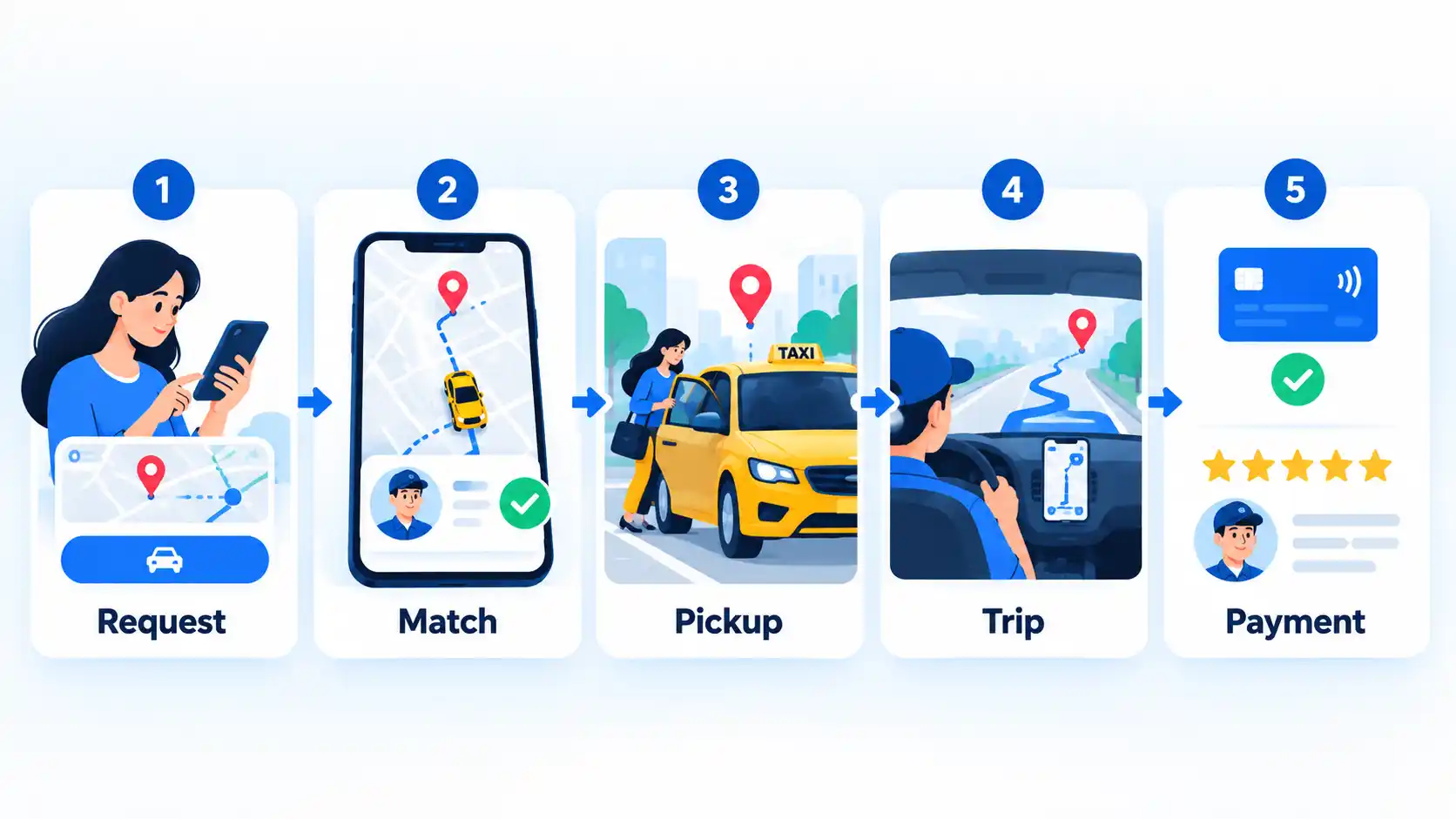
Behind those screens, the service needs a trusted record of what is happening to each trip. For example, the backend should know whether a ride is requested, assigned, accepted, in progress, completed, or cancelled. The rider’s phone and driver’s phone then display the appropriate state instead of each device deciding independently what happened.
That separation matters when something goes wrong. If a passenger loses internet access after tapping the request button, the app should be able to reconnect and discover whether a trip was actually created instead of creating a second ride. Likewise, a driver cancellation should update the central trip state before another driver is assigned.
Live location is another part of the same system. Google’s on-demand journey tooling, for example, separates the consumer experience from backend trip management and vehicle assignment while allowing a rider to follow vehicle location, route progress, and estimated arrival time. The important lesson is not that you must use Google’s implementation. It is that live journey sharing depends on backend-managed trip data, not only a moving marker on a map.
Before You Build: Define the Service and MVP
Technology choices should come after you decide what service you are actually building. A one-city taxi platform using a fixed fare model has different needs from a multi-city marketplace with several vehicle types, scheduled bookings, driver bidding, promotions, subscriptions, and fleet operators.
If the software is part of a new operation rather than an existing fleet, the work required to start a taxi business also includes decisions about the operating model, vehicles, driver requirements, and local rules.
Prerequisites
- Choose the first city, country, or operating area because payment methods, mapping coverage, driver requirements, taxes, and transport rules can vary by location.
- Decide whether drivers are independent providers, fleet employees, or part of another operating model so onboarding, payouts, administration, and permissions can be designed around the real service.
- Define how the first version sets fares, such as a fixed calculation based on time and distance, rather than leaving pricing logic until development is underway.
- Confirm which payment methods the launch market needs and whether the platform must collect money and later pay drivers or fleets.
- Write the complete first-release ride flow, including what should happen when no driver is available, a trip is cancelled, a payment fails, or location access is unavailable.
The first release should be a minimum viable product, or MVP, but “minimum” should not mean incomplete. For a basic taxi service, the MVP should still be able to create a rider account, identify pickup and destination, request a trip, assign or offer it to a driver, show the important trip states, complete the ride, handle the chosen payment flow, and preserve an administrative record of what happened.
Features such as loyalty rewards, subscriptions, scheduled rides, complex promotions, corporate accounts, several vehicle categories, and advanced driver incentives can usually wait if they are not necessary for the first operating model. Cutting those extras reduces scope without breaking the main ride loop.
How to Build a Taxi Booking App Like Uber
Build the service in an order that settles product decisions before expensive implementation work. Each stage should leave you with something concrete that can be reviewed before the next stage begins.
- 1. Define the market and operating model. Choose the first launch area, who supplies the vehicles, how drivers join the service, how fares are determined, and how riders pay. Record any transport, insurance, tax, privacy, or employment questions that need qualified local advice before launch. Do not treat an app-store approval as permission to operate a transport business in a particular jurisdiction.
- 2. Write the complete ride workflow. Describe what should happen from account creation and trip request through driver assignment, pickup, trip start, completion, payment, receipt, and rating. Add branches for no driver available, driver decline, cancellation, failed payment, lost connectivity, and denied location access. This document becomes a practical reference for design, development, and testing.
- 3. Cut the first release to a complete MVP. Keep every capability needed to finish the basic ride workflow and move nonessential expansion features to a later release. At the end of this step, you should be able to explain exactly what a rider, driver, and administrator can do in version one.
- 4. Assign responsibilities to the rider app, driver app, admin tools, and backend. Decide which actions happen on each screen and which decisions must be made by the server. The backend should remain the trusted source for important records such as trip ownership, trip status, payment state, and permissions instead of relying on a rider’s or driver’s device alone.
- 5. Select the supporting services. Choose mapping and routing, payment processing, notifications, identity or authentication, hosting, storage, and monitoring based on the launch requirements. Compare availability, pricing, geographic support, platform support, security responsibilities, and the work required to replace a service later. For routing, an application programming interface, or API, can calculate routes and travel-time estimates using inputs such as stops and traffic-aware options.
- 6. Design data, permissions, security, and recovery rules. Specify what data is stored, who may read or change it, which location permissions are genuinely required, how sessions are authenticated, and what happens when an external service fails. Include rules for retries so a repeated request does not create duplicate rides, charges, or payouts.
- 7. Prototype and build the working ride loop. Build the smallest end-to-end path before polishing secondary features. A useful milestone is a test rider requesting a ride, a test driver accepting it, both sides seeing the correct trip state, the ride reaching completion, and the backend recording the final result. Replace temporary test integrations with production-ready configurations only after the basic workflow is stable.
- 8. Test normal and failure paths. Test the expected ride first, then deliberately interrupt it. Turn off connectivity, deny permissions, cancel from both sides, reject payments in the provider’s test environment, delay notifications, and retry requests. Confirm that the system either recovers safely or gives the user a clear next action.
- 9. Prepare operations and store submissions. Complete the required privacy information, permission explanations, screenshots, support details, production credentials, monitoring, incident contacts, and store-specific declarations. Review the actual Apple App Store and Google Play requirements that apply to the permissions and data used by the finished build rather than assuming development completion guarantees publication.
- 10. Launch narrowly and improve from real operating data. Begin with a controlled operating area or user group when possible. Watch failed requests, driver availability, cancellation patterns, payment errors, location problems, support cases, and service outages. Expand only after the core workflow is reliable enough that adding more users or locations will not magnify unresolved failures.
Core Features for Rider, Driver, and Admin
The rider, driver, and operations sides of the service have different jobs. Separating them prevents a long feature list from hiding which user actually needs each capability.
| Role | Core job | MVP capabilities | Possible later additions |
|---|---|---|---|
| Rider | Request, follow, pay for, and review a trip. | Account access, pickup and destination, fare or price information, ride request, driver details, trip tracking, payment flow, receipt, cancellation, and rating. | Scheduled rides, loyalty rewards, referrals, subscriptions, multiple stops, corporate profiles, and advanced ride preferences. |
| Driver | Receive, accept, navigate, and complete assigned trips. | Driver identity and availability status, trip offers, accept or decline controls, pickup and destination information, navigation handoff or routing, trip-state controls, cancellation handling, and trip or earnings history. | Demand maps, incentive programs, advanced earnings analysis, preferred areas, and additional driver services. |
| Admin and operations | Keep riders, drivers, trips, payments, and support work under control. | User and driver records, trip search and status, fare rules, payment visibility, cancellations, dispute or support records, account controls, and operational monitoring. | Advanced analytics, automated risk rules, campaign tools, fleet dashboards, and more complex pricing controls. |
A feature belongs in the MVP when removing it prevents the first version from completing or safely managing its intended ride workflow. That test is more useful than copying every feature available in a mature platform.
Architecture and Technology Choices
Architecture describes how the parts of the service divide responsibility and exchange information. A framework such as Flutter or React Native can help build mobile interfaces, but choosing a framework does not by itself decide where trip state lives, how a driver is matched, how payments are reconciled, or how failures are recovered.
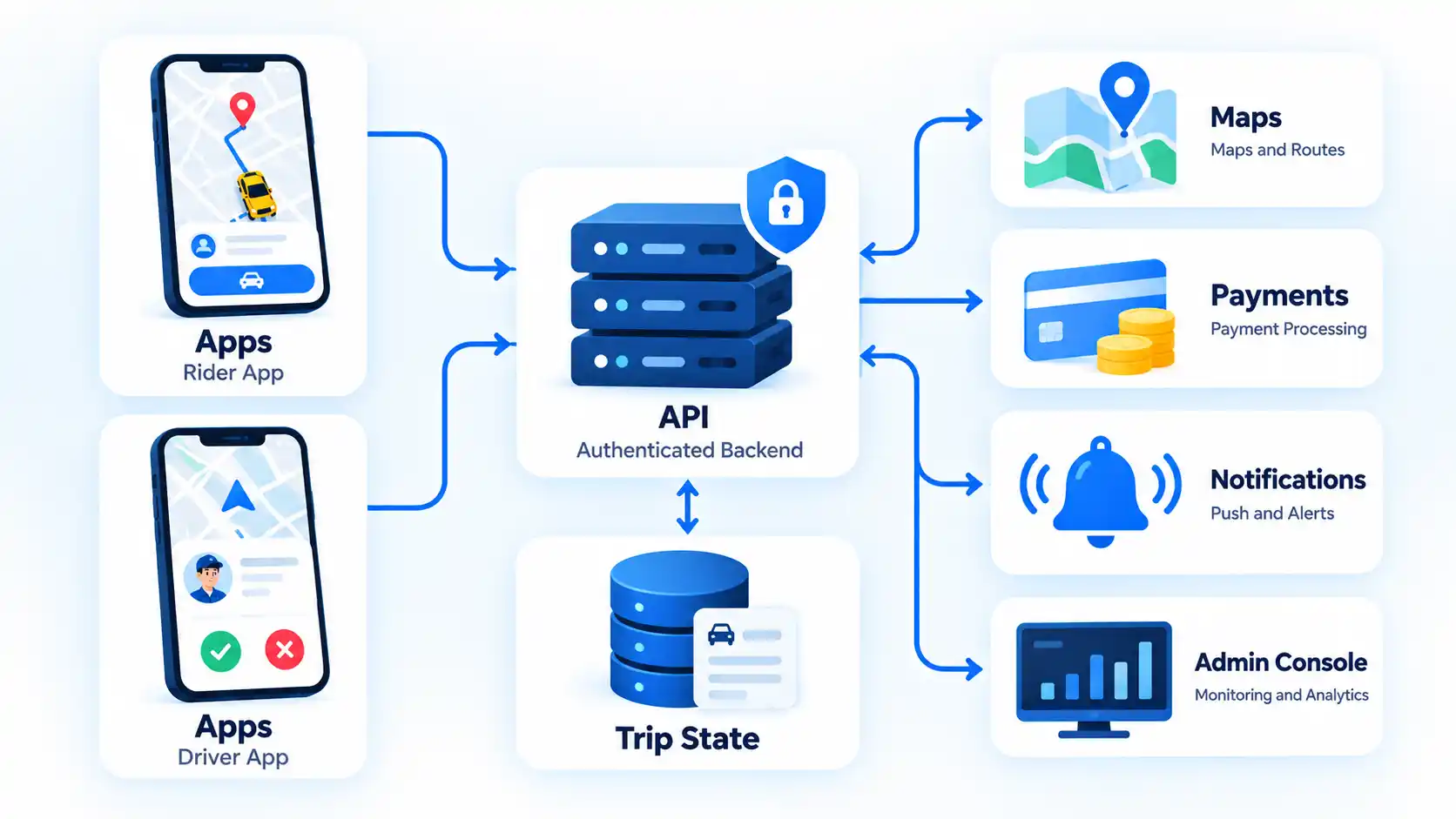
A beginner-friendly architecture can be understood as several responsibilities:
- Rider client: collects rider actions and displays current trip information.
- Driver client: manages driver availability, trip offers, navigation information, and trip-status actions.
- Admin or operations interface: lets authorized staff review drivers, trips, payments, support cases, and service problems.
- Backend and API: receive requests from the apps, enforce permissions, apply business rules, and coordinate other services. An API is simply a controlled way for software systems to send requests and data to each other.
- Trip state and data storage: keep the authoritative record of who owns a trip, its current stage, timestamps, fare information, and other records needed by the service.
- Location and routing: translate pickup and destination points into routes, travel estimates, driver positions, and map information.
- Matching or dispatch: determine which eligible driver or group of drivers should receive a request according to the service’s operating rules.
- Payments: authorize or record rider payments and, where the business model requires it, manage money owed to drivers or fleets.
- Notifications: alert riders and drivers about events such as a new request, driver arrival, cancellation, or completed trip.
- Monitoring: record errors and service health so the team can tell when trips, payments, notifications, or integrations stop working as intended.
For push notifications, the mobile device is not normally the only participant. A service such as Firebase Cloud Messaging accepts message requests from a trusted server environment and routes them to registered app instances. That means server-side notification delivery needs its own credentials and device-registration handling. A notification should therefore support the trip state rather than become the only record that a trip event happened.
Real-time information also does not mean every screen must update continuously. Update frequency should match the job. A driver’s moving position may need frequent updates during an active pickup or trip, while a profile photo or vehicle record can be much less time-sensitive.
Payments, Location, Privacy, and Security
Taxi apps handle more sensitive information than an ordinary content app. They may process identities, precise or near-precise locations, trip histories, contact details, payment records, and information about drivers’ work. Those responsibilities should influence the design before release, not after a privacy or security problem appears.
For payments, first decide whether the platform only collects a passenger’s payment or also needs to move money to drivers or fleet operators. Marketplace payment systems can require separate provider accounts and additional onboarding or verification. Stripe Connect, for example, supports connected accounts, verification, charges, balances, and payouts. The exact responsibilities still depend on the provider, account configuration, industry, and country, so verify the requirements for the launch market before fixing the payment architecture.
Location permissions need similar restraint. On iOS, location access must be directly tied to an app feature. The app must also tell users why it needs location data and obtain consent before gathering or using it.
On Android, foreground and background location are different policy cases. Google Play requires apps to request the minimum location scope necessary, and background access is subject to additional justification and a declaration process. If a feature works while the app is visible, requesting broader background access can create avoidable review problems.
A taxi service may have a legitimate need to keep updating a driver’s position during an active job, but that does not justify collecting every user’s location all the time. Define when tracking starts, what event stops it, who can see the data, and how long the service needs to retain it.
Security should also be divided into concrete jobs. The OWASP Mobile Application Security Verification Standard separates concerns such as secure storage, authentication and authorization, network communication, platform interaction, and privacy. For a taxi app, this translates into practical checks such as preventing one rider from reading another rider’s trip, preventing a driver from changing a trip they do not own, keeping sensitive records out of unsafe logs, protecting network traffic, and reviewing what third-party software development kits can access.
Do not treat a successful login as proof that every action is authorized. The backend should check whether the signed-in account is actually permitted to read or modify the requested trip, payment, driver record, or administrative action.
How Much Does a Taxi Booking App Cost?
There is no reliable universal price for building an app like Uber because the phrase can describe very different projects. A prototype with basic rider and driver screens is not comparable with a production service that includes real-time dispatch, driver onboarding, marketplace payments, background location, support tooling, monitoring, several cities, and ongoing operations.
When comparing quotes, ask each vendor to break the taxi booking app development cost into platforms, feature scope, integrations, testing, infrastructure, and maintenance instead of giving you only one headline total.
A useful estimate should make the following cost drivers visible:
- Supported platforms: iOS, Android, web administration, and any separate driver or fleet interfaces.
- Product scope: the number of rider, driver, operations, payment, pricing, safety, support, and reporting capabilities.
- Location and routing: mapping, geocoding, route calculations, driver tracking, estimated arrival times, and the usage charges of the chosen provider.
- Payments and payouts: rider payment methods, refunds, disputes, driver or fleet payouts, identity checks, and regional provider availability.
- Backend complexity: trip state, matching rules, fare rules, retries, permissions, integrations, and administrative actions.
- Design: research, user flows, prototypes, accessibility work, and the number of distinct screens and states.
- Security and privacy: threat review, permission design, authentication, authorization, secure storage, testing, and any specialist compliance work required for the operating region.
- Quality assurance: devices, operating-system versions, weak-network testing, location scenarios, payment-provider test cases, store-review preparation, and regression testing.
- Infrastructure and third-party services: hosting, databases, maps, notifications, communications, monitoring, support tools, and other usage-based services.
- Maintenance: operating-system changes, security updates, provider API changes, bug fixes, support, monitoring, and new product requirements after launch.
Ask every team quoting the project to estimate the same written scope. If one quote includes a production backend, driver app, payment integration, security work, store submission, and post-launch support while another covers only mobile interfaces, comparing the totals tells you very little.
Also separate one-time development work from recurring operating costs. Map requests, cloud resources, payment fees, messaging, monitoring, identity services, customer support, and maintenance can continue after the first version is published.
How Taxi Booking Apps Make Money
The revenue model should follow the service’s actual role in a ride. A platform might keep a fee or commission from completed trips, charge drivers or fleets a subscription or service fee, apply permitted cancellation charges, sell business-account services, or use other models that fit its market and contracts.
Fare calculation and company revenue are related but not identical. A fare tells the rider what a trip costs. The platform’s revenue model determines what part of that amount, if any, the business retains and what is owed to drivers, fleets, payment providers, governments, or other parties.
Uber says its U.S. upfront prices use estimated trip length and duration and can vary with demand patterns and real-world conditions such as traffic. It also warns that pricing information may not apply in every country, region, or city. That is a useful example of why an upfront fare can depend on trip and market conditions, but another taxi platform should define its own fare rules for its operating model and location.
Dynamic pricing, where prices change in response to conditions such as supply or demand, is a pricing mechanism rather than automatic proof of higher profit. Before using it, decide what inputs are allowed, what limits apply, how the rider sees the resulting price, and whether local transport or consumer rules restrict how fares may change.
The administrative system should preserve enough information to explain how a fare, fee, refund, cancellation amount, or driver payment was produced. That becomes especially important when a rider or driver disputes the result.
What to Test Before Launch
A taxi app is not ready simply because the normal demo works. Release testing should prove that the service reaches a safe, unambiguous result when common failures interrupt the ride workflow.
Use payment-provider test or sandbox environments for failure scenarios instead of deliberately creating real charges. Test location and network problems separately as well. Turning off location permission is different from losing internet access, and both are different from receiving a stale or inaccurate position.
Verify the result
- A rider can request one ride and the backend creates only one active trip even if the request is retried after a timeout.
- An eligible driver can receive and accept a request, and another driver cannot take control of the same trip after it has been assigned.
- When a driver declines or cancels, the rider sees the correct state and the service either searches again or ends the request according to the defined rule.
- When a rider cancels, the driver’s app, rider’s app, backend, and any applicable payment state agree that the trip is cancelled.
- Denied foreground or background location permission produces the intended explanation or reduced functionality rather than an unexplained broken screen.
- If a driver’s position becomes stale or unavailable, the rider is not shown misleading live-tracking information as though it were current.
- If routing or estimated-arrival data fails, the ride remains recoverable and the failure does not silently change the trip into an invalid state.
- A temporary loss of network connectivity can recover without creating duplicate trips, duplicate completion events, or contradictory trip states.
- Delayed or missing push notifications do not become the only record of a trip change; reopening or refreshing the app retrieves the authoritative current state.
- A declined or interrupted test payment leaves a clearly identifiable unpaid or failed state and does not mark the ride as successfully settled.
- Any driver payout or amount owed can be reconciled with the completed trip and payment record before money is released.
- A rider, driver, or ordinary support account cannot read or change trips, payment records, administrative settings, or personal data outside its authorized role.
- Logs and monitoring provide enough information to diagnose a failed ride or integration without exposing unnecessary passwords, payment details, location histories, access tokens, or other sensitive data.
- Completing or cancelling a trip stops any location tracking that the service no longer needs and leaves rider, driver, payment, and administrative records in one consistent final state.
Do not launch while an ordinary retry can create duplicate trips or charges, a completed ride can remain indefinitely active, users can access records that do not belong to them, or the service cannot tell whether a payment succeeded. Those are system-state problems, not minor interface defects, and adding more users will make them harder to resolve.

💬 Comments