CISSP Domain 8, titled Software Development Security, covers the controls and practices required to build, test, and protect software throughout its entire lifecycle. Candidates must understand how to integrate security into software development, apply secure design principles, test applications for vulnerabilities, and manage third-party software risks.
Quick Take
Domain 8 accounts for 11% of the total score on the CISSP exam. You do not need to write complex code to pass this section. Instead, you must understand how security fits into each development stage. Focus your study time on software development lifecycles, threat modeling with STRIDE, common code vulnerabilities, and automated security testing tools. Reviewing this domain alongside CISSP Domain 1 risk management guide will help you connect software risks to enterprise policy.
Prerequisites: What You Need Before Studying Domain 8
Many beginners worry that Domain 8 requires professional programming experience. You do not need to be a software developer to master this domain. However, you should understand basic programming concepts before reading further.
You need to know how applications process data. Learn how input fields accept text from users. Understand how web servers send queries to database servers. You should also recognize simple code structures like loops, variables, and conditional statements in languages like Python or Java.
Most importantly, you must view software through a risk management lens. Software security is not about fixing bugs after a release. It is about preventing defects during design. Understanding fundamental cybersecurity management practices will help you evaluate application risks accurately.
Core Concept 1: Integrating Security into the SDLC
The Software Development Life Cycle (SDLC) defines the steps required to build software. Historically, teams treated security as a final review before deployment. This approach failed because fixing bugs late in development costs far more than fixing them during design.
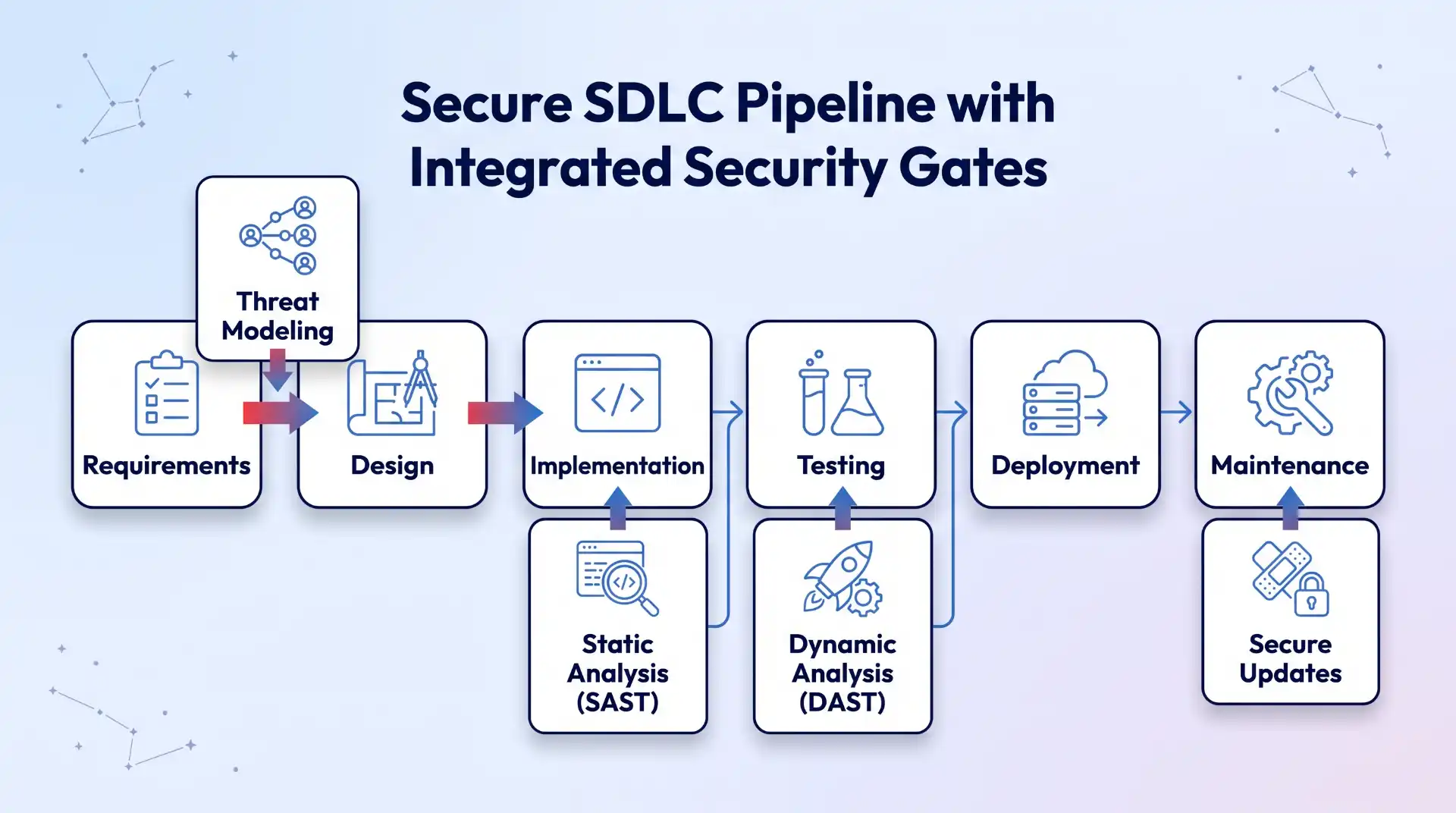
Modern application security integrates controls into every stage of the lifecycle. According to the NIST systems security engineering guidelines, security must be treated as a core property of the system rather than an added feature.
Waterfall vs. Agile vs. DevSecOps Security Gates
Different development models handle security checkpoints in different ways:
- Waterfall Model: Software moves sequentially through distinct phases: Requirements, Design, Implementation, Testing, Deployment, and Maintenance. Security reviews occur at formal gates between phases. This model is predictable, but it makes late changes difficult.
- Agile Methodology: Software is developed in short iterations called sprints. Security requirements must be broken into small tasks and included in every sprint backlog.
- DevSecOps: DevSecOps integrates security into automated continuous integration and continuous deployment (CI/CD) pipelines. Security tests run automatically every time a developer updates the code base. You can learn more about pipeline automation in our DevSecOps pipeline automation tutorial.
Defining Security Requirements Early
Security starts before any code is written. During the requirements phase, teams must define functional security needs. Functional requirements include user authentication, role-based access control, and data encryption standards.
Teams must also define non-functional security requirements. These include uptime expectations, performance limits under attack, and audit logging standards. Writing user stories with clear acceptance criteria ensures developers understand these limits.
Core Concept 2: Secure Design and Threat Modeling
Secure design principles prevent vulnerabilities before developers write code. Building a secure architecture requires assuming that components will eventually fail or come under attack.
The STRIDE Threat Model
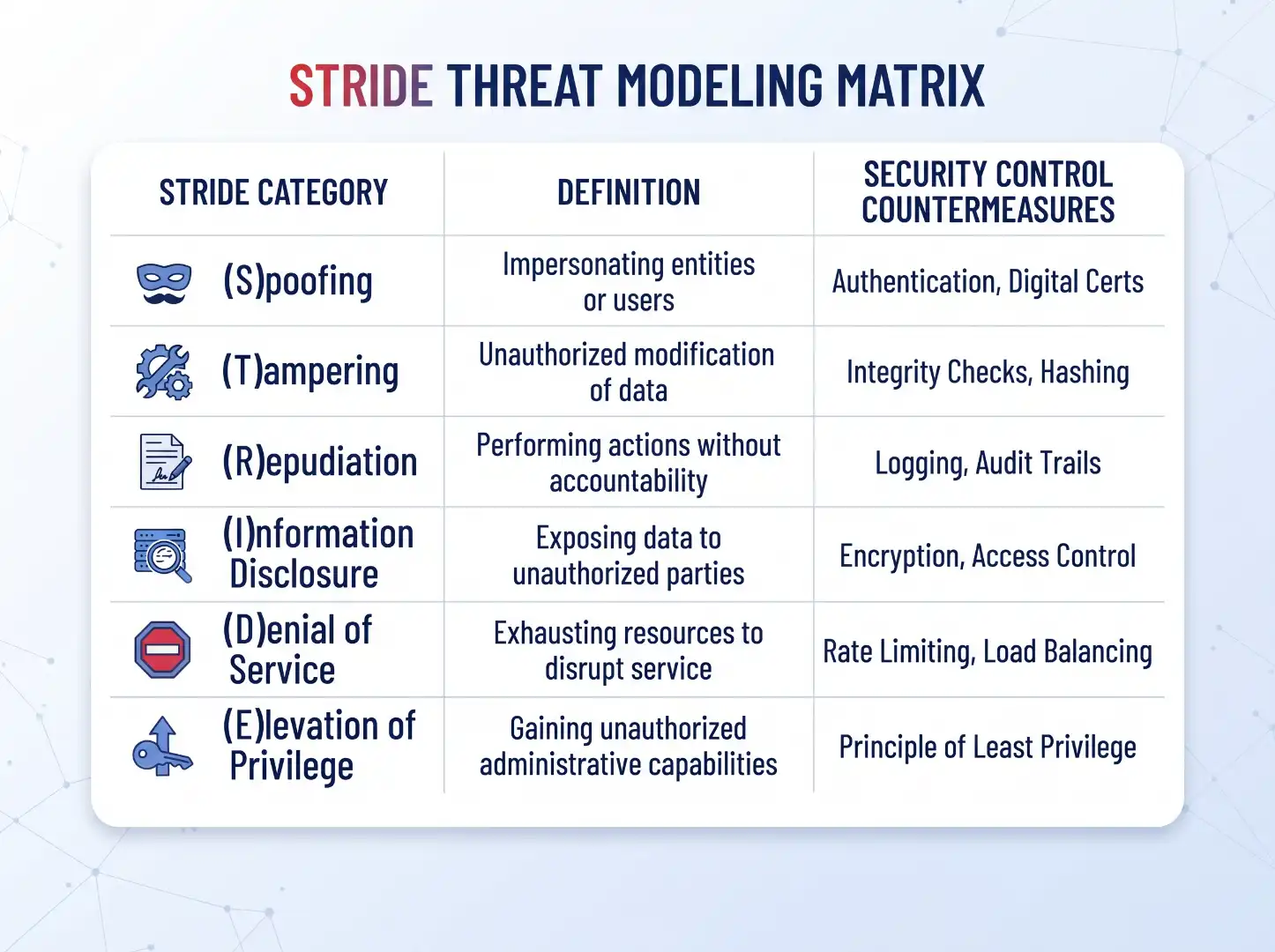
Threat modeling identifies potential attack vectors during the design phase. CISSP candidates must memorize the STRIDE framework. As detailed in the official STRIDE threat framework documentation, this framework groups threats into six distinct categories:
- Spoofing: An attacker pretends to be another user or system. Countermeasure: Strong authentication and digital signatures.
- Tampering: An attacker alters data in transit or at rest. Countermeasure: Cryptographic hashes and access permissions.
- Repudiation: A user denies performing an action due to lack of proof. Countermeasure: Immutable audit logs and digital signatures.
- Information Disclosure: Confidential data is exposed to unauthorized users. Countermeasure: Encryption and strict access control.
- Denial of Service: An attacker disrupts service availability. Countermeasure: Rate limiting, filtering, and resource quotas.
- Elevation of Privilege: A user gains higher authorization levels than permitted. Countermeasure: Principle of least privilege and input validation.
Fundamental Secure Architecture Principles
Engineers use several foundational rules when designing secure systems:
- Least Privilege: Users and processes receive only the permissions required to complete their tasks. Combine this concept with our identity and access management principles for effective role assignment.
- Defense in Depth: Systems use multiple overlapping security controls. If one control fails, another stops the attacker.
- Fail Securely: When a system crashes or encounters an error, it defaults to a closed, secure state rather than exposing access.
- Economy of Mechanism: Keep design structures as simple as possible. Simple designs are easier to inspect and test for security flaws.
- Leverage Existing Components: Reusing proven security modules reduces custom code errors. Review our security architecture and engineering overview to see how reusable modules fit into system design.
Core Concept 3: Common Application Vulnerabilities and Defenses
Understanding common coding mistakes helps security auditors spot flaws during code reviews. The OWASP Top 10 vulnerability risk index provides an industry standard list of critical web application risks.
Injection Attacks
Injection attacks occur when untrusted user input is sent directly to an interpreter as part of a command or query. The most common form is SQL Injection (SQLi).
In a SQL injection attack, an attacker enters malicious database commands into a web form. The database server executes the script, exposing confidential data. Primary Defense: Use parameterized queries and prepared statements. Never concatenate user input directly into SQL strings.
Cross-Site Scripting (XSS)
Cross-site scripting occurs when an application includes untrusted data in a web page without proper validation. The attacker’s script executes in the victim’s browser. This allows the attacker to steal session cookies or hijack accounts.
Primary Defense: Perform context-aware output encoding before rendering user data in the browser. Use Content Security Policy (CSP) headers to restrict script sources.
Input Validation and Sanitization
All data entering an application must be treated as untrusted. Applications should rely on allowable lists (positive validation) whenever possible. Allowable lists accept only pre-approved character formats and reject all other input. Blocking lists (negative validation) are less effective because attackers easily bypass known signature lists.
Core Concept 4: Software Security Testing Tools
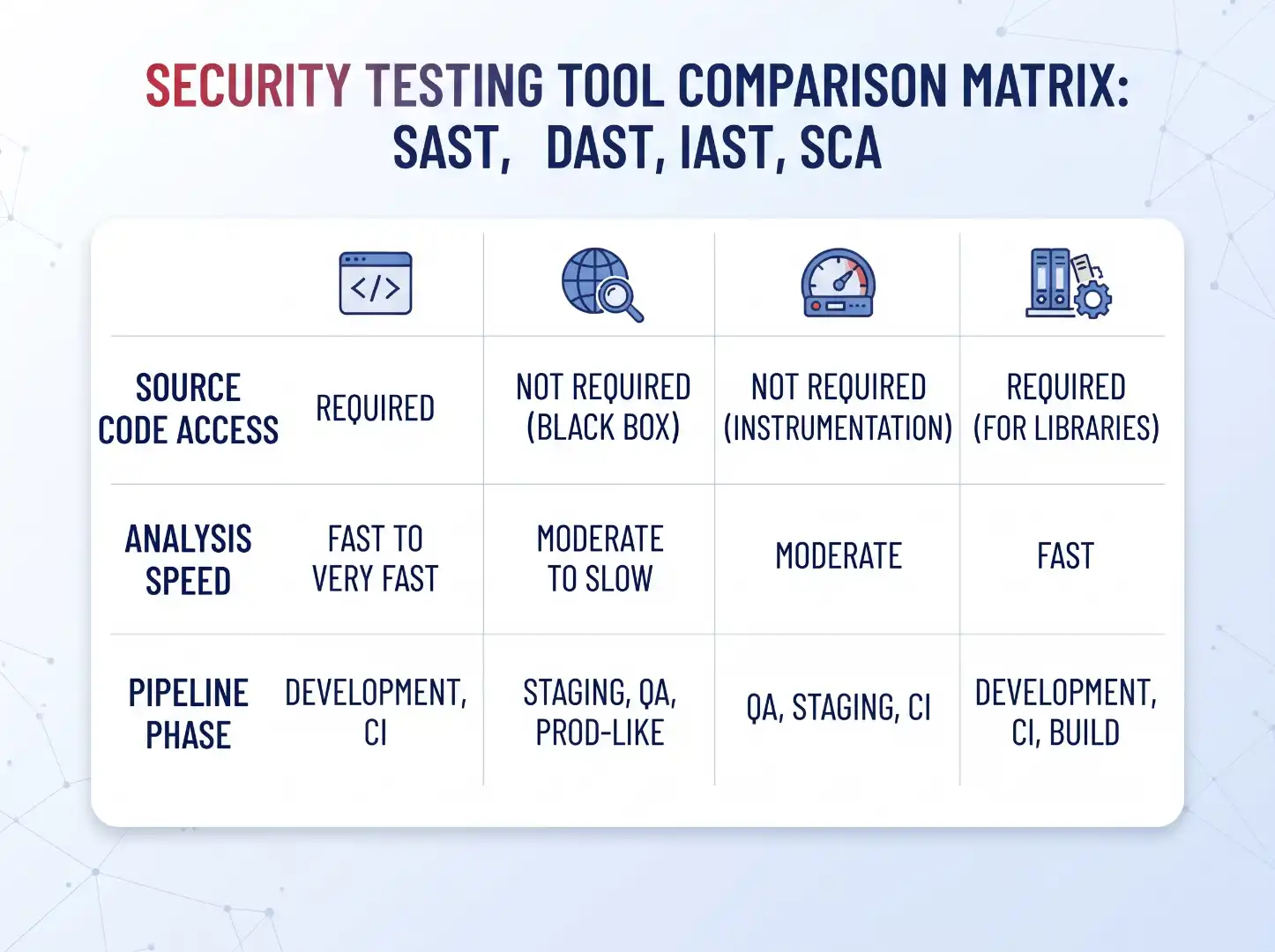
Security testing identifies vulnerabilities before software reaches production. Organizations use different testing tools at different points in the development lifecycle.
Static vs. Dynamic vs. Interactive Testing
Each security testing method offers unique strengths and limitations:
| Testing Method | Code Access Required? | When Executed | Primary Benefit | Main Limitation |
|---|---|---|---|---|
| SAST (Static Analysis) | Yes (White-box) | Build Phase | Finds line-level code errors early. | High rate of false positive alerts. |
| DAST (Dynamic Analysis) | No (Black-box) | Testing / Staging | Finds operational runtime flaws. | Cannot pinpoint exact code lines. |
| IAST (Interactive Analysis) | Yes (Gray-box) | Testing Phase | Combines SAST and DAST accuracy. | Requires agent deployment in runtime. |
| SCA (Composition Analysis) | Yes | Build Phase | Identifies open-source component risks. | Only checks known public flaw databases. |
For more details on setting up assessment workflows, read our software vulnerability assessment guide.
Code Reviews and Penetration Testing
Automated tools cannot catch every logic flaw. Manual code reviews allow experienced developers to check business logic, authorization rules, and design choices. Penetration testing provides a final black-box evaluation, simulating real attacker methods against a deployed environment.
Core Concept 5: Software Acquisition and Supply Chain Risk
Modern applications rely heavily on commercial off-the-shelf (COTS) software and open-source libraries. Organizations rarely write applications entirely from scratch. Managing third-party software risks is now a major component of Domain 8.
Federal guidance from the CISA Secure by Design guidelines emphasizes that organizations must demand transparency from software vendors. Organizations should request a Software Bill of Materials (SBOM) for all acquired applications. An SBOM lists every third-party library, module, and dependency included in the software.
To measure overall software security governance, organizations use mature frameworks. The OWASP Software Assurance Maturity Model helps companies evaluate, score, and improve their internal software security posture over time.
While Domain 8 focuses heavily on software lifecycles, remember that achieving full CISSP certification requires passing all eight CBK domains. Integrating software controls with network security, asset security, and risk management ensures complete defense capabilities.
Verification: How to Check Your Domain 8 Readiness
Use these scenario-based questions to verify your understanding of Domain 8 concepts before taking practice exams:
- Scenario 1: A developer wants to catch missing input validation flaws directly in their source code before building the application binary. Which tool should they use?Answer: A Static Application Security Testing (SAST) tool. SAST analyzes uncompiled source code in a white-box environment.
- Scenario 2: An application crashes during a heavy database lookup and displays raw database error logs to the end user. Which secure design principle was violated?Answer: Fail Securely. The application exposed internal system implementation details instead of handling the error safely.
- Scenario 3: You need to verify that a third-party software vendor has not included outdated open-source components with known vulnerabilities. What document should you request?Answer: A Software Bill of Materials (SBOM), combined with a Software Composition Analysis (SCA) report.
For additional study recommendations across all eight exam areas, review our comprehensive CISSP exam preparation strategy.
Where CISSP Domain 8 Concepts Have Limits
CISSP Domain 8 presents ideal governance standards. In practice, security professionals face trade-offs when enforcing these rules in production environments.
For example, automated SAST scanners produce high rates of false positive results. Halting a production deployment pipeline for every minor flag alienates development teams. Security leaders must configure severity thresholds, allowing low-risk code to deploy while blocking critical vulnerabilities.
Additionally, legacy monolithic applications often lack modular designs. Implementing modern security controls like container isolation or OAuth microservices may require expensive rewrites rather than simple security patches.
Key Takeaways
- Domain 8 accounts for 11% of the CISSP exam and focuses on security throughout the software lifecycle.
- You do not need to write code, but you must understand SDLC phases, vulnerability types, and testing tools.
- STRIDE is the primary threat modeling framework tested on the exam.
- Always prioritize input validation (allowable lists) and parameterized queries to prevent injection attacks.
- Combine SAST, DAST, and SCA tools to cover source code, runtime, and open-source supply chain risks.
Frequently Asked Questions
Do I need to memorize specific coding syntax for the CISSP exam?
No. The CISSP exam tests software security concepts, governance, and architectural principles rather than language syntax. You should recognize vulnerability patterns, such as an unparameterized SQL statement, but you will not be asked to write code lines from memory.
How does Domain 8 differ from Domain 3 (Security Architecture and Engineering)?
Domain 3 focuses on general system design, physical hardware security, cryptography, and network architecture models. Domain 4 and Domain 8 narrow the focus specifically to application development lifecycles, database interactions, secure coding, and software testing methodologies.
Which security testing tool is best for finding logic flaws?
Manual code reviews and manual penetration testing are best for discovering business logic flaws. Automated tools like SAST and DAST follow rule patterns and often miss errors where code behaves logically but violates business permissions.
What is the difference between input validation and output encoding?
Input validation inspects incoming user data before processing to ensure it meets expected format limits. Output encoding translates user data before displaying it back in the browser, preventing executable scripts from running during rendering.

💬 Comments