Master Data Management (MDM) improves data security by consolidating fragmented enterprise data into a single authoritative source of truth, eliminating dark data silos, and enforcing centralized access controls, dynamic data masking, and continuous lineage auditing across all connected systems. By standardizing core entities such as customer, supplier, and product records, MDM shrinks the organizational attack surface, prevents unauthorized data proliferation, and ensures consistent compliance with frameworks like GDPR and ISO 27001.
Quick Take
In a traditional distributed enterprise, sensitive data exists across dozens of isolated databases, cloud applications, and legacy systems—each with its own security settings, permissions, and vulnerabilities. Master Data Management resolves this fragmentation by establishing an authoritative hub for critical domain entities. Key security advantages include:
- Attack Surface Reduction: Eliminates rogue data duplication, unmonitored shadow databases, and redundant storage repositories.
- Centralized Policy Enforcement: Replaces fragmented, application-specific permissions with uniform Role-Based Access Control (RBAC) and Attribute-Based Access Control (ABAC).
- Auditing and Lineage: Tracks every modification, ingestion source, and downstream consumer with immutable audit logs.
- Automated Privacy Protection: Integrates dynamic data masking and encryption governance directly into master records to comply with stringent privacy mandates.
The Security Risks of Fragmented Master Data
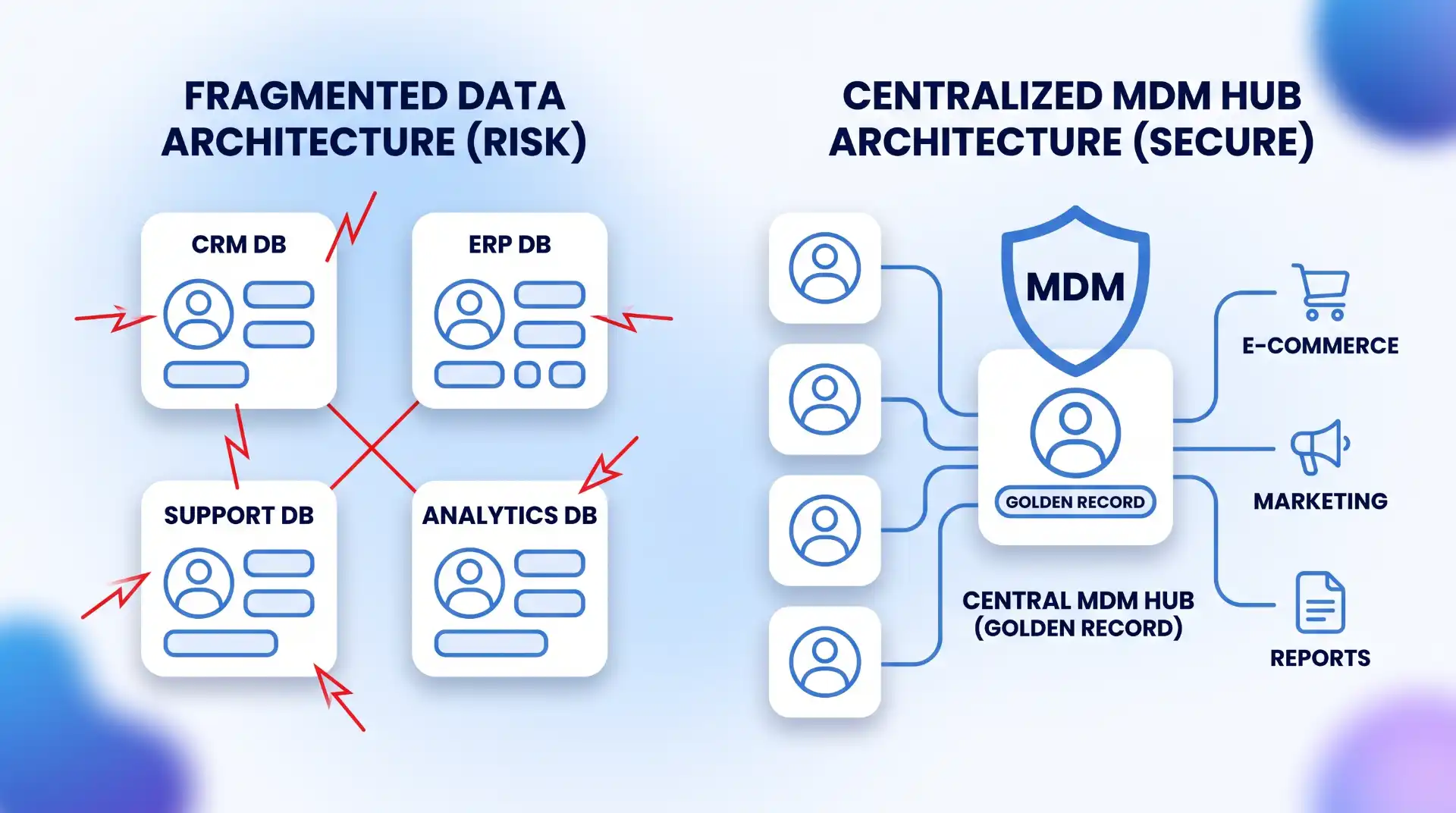
When enterprise data operates in departmental silos, data security breaks down at the integration boundaries. A customer’s personally identifiable information (PII)—such as social security numbers, billing addresses, or payment credentials—may reside in a CRM system, an ERP platform, a customer support queue, and multiple data warehouses. When security teams must secure five distinct data stores rather than one governed pipeline, several critical risks emerge:
- Inconsistent Access Rules: An employee who loses access to sensitive files in the primary CRM may retain read access to duplicate records stored in an unmonitored analytics database.
- Dark Data Proliferation: Unstructured and orphaned data copies accumulate across non-production environments (such as staging or testing servers), leaving sensitive attributes exposed to exfiltration. Implementing proven strategies to protect your data from fraudsters requires total visibility into where sensitive attributes live.
- Audit Blind Spots: Without centralized lineage, tracking who accessed, modified, or exported a compromised record across disparate applications becomes functionally impossible during incident response.
- Manual Governance Overhead: Security officers spend excessive time reconciling permissions manually, increasing the likelihood of human error and delayed revocation of access rights.
Four Core Mechanisms How MDM Strengthens Data Security
Modern enterprise platforms evaluated in Gartner MDM research demonstrate that effective data architecture treats security as an inherent property of data governance rather than an perimeter-only overlay. Master Data Management enforces data security through four specific technical mechanisms.
1. Attack Surface Reduction Through Centralization and De-Duplication
Cybersecurity fundamentals dictate that every system hosting sensitive data represents an entry point for threat actors. MDM applications ingest operational data, run matching and merging algorithms, and establish a single master record (the “Golden Record”) for each enterprise entity. By identifying duplicate records and deprecating redundant point-to-point data syncs, organizations drastically reduce the volume of vulnerable, unmonitored endpoints across the tech stack.
2. Fine-Grained Access Control and Policy Enforcement
Managing access permissions at the individual database or application layer creates administrative drag and policy drift. MDM centralizes authorization by integrating with Enterprise Identity and Access Management (IAM) providers (such as Okta, Azure AD, or Ping Identity). Security leaders can establish unified governance policies that dictate access based on user role, department, and context:
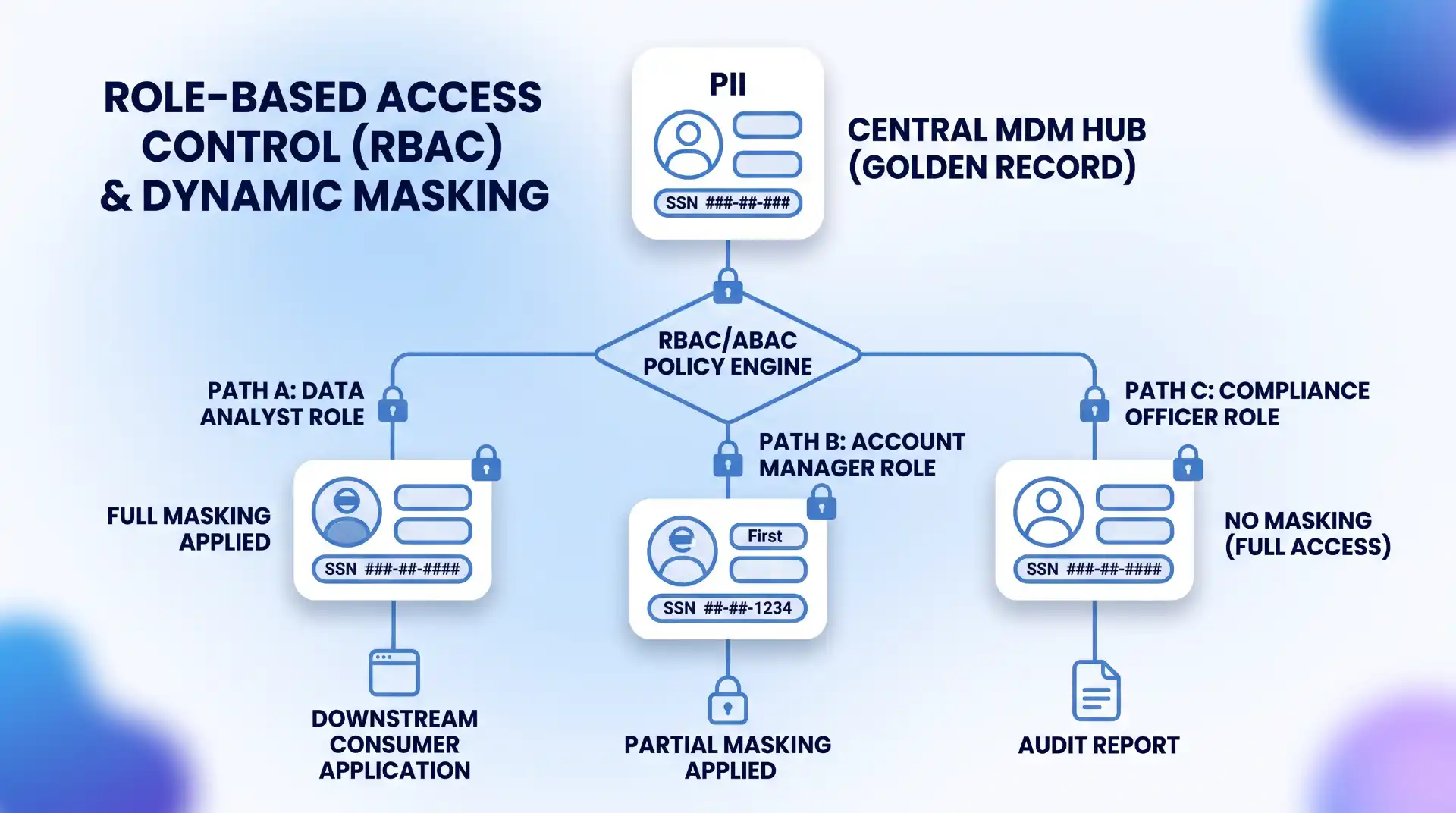
- Role-Based Access Control (RBAC): Restricts access to entire master entities or specific attributes based on assigned organizational roles (e.g., billing agents see financial attributes, while account managers see contact info).
- Attribute-Based Access Control (ABAC): Dynamically evaluates contextual variables—such as user location, network security level, time of day, and compliance consent status—before granting access to protected fields.
According to research on enterprise data governance by Datavid, integrating automated stewardship workflows with centralized access management ensures that data permission policies are enforced consistently at the point of ingestion rather than patched retroactively during an audit.
3. Dynamic Data Masking and Classification Frameworks
Master Data Management hubs incorporate data classification metadata into every record schema. When raw data enters the MDM hub, classification engines tag fields as Public, Internal, Confidential, or Restricted based on predefined standards such as NIST SP 800-53 or ISO 27001 guidance highlighted by privacy platforms like Transcend.
Based on these classification tags, MDM applies dynamic data masking rules before delivering master data to downstream consumers or operational tools:
- Full Masking: Completely obscures sensitive fields (e.g., displaying `XXX-XX-XXXX` for Social Security numbers) for unauthorized users.
- Partial Masking: Exposes only necessary portions of a field (e.g., displaying only the last four digits of a credit card number for verification workflows).
- Anonymization and Pseudonymization: Replaces direct identifiers with tokenized substitutes, allowing data analysts to execute aggregations without exposing personal identities.
4. Continuous Lineage Tracking and Audit Trails
Understanding where data originated, how it mutated, and where it flowed is essential for security forensics and regulatory accountability. MDM platforms maintain automated metadata management pipelines that log every CRUD (Create, Read, Update, Delete) operation against a master record.
As documented in data management analysis from Snowflake, automated data integration workflows and audit logs in modern MDM platforms allow security operations centers (SOC) to detect anomalous data exfiltration attempts, verify data integrity, and prove compliance during external regulatory evaluations.
Comparing Traditional Data Architecture vs. MDM Security Architecture
Understanding the security leap between unmanaged environments and MDM-backed infrastructure requires looking at how core security functions operate under each model:
| Security Capability | Traditional Distributed Architecture | MDM-Driven Architecture |
|---|---|---|
| Access Control | Fragmented across individual applications; prone to permission creep. | Centralized RBAC/ABAC enforced at the master data hub layer. |
| Data Visibility | High volume of “dark data” and unmapped duplicate files. | Comprehensive cataloging with real-time entity resolution. |
| Breach Impact | High; compromise of one system exposes redundant sensitive fields. | Low; isolated payload boundaries and centralized credential revoking. |
| Regulatory Compliance | Manual, reactive reconciliation across siloed databases. | Automated consent tracking, classification, and right-to-be-forgotten execution. |
| Incident Forensics | Incomplete, uncoordinated system logs; difficult to trace leaks. | Unified data lineage showing exact origin, transformation, and distribution. |
Real-World Operational Benefits and Regulatory Compliance
Adopting MDM as a core component of your technical stack yields immediate operational advantages that extend well beyond compliance checkboxes. Organizations that integrate MDM into their security strategy experience broader organizational benefits:
- Streamlined Regulatory Audits (GDPR, CCPA, HIPAA): Privacy regulations grant consumers the right to access, rectify, or erase their personal records. In a siloed environment, executing a “Right to be Forgotten” request requires manual queries across dozens of databases—risking incomplete erasure and severe regulatory fines. An MDM hub executes global erasures and consent updates across all linked operational systems from a single control interface.
- Safe Ecosystem Integrations: When connecting external SaaS tools, APIs, or AI services, exposing entire raw databases creates immense third-party risk. MDM allows enterprises to feed third-party applications with cleansed, masked, and scoped master records. Learning how to maximize your data security during cloud transformations requires limiting third-party exposure to authorized master feeds.
- Protection for Cloud Platforms: Specialized software ecosystems demand dedicated governance controls. For example, specialized solutions addressing Salesforce data protection function far more effectively when connected to a master data architecture that enforces uniform security standards before records enter the CRM environment.
- Reduced Operational Costs: Eliminating manual data reconciliation, redundant storage infrastructure, and repeated security audits reduces IT overhead while accelerating project deployment timelines. Exploring modern enterprise solutions shows how fundamental effective data management is to controlling infrastructure expenditure.
As detailed in cybersecurity integration analysis by DataGuard, integrated data management simplifies compliance frameworks while strengthening operational resilience against insider threats and external security incidents.
Common Misconceptions About MDM and Security
Misconception 1: “MDM Creates a Single Point of Failure That Increases Risk”
A common concern among security teams is that aggregating master data into a single hub creates a high-value target for threat actors. In practice, MDM does not mean dumping all unstructured enterprise data into one monolithic database. Instead, MDM acts as an index and governance layer that orchestrates data synchronization across encrypted, access-controlled repositories. Furthermore, securing a single, highly hardened hub with multi-factor authentication, HSM-backed key management, and rigorous monitoring is vastly more secure than attempting to perimeter-protect hundreds of fragmented, unmonitored databases.
Misconception 2: “MDM Is Purely an Operational Tool, Not a Cybersecurity Asset”
Historically, MDM was viewed primarily as a business intelligence tool designed to clean customer lists for marketing teams or streamline supply chains. Today, cybersecurity leaders recognize that data quality and data security are inseparable. Inaccurate, outdated, or duplicated data leads directly to authorization vulnerabilities, misplaced security controls, and failed threat detection models. High-quality master data is the foundation of effective zero-trust architecture.
Misconception 3: “Implementing MDM Means Replacing Existing Security Tools”
MDM does not replace Identity and Access Management (IAM), Security Information and Event Management (SIEM), or Data Loss Prevention (DLP) systems. Instead, it enhances them. MDM feeds clean contextual metadata (such as record sensitivity and owner classification) into SIEM tools, allowing SOC analysts to prioritize alerts based on the true underlying business value of the affected asset.
Implementation Edge Cases and Failure Modes
While MDM significantly enhances data security, flawed implementation can introduce new operational risks. Security teams must account for several practitioner-level edge cases during deployment:
- The Shadow Data Store Bypass: If operational teams bypass the MDM API to build ad-hoc point-to-point integrations between legacy systems, unmonitored data paths will persist outside governed security channels. All system integrations must strictly enforce MDM broker routing.
- Over-Permissioned Data Stewards: Data stewards assigned to resolve entity matches often receive elevated privileges to view unmasked PII. If steward accounts are not governed by strict MFA, session timeouts, and audit logging, they become prime targets for credential harvesting attacks.
- Latency vs. Security Enforcement Trade-offs: Real-time streaming architectures (such as Apache Kafka pipelines) require instant authorization checks. Implementing heavyweight, synchronous security lookups in the MDM path can introduce latency spikes. Organizations must deploy cached policy enforcement points (PEPs) to maintain sub-second streaming throughput without compromising security controls.
When planning broader security modernizations, evaluating reasons cyber security should be a business priority helps align executive leadership around the capital expenditure required for robust MDM deployment. Investing in foundational governance remains one of the most effective strategic steps toward adopting disruptive technologies, as highlighted in analysis on technologies that will boost your business growth.
Key Takeaways
- Centralized Authority: MDM eliminates redundant dark data, directly shrinking the enterprise attack surface and minimizing exposed data stores.
- Granular Governance: Enforces consistent Role-Based and Attribute-Based Access Control policies across disparate enterprise applications.
- Embedded Privacy Controls: Integrates dynamic masking, classification tags, and encryption management directly into master record schemas.
- Audit Readiness: Maintains immutable data lineage logs required for rapid incident response and compliance with GDPR, CCPA, and ISO standards.
Frequently Asked Questions
Does Master Data Management replace the need for Data Loss Prevention (DLP) software?
No. MDM and DLP perform complementary roles. MDM centralizes, classifies, and governs master data entities, establishing clear security policies at the data layer. DLP software monitors endpoints, network traffic, and perimeter egress points to stop unauthorized transmission of that classified data. MDM provides the contextual classification that makes DLP policies effective.
How does MDM assist with GDPR’s “Right to be Forgotten”?
In a standard IT environment, fulfilling a deletion request requires searching dozens of disconnected databases, leaving high potential for missed records. MDM maintains cross-system entity mapping. When a deletion request is processed in the MDM hub, it automatically cascades the erasure instruction across all linked operational systems and downstream applications.
Can MDM prevent insider threats and unauthorized employee data access?
Yes. By implementing fine-grained Attribute-Based Access Control (ABAC) and dynamic data masking within the MDM hub, employees only view the specific data attributes required for their immediate job functions. Unmasked PII remains restricted, reducing the risk of malicious insider exfiltration or accidental data exposure.
What is the difference between Data Governance and Master Data Management?
Data Governance is the overarching policy framework, strategy, and organizational rules regarding data ownership, privacy, and quality. Master Data Management is the operational technology architecture and process framework that enforces those governance rules across enterprise software systems.

💬 Comments