To land a job in cybersecurity, choose a specific type of security work first, identify the skills that role actually requires, build evidence that you can perform relevant tasks, and then target jobs that match that evidence. You do not need to master every part of cybersecurity before applying, but you do need a clearer plan than simply collecting courses and certifications.
Quick Take
A strong cybersecurity job search is role-first, not certification-first. Pick the work you want to do, learn its fundamentals, practice in authorized environments, document what you can do, and tailor your applications to jobs where those capabilities matter.
What Employers Mean by a Cybersecurity Job
Cybersecurity is not one job. It includes defensive monitoring, incident response, identity and access management, governance and risk work, security engineering, secure software development, vulnerability analysis, digital forensics, and other specialties.
The NICE Workforce Framework for Cybersecurity helps explain the difference. It defines a Work Role as a grouping of work for which a person or team is responsible. A job can contain one or several Work Roles, which is why two employers can advertise similar titles but expect different tasks.
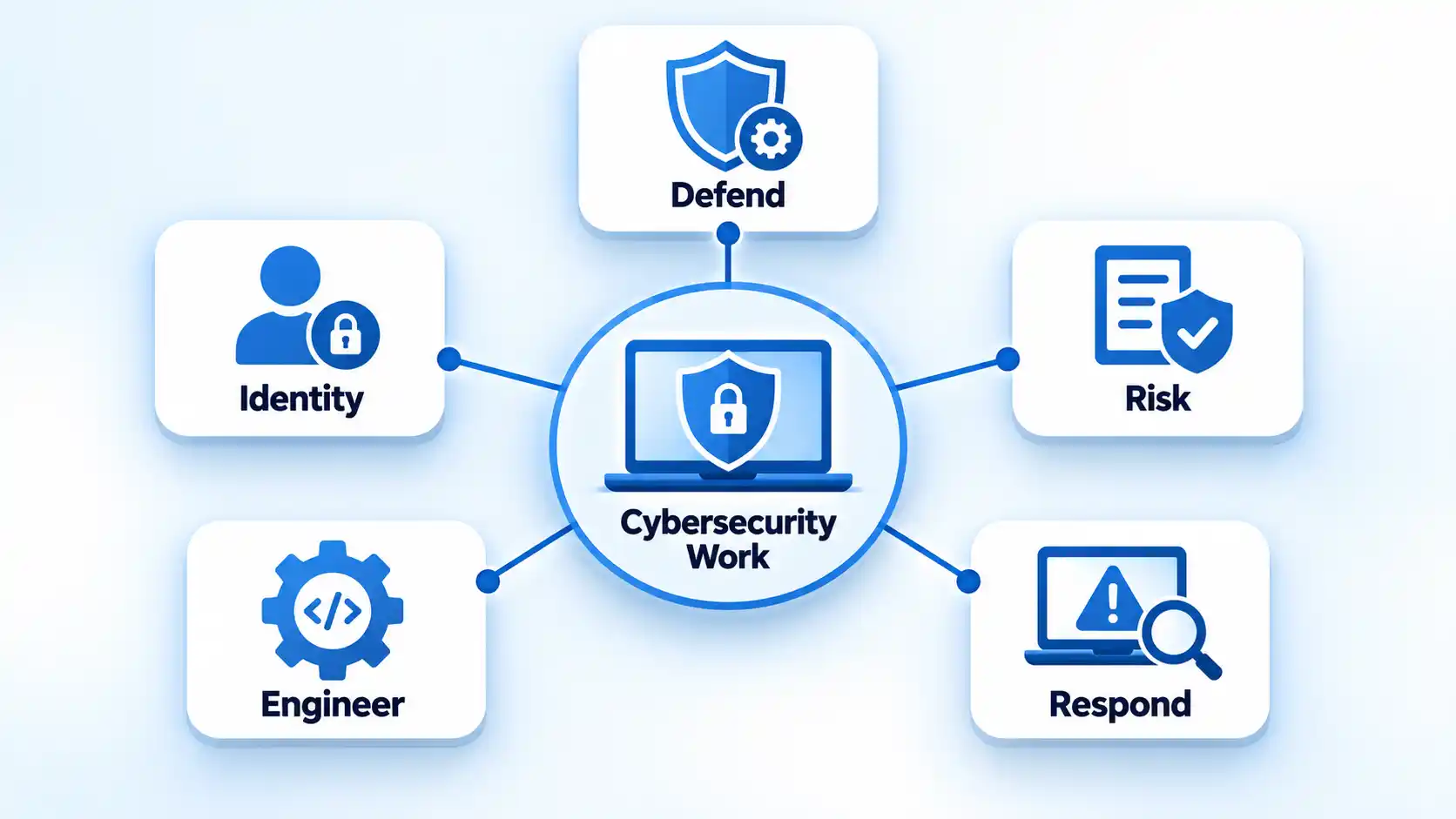
This distinction matters when you are starting out. Searching only for a broad title such as “cybersecurity specialist” can hide the skills employers actually want. Instead, examine the tasks behind a vacancy. A defensive security role may emphasize log analysis and alert investigation, while an identity-focused role may concentrate on authentication, account privileges, and access controls.
That also means there is no single technical stack every cybersecurity candidate must master. Linux, networking, scripting, cloud platforms, identity systems, governance frameworks, and security tools matter differently depending on the role you choose.
What You Need Before You Start
You do not need an advanced security qualification before beginning this process. You do need enough basic technology knowledge to understand the systems, accounts, networks, applications, or data you may eventually help protect.
Prerequisites
- Basic computer literacy, including files, applications, user accounts, web browsers, and common operating-system concepts.
- A willingness to learn networking, authentication, operating systems, logs, and security principles at the depth required by your chosen role.
- A safe, authorized environment for practical exercises. Never treat systems you do not own or have permission to test as practice targets.
How to Land a Job in Cybersecurity in 7 Steps
The steps below deliberately start with role selection rather than a particular course or certificate. That keeps your training, projects, résumé, and applications pointed at the same type of work.
- Pick a target work role before choosing training. Start by identifying two or three kinds of cybersecurity work that interest you, then compare the tasks and capabilities involved. The CISA/NICCS Career Pathways Roadmap is useful because it lets you explore NICE Work Roles and the skills that connect them. Read several real job descriptions as well. Focus on repeated responsibilities rather than assuming the job title itself is standardized. If one vacancy calls a role “security analyst” and another calls a similar role “SOC analyst,” compare what the people actually do.
Conversely, two jobs with the same title may have very different responsibilities. This is also the point to compare technical security operations and governance-focused cybersecurity work if you are unsure whether you prefer hands-on monitoring and investigation or policy, risk, and compliance-oriented work. - Build the technical foundation your target role needs. Learn the fundamentals that let you understand what is being protected and how failures appear. Networking knowledge helps you reason about devices, addresses, connections, ports, protocols, and traffic. Operating-system knowledge helps you understand processes, permissions, files, services, and logs. Identity concepts help you understand authentication, authorization, accounts, and privileges. Security fundamentals add ideas such as least privilege, defense in depth, vulnerability management, monitoring, and incident response. The depth should follow your target role.A defensive-security candidate may spend more time on network traffic and log analysis, while an identity candidate may go deeper into access controls and account lifecycle management. Linux is valuable in many technical environments, but it is not a universal prerequisite for every cybersecurity role. The same is true of programming. Learn scripting or programming when it helps you automate, analyze, develop, or test the systems relevant to the work you want.
- Add training or a certification strategically. Choose a credential because it addresses a specific knowledge gap or appears repeatedly in jobs you realistically want, not because it is popular. CISA’s guidance on researching cybersecurity certifications recommends starting with relevant NICE Work Roles and their Task, Knowledge, and Skill statements, then researching credentials that strengthen those areas. Entry-level options do exist. ISC2’s Certified in Cybersecurity credential requires no prior work experience, while ISACA states that its Cybersecurity Fundamentals Certificate has no prerequisites. Those facts do not make either credential automatically right for every candidate. Check the exam domains against your target role before paying for training or an exam. After choosing a specialization, vendor-specific learning can also make sense when it matches technology used in the roles you are targeting. For example, someone focusing on privileged access management may consider CyberArk training alongside broader identity and access-management fundamentals. You can also choose a cybersecurity certification that matches your target role by comparing its level, syllabus, experience requirements, and relevance to actual vacancies.
Warning
A certification can validate knowledge, but it does not prove that you can perform every task in a job or guarantee employment. Check the level carefully: Microsoft’s Cybersecurity Architect Expert credential, for example, is currently positioned for experienced practitioners and requires prerequisite certification rather than serving as a generic beginner starting point.
- Build evidence that you can perform relevant work. Turn study into something observable. Use authorized labs, CISA micro-challenges, capture-the-flag exercises, structured home labs, coursework, internships, or relevant responsibilities from an existing IT job. The goal is not to accumulate screenshots. Create evidence that shows what problem you faced, what you examined or configured, how you reached a conclusion, and what you learned. A defensive-security project might document how you reviewed sample authentication logs and distinguished expected activity from suspicious patterns.An identity project might demonstrate how you designed role-based access for a fictional organization and justified privilege boundaries. A security-automation project might show a small script that parses safe sample data and explain its limitations. Only test systems you own or have explicit permission to test. If you use workplace experience, remove confidential information before placing anything in a public portfolio.
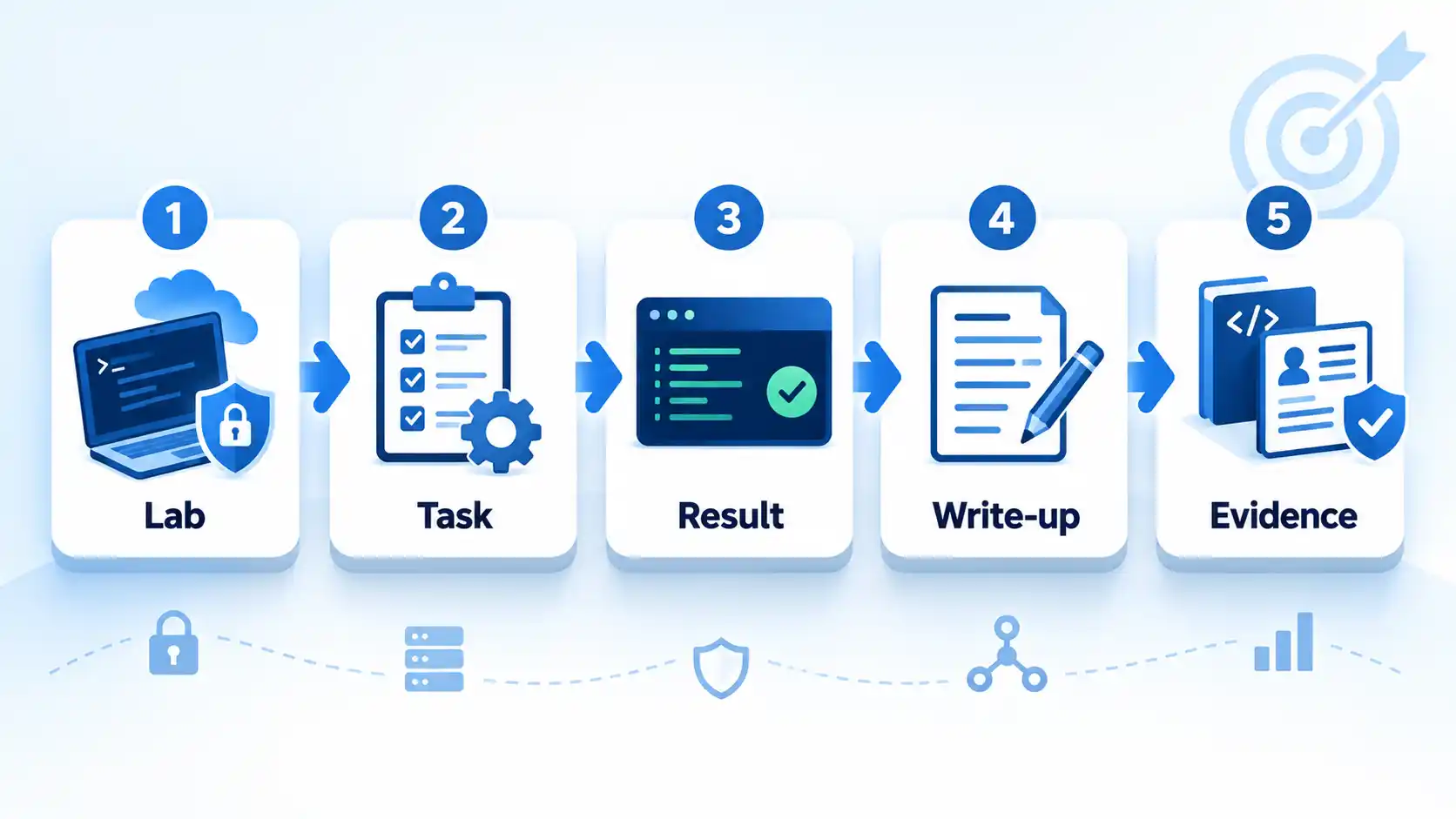 You do not need dozens of projects. A few well-explained examples that match the target role are more useful than a large collection of unrelated exercises. The important skill is being able to explain what you did and why. When professional experience is limited, you can build a cybersecurity portfolio from authorized projects and labs rather than presenting practice exercises as paid employment.
 - Turn your experience into a role-matched résumé. Rewrite your résumé around evidence that matters to the vacancy. Replace vague statements such as “passionate about cybersecurity” with truthful descriptions of tasks, tools, outcomes, and relevant knowledge. If you reviewed authentication logs in a lab, explain what you analyzed and what you were looking for. If you administered user accounts at an IT support job, explain the identity or access responsibilities you actually handled. If you wrote a script, explain what it automated. Transferable experience matters when the connection is real: troubleshooting, systems administration, networking, documentation, customer support, audit work, software development, cloud administration, and compliance work can all supply useful foundations for particular security roles. Do not relabel a home lab as professional experience or inflate participation in a course into production responsibility. The résumé should make it easy for a recruiter or hiring manager to see the connection between your evidence and the advertised work.
- Apply beyond jobs that literally say “cybersecurity.” Search for target security roles, but also consider adjacent positions that build the same capabilities. Depending on your starting point, technical support, network operations, systems administration, cloud operations, software development, identity administration, audit, risk, or compliance work may give you experience that later transfers into security responsibilities. Treat these as possible pathways rather than guaranteed steppingstones. Read each vacancy on its own merits. A support job that includes account management, endpoint troubleshooting, access controls, or security escalation may be more relevant to your goal than a similarly titled job with none of those responsibilities. Organizations invest in security because technology, operations, and data introduce business risk, which is why cybersecurity remains a business priority across many sectors. Your job search should therefore follow the work and skills, not only the word “cybersecurity” in a title.
- Prepare to explain how you think, then iterate. Practice explaining your projects and technical decisions in plain language. For an analyst-style interview, you might be asked how you would investigate a suspicious login. A good response identifies what you would verify, which evidence you would gather, what assumptions you are making, and when you would escalate. You do not need to bluff when you do not know something. Explain how you would find the answer safely and what source or evidence you would trust. After applications and interviews, look for patterns. No callbacks may point to poor role targeting or résumé evidence. Interviews without offers may expose technical, communication, or scenario-reasoning gaps. Use that feedback to decide what to improve next rather than automatically buying another certification.
How to Know You Are Ready to Apply
Do not wait until you satisfy every item in every job description. Instead, check whether you can demonstrate a credible foundation for the work and explain your evidence clearly.
Verify the result
- You can name the type of cybersecurity work you are targeting and explain what people in that role actually do.
- You understand the networking, operating-system, identity, security, and role-specific fundamentals needed for the vacancies you are pursuing.
- You can discuss at least two or three relevant examples of work, labs, projects, coursework, or transferable experience without exaggerating what you did.
- Your résumé connects those examples to the responsibilities and skills appearing in your target vacancies.
- You can walk through a basic security scenario, state what you know, identify what you still need to verify, and explain your next action.
Why Your Cybersecurity Applications May Be Stalling
A slow job search does not automatically mean you need another certificate. Diagnose where the process is failing before deciding what to change.
You are applying widely but getting few or no interviews
Check whether the vacancies actually share a common work profile. Applying simultaneously to penetration testing, governance, cloud security, incident response, and security architecture roles can produce a résumé that looks unfocused. Narrow the target, identify repeated requirements, and move the most relevant evidence higher on the page.
Your résumé contains certifications but little evidence of applied skill
Add truthful examples showing how you used the underlying knowledge. A credential can establish that you studied or passed an assessment, while a project, lab, internship, or work responsibility can show how you approached a task. Do not invent production experience to fill the gap.
You reach technical interviews but struggle with scenarios
Move from memorizing definitions to practicing reasoning. Take a safe scenario, identify the evidence you would gather, explain possible causes, state what would make you change your hypothesis, and describe the point at which you would escalate. Review the fundamentals behind questions you repeatedly miss.
Most target vacancies ask for experience you do not yet have
Separate requirements you can demonstrate through authorized projects from responsibilities that genuinely require workplace exposure. Look for junior roles and adjacent IT positions that build the missing capabilities, and continue applying where your existing evidence reasonably overlaps with the work rather than waiting for a perfect match.
Cybersecurity Career Outlook: What the Numbers Actually Mean
Cybersecurity demand is substantial, but market statistics need context. They describe populations and reporting periods, not your personal probability of receiving an offer.
| Measure | Population or period | Current figure | What it means |
|---|---|---|---|
| Median annual wage | U.S. information security analysts, May 2025 | $129,180 | The U.S. Bureau of Labor Statistics reports this for the specific Information Security Analysts occupation. It is not a median for every cybersecurity job. |
| Employment growth | U.S. information security analysts, 2025–2035 projection | 21% | BLS projects this occupation to grow much faster than the average for all occupations. A national projection does not guarantee local openings or individual employment. |
| Average annual openings | U.S. information security analysts, 2025–2035 projection | About 14,100 per year | The estimate includes openings created by growth and by workers leaving or changing occupations. |
| Cybersecurity job listings | U.S. CyberSeek reporting period, May 2024 through April 2025 | 514,359 | CyberSeek counts employer listings for dedicated cybersecurity positions and adjacent technical positions with substantial cybersecurity skill requirements. This is a job-posting measure, not the number of guaranteed entry-level vacancies. |
BLS also says a bachelor’s degree and related experience are typical for information security analysts, while noting that some people enter with a high-school diploma plus relevant industry training and certifications. Requirements therefore vary enough that you should evaluate the actual vacancy rather than assume there is one mandatory educational route into every security role.
Build a Career Path Around the Work, Not the Buzzwords
The most useful starting question is not “Which cybersecurity certification should I get?” It is “What security work do I want to become capable of doing?” Once that is clear, the rest becomes easier to sequence: identify the required skills, build the foundation, practice safely, document evidence, target suitable vacancies, and improve the weakest part of your process as you receive feedback.
You do not need to know every operating system, programming language, security product, or framework before applying. You need enough relevant capability and evidence to make a credible case for the particular work an employer needs done.

This article helps. Hoping to land my first job