Hashtags still have practical uses in 2026, but they are better treated as tools for context, search, campaigns, and conversation tracking than as automatic reach boosters. The useful approach is to choose a small, relevant set based on what the hashtag needs to accomplish and how the specific social platform handles it.
Quick Take
- Use hashtags to describe and organize a topic, make relevant content easier to find, connect campaign posts, or follow a conversation.
- Do not assume that adding more hashtags creates more reach. Platform recommendation systems use many signals beyond hashtags.
- Check each hashtag on the platform before publishing. A useful tag should match the post, audience, and purpose rather than simply have a large volume of posts.
Do Hashtags Still Work in 2026?
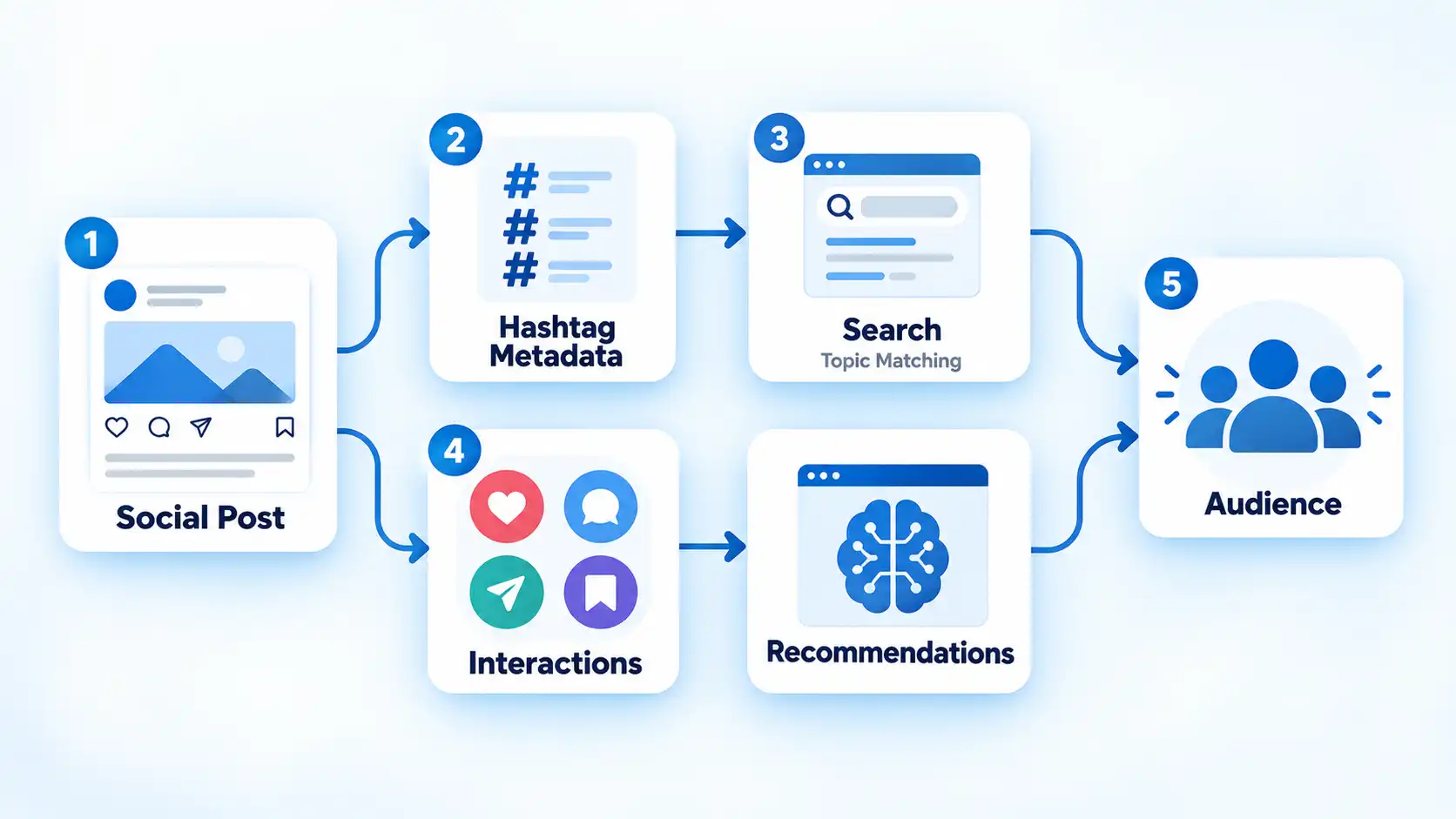
Yes, but only if you define what “work” means. A hashtag can help classify a post, connect it with a topic, make it searchable, or organize posts around an event or campaign. None of those functions guarantees that a recommendation algorithm will distribute the post to a large audience.
That distinction matters because social networks increasingly rely on multiple signals to decide what people see. TikTok, for example, explains that its recommendation systems consider user interactions, content information, and user information. Hashtags are included among the content signals, but TikTok also considers factors such as sounds, views, country of publication, language, location, and how people interact with content. TikTok’s recommendation-system documentation describes these signals and notes that their weighting can vary.
The practical lesson is simple: a relevant hashtag can provide useful context, but it cannot rescue a post that people do not find useful or interesting. Hashtags are only one part of a wider social media distribution system, so discoverability should not be confused with guaranteed organic reach.
What Hashtags Actually Do Now
The easiest way to understand hashtags is to stop treating them as one universal growth tactic. Depending on the platform and post, they can perform several different jobs.
- Categorize a topic: a hashtag provides an explicit label describing what a post concerns.
- Support search and discovery: some platforms let people search, select, or otherwise explore hashtagged topics.
- Organize campaigns and events: a distinctive tag can connect posts from a launch, conference, competition, community project, or other coordinated activity.
- Support research: marketers, journalists, community managers, and other users can search topic tags to locate public discussions and relevant posts.
For example, an event hashtag can give attendees a common label for posts about the event. Someone searching that tag may then find related public posts. That does not mean every post carrying the tag will receive broad recommendation-feed distribution.
Warning
Discoverability and distribution are not the same thing. A hashtag may help a platform or user identify a topic without causing the recommendation system to give the post additional reach.
Hashtag searches can also support social listening and content curation by helping marketers locate public posts around a defined subject. Treat that as a research technique rather than proof that every relevant conversation will contain the hashtag you searched.
How Hashtags Work Differently by Platform
A hashtag strategy should change with the platform. Copying the same block of tags to Instagram, TikTok, X, LinkedIn, and Facebook ignores differences in their search and recommendation systems.
| Platform | Current role | Practical approach | Important limitation |
|---|---|---|---|
| Topic context and search/discovery | Use a few specific tags that accurately describe the post. | Instagram now limits posts and Reels to five hashtags, and its leadership has said hashtags should not be treated as a primary reach tactic. | |
| TikTok | One source of content information used alongside other recommendation and search signals | Use tags that accurately identify the video’s subject instead of filling the caption with unrelated popular tags. | TikTok does not establish a universal hashtag count that guarantees better distribution. |
| X | Topic categorization and searchable conversation | Use one or two directly relevant tags when they make the topic easier to identify or follow. | Hashtag use does not guarantee inclusion in search results, and X discourages abuse of trending topics and hashtags. |
| Searchable topic labels within a broader keyword and natural-language search system | Use hashtags only when they add useful topic context; also write the post itself with clear descriptive language. | LinkedIn search is broader than hashtags, so a hashtag should not carry the entire discovery strategy. | |
| Topic labeling and searchable context where relevant | Use tags selectively when they have a clear purpose, such as a campaign, event, branded initiative, or recognizable topic. | Do not assume that adding hashtags will independently improve feed distribution. |
Instagram is a good example of why old hashtag advice needs updating. In December 2025, Instagram began limiting posts and Reels to five hashtags, with Instagram chief Adam Mosseri emphasizing a smaller number of targeted tags rather than long lists of generic ones. Current reporting on the change also reflects Instagram’s broader position that hashtags can assist search and topic context but are not a dependable way to increase reach. The Verge’s report on Instagram’s five-hashtag limit documents the change.
That makes a 20- or 30-tag block an outdated strategy. Instead, ask whether each tag gives Instagram or a potential viewer useful information about the post.
TikTok
TikTok should not be reduced to a hashtag formula either. Its recommendation documentation describes hashtags as part of the content information its systems can consider, alongside sounds and other content attributes. User interactions such as watching, liking, sharing, commenting, and skipping also contribute to recommendations. The importance of individual factors can differ by recommendation surface and user.
If you publish a tutorial about securing a home Wi-Fi network, a precise cybersecurity or Wi-Fi tag can reinforce what the video is about. Adding an unrelated viral tag simply because it is popular does not make the video relevant to people interested in that trend.
X
X retains one of the clearest traditional hashtag implementations. According to X’s official hashtag guidance, hashtags categorize posts by keyword and can help those posts appear in X search. Selecting a hashtag also displays other posts containing it. X recommends no more than two hashtags per post as a best practice, although the platform technically permits more.
Search visibility still is not automatic. X says it filters search results for relevance and quality and explicitly warns users not to abuse trending topics or hashtags. X’s search rules also identify repetitive or near-duplicate posting as behavior that can affect search visibility.
LinkedIn now has a broader search environment than a hashtag-only approach suggests. Its search bar accepts keywords and natural, conversational queries and can return posts, people, companies, jobs, groups, events, and other results. LinkedIn also confirms that users can still search hashtags by entering them directly into the search bar, even though its suggested searches do not suggest hashtags. LinkedIn’s current search documentation explains this behavior.
For marketers, that means clear wording in the actual post matters alongside any hashtags. A post about zero-trust security should explain the subject naturally instead of expecting a tag such as #ZeroTrust to provide all of the searchable context.
On Facebook, the safest practical approach is restraint. A hashtag may provide a useful label for a campaign, event, location, or recurring topic, but there is not enough current evidence to justify a universal claim that adding a particular number of Facebook hashtags will increase organic distribution.
Use them when they serve an identifiable purpose. If removing a hashtag would make no meaningful difference to how someone understands, searches for, or follows the topic, you probably do not need it.
How to Choose Useful Hashtags
Choosing hashtags starts with the subject of the post, not with a list of whichever tags currently have the biggest numbers. A smaller relevant audience is usually more useful to a marketer than accidental exposure to people who have no connection to the subject.
Start with the topic of the post
Describe the post in a few plain words before searching for tags. A post promoting a cybersecurity webinar, for example, might concern ransomware prevention, cloud security, identity management, or small-business cybersecurity. Those concepts provide better starting points than an unrelated viral tag.
This fits a broader social media marketing strategy in which the goal, target audience, platform, and content all need to align. Hashtags should support that strategy rather than determine it.
Match the hashtag to its job
Useful hashtags generally fall into a few practical categories:
- Topic or niche hashtags describe the subject, industry, hobby, profession, or problem.
- Branded hashtags identify a business, product line, creator project, or recurring branded initiative.
- Campaign and event hashtags connect posts associated with a particular launch, conference, competition, promotion, or event.
- Community hashtags help participants identify conversations associated with a group or shared interest.
- Location hashtags can add geographical context when location genuinely affects the post.
A hashtag can belong to more than one category. What matters is whether its function is clear and relevant to the people you want to reach or understand.
Search the hashtag before publishing
Do not assume a tag means what you think it means. Search it on the destination platform and inspect the current results.
Check whether the posts match your intended topic, whether another community uses the same abbreviation, and whether a previously harmless tag has become associated with an unrelated event or controversy. This matters especially for short campaign acronyms, which can have several interpretations.
Also look at the type of content around the tag. If virtually every result concerns a different subject, adding the hashtag to your post is unlikely to provide useful context.
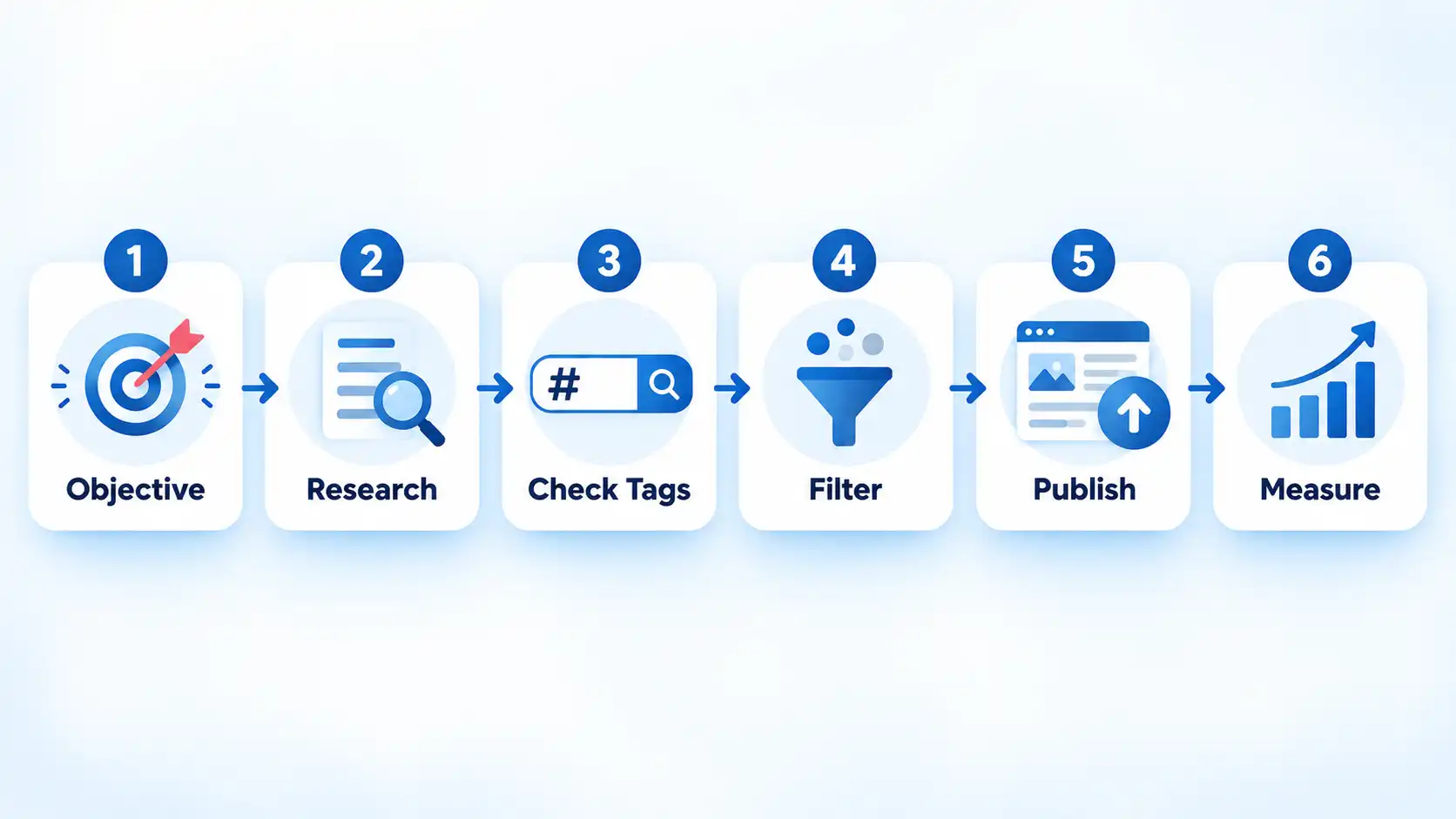
A Practical Hashtag Workflow
Use this sequence instead of copying a generic hashtag list into every post.
Hashtag Mistakes That Still Hurt a Strategy
The most common hashtag mistakes come from treating tags as shortcuts. The following habits either weaken relevance or make it difficult to understand what is actually helping a post.
- Hashtag stuffing: adding as many tags as possible without asking whether each one adds useful context.
- Copying the same block everywhere: recycling identical tags across unrelated posts and platforms even when their topics differ.
- Hijacking unrelated trends: adding a popular tag to content that has no legitimate relationship to the conversation.
- Confusing popularity with audience fit: selecting a huge tag even though the people using it are unlikely to care about the post.
- Using hashtags instead of descriptive copy: expecting a list of tags to compensate for a vague caption, title, or video.
- Assuming a hashtag guarantees search placement: ignoring platform ranking, quality filters, account visibility, and other search rules.
The third mistake can create more than a relevance problem on X. The platform’s search rules explicitly tell users not to abuse trending topics or hashtags, and they warn against repeatedly publishing duplicate or near-duplicate posts. A legitimate recurring campaign tag is not automatically abusive, but repetitive posts designed merely to insert an account into unrelated searches are a different behavior.
The same principle applies more broadly: use a trending hashtag because the post genuinely belongs in the conversation, not because the tag appears to offer free traffic.
How to Measure Whether Your Hashtags Are Useful
Measurement should begin with the job you assigned to the hashtag. There is no single “hashtag success” metric because a campaign tag and a topic tag can serve different purposes.
If the objective is discovery, look at relevant search or discovery data where the platform exposes it, along with profile visits and qualified engagement. If the hashtag belongs to a campaign, look for participation, appropriate user posts, campaign-related conversations, traffic, leads, or conversions that can be reliably connected to the campaign.
A branded community tag may be more valuable as an organizational tool. In that case, useful signals could include how many relevant people use it, whether it helps you locate community posts, and whether the conversations remain aligned with the intended subject.
Do not confuse correlation with causation. If a post containing three hashtags performs better than another post containing one, that does not prove the extra hashtags caused the improvement. The posts may differ in subject, creative quality, timing, audience interest, format, early engagement, or numerous other signals.
A more useful testing habit is to look for patterns across multiple comparable posts. Record the tags used, the purpose of each post, its format, and the outcomes that matter to the campaign. Over time, remove tags that consistently add no obvious research, campaign, or discovery value.
The Bottom Line
Hashtags are still useful when they make a topic clearer, connect related campaign posts, support a relevant search, or help people follow a conversation. They are much less useful when they are added mechanically in the hope that more tags will force an algorithm to distribute a post.
Start with the content and the audience. Then choose only the hashtags that perform a clear job on the platform you are using. In 2026, relevance and purpose are better principles than hashtag volume.

💬 Comments