To tell whether an online casino is safe, verify its claimed licence against the relevant regulator’s official records, match the exact operator and domain, and then examine its withdrawal rules, identity requirements, game information, and complaint process. HTTPS, familiar payment logos, positive reviews, or well-known games can support your assessment, but none of them proves by itself that the casino is legitimate.
The most useful approach is to verify evidence in order. Start with authorization because there is little value in evaluating payment options, games, or customer reviews when you cannot establish who operates the website or whether it is authorized to offer the relevant gambling activity.
Start With the Licence, but Verify It Independently
A regulator logo or licence number in a casino footer is a claim to investigate, not proof by itself. The stronger check is to leave the casino’s website, open the relevant regulator independently, and match the casino’s information against the regulator’s own records.
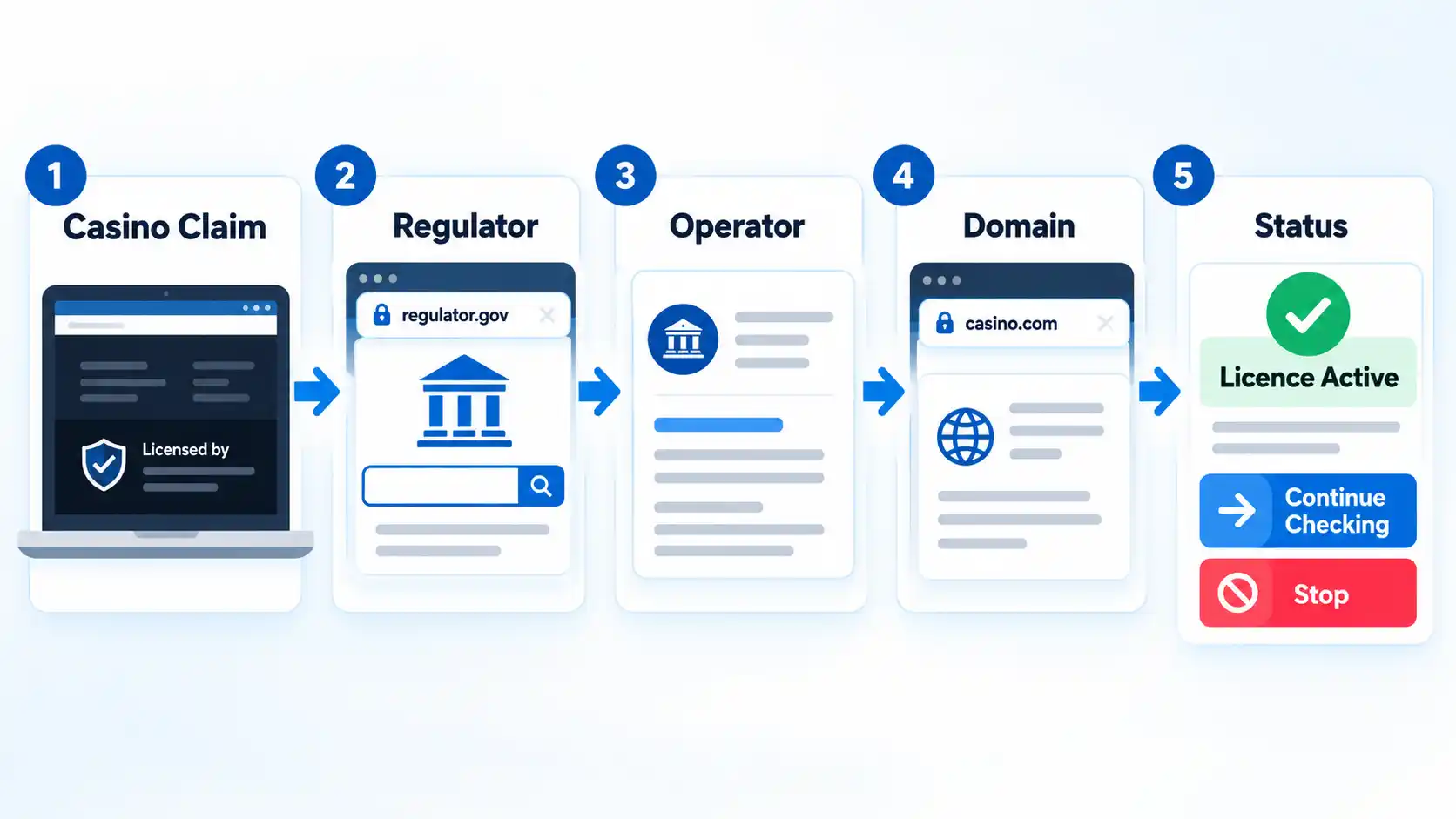
- Identify the claimed regulator and legal operator. Find the licence information in the casino’s footer, terms, contact information, or regulatory page. Record the legal company name, trading name, licence or account number, claimed regulator, and the exact domain shown in your browser. Do not assume the casino brand and legal company will have identical names.
- Open the regulator independently. Do not make the footer badge your only route to the regulator. Navigate to the regulator through a trusted route and confirm that you are on its real domain. This matters because the Malta Gaming Authority reported in July 2026 that websites were impersonating MGA-licensed operators and making false licensing claims. Its notice tells consumers to verify operators and websites through the official licence register.
- Search the official register. Use the search fields the regulator provides. For example, the UK Gambling Commission business register accepts searches by business name, trading name, domain name, or account number. If a regulator publishes a list rather than a domain-searchable database, compare the legal operator, licence identifier, trading name, and any officially listed website information.
- Match the operator and exact domain. Confirm that the legal entity, trading name where relevant, and website you are actually visiting have a documented connection to the licence. A genuine licence belonging to one company does not automatically validate another website displaying the same number. The process for verifying an online casino licence explains the operator, domain, status, and permitted-activity checks in greater depth.
- Check the current status and permitted activity. Do not stop when you find a company name. Read the licence status and applicable activity information. The UK register, for example, distinguishes active licences from statuses such as pending, expired, suspended, surrendered, lapsed, forfeited, and revoked, and it publishes regulatory actions. A historical or inactive record is not the same as current authorization.
- Resolve material mismatches before continuing. A different brand name can sometimes have a legitimate explanation, such as a registered trading name or white-label arrangement. An unexplained operator, domain, licence, or activity mismatch is different. Do not provide identity documents or deposit money while a material licensing or identity conflict remains unresolved.
Check Who Actually Operates the Site
The consumer-facing casino name may be a brand rather than the legal entity that holds the licence. That is not automatically a problem, but you should be able to trace the brand back to an identifiable operator through official records and the casino’s legal information.
Compare the legal company named in the casino’s terms with the regulator’s record. Also check trading names, registered details where published, the exact domain, and any disclosed white-label relationship. A mismatch needs an explanation supported by the regulator’s record or other authoritative operator information.
Domain identity deserves particular attention because a copied website can reproduce branding, legal text, and even a genuine licence number. The Malta Gaming Authority’s July 2026 impersonation warning documents websites that falsely presented themselves as connected to MGA licences and directs consumers to verify the operator or website through the official register.
Small differences can be significant. A licence associated with examplecasino.com does not automatically establish that example-casino.net belongs to the same licensed operator. When a suspicious domain resembles a legitimate brand, checks for cloned online casino websites include identifying the registrable domain, matching the operator and licence record, and watching for unexplained redirects to other destinations.
Treat HTTPS as Necessary, Not as Proof of Trust
HTTPS protects the connection between your browser and the website. It helps keep information exchanged with that domain private in transit. It does not establish that the business receiving the information is licensed, financially sound, or the operator you intended to reach.
Google’s Chrome guidance distinguishes those issues clearly: a secure status means the connection is private, but users are still told to check the site name in the address bar before sharing sensitive information. That distinction matters for casino verification. Encryption protects the connection to a domain, while regulator and identity checks help establish who is behind it. See Google’s explanation of website connection security.
Do not treat a padlock or HTTPS address as proof that a casino is licensed or legitimate. A deceptive website can still use an encrypted connection, so verify the exact domain and operator independently.
What Each Safety Signal Actually Proves
Several familiar signals are useful only when interpreted narrowly. The table separates stronger verification evidence from indicators that are often given more weight than they deserve.
| Signal | What it can establish | What it cannot establish |
|---|---|---|
| Official regulator match | An operator, trading name, domain, licence status, or permitted activity can be connected to an official regulatory record when the regulator publishes those fields. | It does not guarantee fast withdrawals, favorable terms, good service, or future compliance. |
| HTTPS | The browser has established a private, encrypted connection to the domain. | It does not prove that the domain belongs to a legitimate or licensed casino. |
| Known game provider | It can identify the stated source of a game when the supplier relationship is genuine. | It does not establish the casino operator’s licence or authorization for your location. |
| Published RTP | Return to player can describe the theoretical return of a particular game or configuration over its defined statistical basis. | It does not predict whether an individual session will end in profit, and it is not a casino trust score. |
| Card or payment logos | They can indicate payment methods the cashier claims to support. | They do not prove operator legitimacy, withdrawal reliability, or PCI DSS compliance. |
| Positive reviews | They can provide supplementary information about reported experiences and recurring issues. | Review volume or star ratings cannot independently verify a licence, operator, or domain. |
Read the Withdrawal, Verification, and Customer-Fund Rules
After authorization, examine the conditions that control access to your money. A casino may make depositing straightforward while imposing verification, withdrawal, currency, limit, or bonus conditions that become important when you attempt to cash out.
Before depositing, find the withdrawal policy and relevant terms. Check the available withdrawal routes, minimum and maximum amounts, stated fees, account-verification requirements, restricted payment methods, currency rules, and any conditions attached to bonus funds. These conditions should be understandable before money is committed rather than discovered only during a dispute.
Identity checks are not automatically a red flag. In Great Britain, applicable remote licensees must establish and verify a customer’s identity before permitting that customer to gamble. The UK Gambling Commission’s customer identity verification condition also states that a withdrawal request must not create an additional information requirement that the operator could reasonably have requested earlier, while allowing information that becomes necessary because of another legal obligation.
This distinction matters when evaluating complaints about delayed withdrawals. A later request for information is not automatically improper, but unexplained or repeatedly changing requirements deserve closer scrutiny against the applicable rules and the operator’s published terms.
Where the regulator requires disclosure of customer-fund protection, read it carefully. The UK Gambling Commission requires applicable operators that hold customer funds to state whether those funds are protected in insolvency, the level of protection, and the method used. Its customer-funds disclosure guidance also requires this information to be presented to customers under specified conditions.
Payment convenience is a separate decision from casino legitimacy. Once the operator itself has passed the regulatory and identity checks, you can compare casino payment methods by factors such as withdrawal support, fees, account controls, and availability. A familiar payment method cannot make an unverified operator safe.
Likewise, payment-card logos are not evidence of Payment Card Industry Data Security Standard compliance. The PCI Security Standards Council describes PCI DSS as baseline technical and operational requirements for protecting payment-account data in relevant card-data environments. Consumers should not infer an operator’s compliance status merely from the payment brands displayed in its cashier.
Check What the Casino Can Prove About Its Games
Game safety should be judged through applicable technical rules and verifiable testing requirements, not only through familiar developer names. A recognizable studio can be relevant context, but it does not establish that the casino operating the website is properly licensed.
In Great Britain, the Gambling Commission’s Remote Gambling and Software Technical Standards set requirements for remote gambling and software. Its testing strategy specifies when independent third-party assurance is required rather than treating every technical requirement as externally tested.
For example, the Commission’s testing strategy requires approved third-party testing for specified game-fairness areas and describes examination of game mathematics, rules, random-number generation, and theoretical return to player where applicable.
Look for accessible game rules and likelihood-of-winning information. Where applicable, the regulatory standards may require information such as return to player (RTP), house edge, or probability information so that customers can understand the game’s mathematical basis.
RTP needs careful interpretation. It is a theoretical statistical measure associated with a game or configuration, not a prediction of what will happen during one person’s session. A casino advertising a high RTP does not become safer merely because the percentage looks attractive. The useful question is whether the game information is accurate, accessible, and covered by the applicable regulatory and testing framework.
Look for a Real Complaint and Dispute Route
A credible regulatory framework should provide more than a licence badge. It should also define what happens when a customer and operator cannot resolve a dispute.
Find the casino’s complaints procedure before you need it. Look for how a complaint is submitted, the response process, any escalation stage, and the independent dispute route required in that jurisdiction. If the regulator publishes enforcement or regulatory-action records, those records can provide additional context about the operator.
For Great Britain, licensed operators that contract directly with consumers must provide complaints information and make an independent Alternative Dispute Resolution (ADR) route available for qualifying unresolved disputes. The UK Gambling Commission’s complaints and ADR guidance states that the entire complaints process must take no longer than eight weeks, with ADR available earlier when the operator and customer reach a final position sooner.
Do not interpret every service complaint as proof that a casino is unsafe. Slow support, an account disagreement, and a regulatory breach are different issues. What matters for this check is whether the operator has a transparent process and whether an applicable independent escalation route can be verified.
Use Reviews as a Cross-Check, Not as Proof
Reviews can expose patterns that deserve investigation, particularly repeated reports involving withdrawals, identity checks, account closures, or customer support. They are most useful after official verification, not instead of it.
Pay more attention to specific, dated patterns than to a large review count. Compare complaints with the casino’s current terms and regulator records. A review written for an old domain, previous operator, different jurisdiction, or unrelated company may not describe the website you are evaluating now.
Official evidence should outweigh anonymous popularity signals when the two conflict. If favorable reviews describe a website but the exact domain cannot be connected to the claimed licence holder, the unresolved authorization problem remains.
Final Safety Verification Checklist
Before registering, submitting identity documents, or depositing, confirm that the evidence you collected tells one consistent story. A cosmetic trust signal should not be used to explain away an unresolved operator or authorization problem.
Verify the result
- You identified the regulator or licensing framework relevant to the casino and your location.
- The legal operator or documented trading relationship matches an official regulatory record.
- The exact domain is verified where the regulator publishes domain information, with no unresolved lookalike or ownership mismatch.
- The relevant licence or authorization is current and covers the activity you intend to use.
- The website uses HTTPS, and you have separately confirmed that you are on the intended domain.
- Withdrawal, identity-verification, fees, limits, and relevant bonus conditions are available and understandable before depositing.
- You understand the applicable treatment of customer funds where the regulator requires that protection information to be disclosed.
- Game rules and relevant likelihood-of-winning information are accessible, with technical or testing claims traceable to the applicable framework rather than assumed from a provider logo.
- A documented complaint process and any applicable independent dispute route can be identified.
- No material operator, domain, licence, or authorization mismatch remains unresolved.
A casino passing these checks has provided stronger evidence than a website that merely displays reassuring logos and reviews. The checks still cannot guarantee good service, immediate withdrawals, future financial stability, or a favorable gambling outcome. Their purpose is narrower: to establish whether the site’s identity, authorization, rules, and relevant consumer protections can be independently verified before you trust it with money or personal information.

💬 Comments