Energy brokers can support business sustainability by turning energy goals into practical procurement requirements, comparing suitable contracts, and helping buyers understand renewable electricity options and the environmental attributes attached to them. Their contribution is mainly through energy purchasing and contract decisions, not by automatically replacing energy auditors, engineers, carbon accountants, or regulatory advisers.
Quick Take
A broker can connect commercial energy purchasing with sustainability requirements, but the value depends on what the broker actually searches, how they are paid, which renewable-energy attributes are included, and where specialist technical or accounting expertise is still required.
That distinction matters because “sustainable energy” can refer to several different activities. Buying a renewable electricity product is not the same as reducing the amount of energy a facility consumes. Measuring greenhouse gas emissions is different again. A useful broker should make those boundaries clearer rather than treating every environmental objective as part of the same service.
What an Energy Broker Actually Does
An energy broker is an intermediary that helps a customer evaluate energy supply options and arrange a contract with a supplier. In Great Britain, for example, energy regulator Ofgem says businesses can use brokers to find a suitable contract and negotiate with their chosen supplier. Ofgem also advises businesses to understand how the intermediary is paid and what part of the market it searches. Ofgem’s business energy contract guidance explains these roles and payment arrangements.
This means the broker’s job is broader than simply finding the lowest advertised unit rate. Business energy contracts can differ by term, pricing structure, market exposure, renewal conditions, and other commercial provisions. Ofgem describes fixed, variable, deemed, rollover, and flexible contract structures, with flexible contracts typically aimed at larger energy users that purchase portions of their requirement at different times.
Consider a company with several sites whose electricity contracts expire at different times. A broker may gather consumption information, identify suitable suppliers, compare offers, organize contract terms, and help the company evaluate whether one structure better fits its expected usage and budget risk. The final contracting decision remains with the customer.
Broker coverage also matters. An intermediary may search many suppliers or only part of the available market. A business should therefore distinguish “the best option we found” from “the best option across the entire available market.”
Where Sustainability Enters the Procurement Decision
Sustainability becomes relevant when environmental requirements are included in the energy-buying brief rather than added after a contract has already been selected. A company might specify that it wants renewable electricity, evidence supporting renewable-energy claims, particular contract terms, coverage for defined facilities, or reporting information that can be passed to its sustainability or finance team.
Historical consumption helps establish how much electricity a business needs and gives the procurement process a factual basis for comparing offers and contract structures. Businesses that need more detailed visibility into consumption may use metering and monitoring separately from brokerage; power meters can provide more detailed information about electricity use for operational energy management.
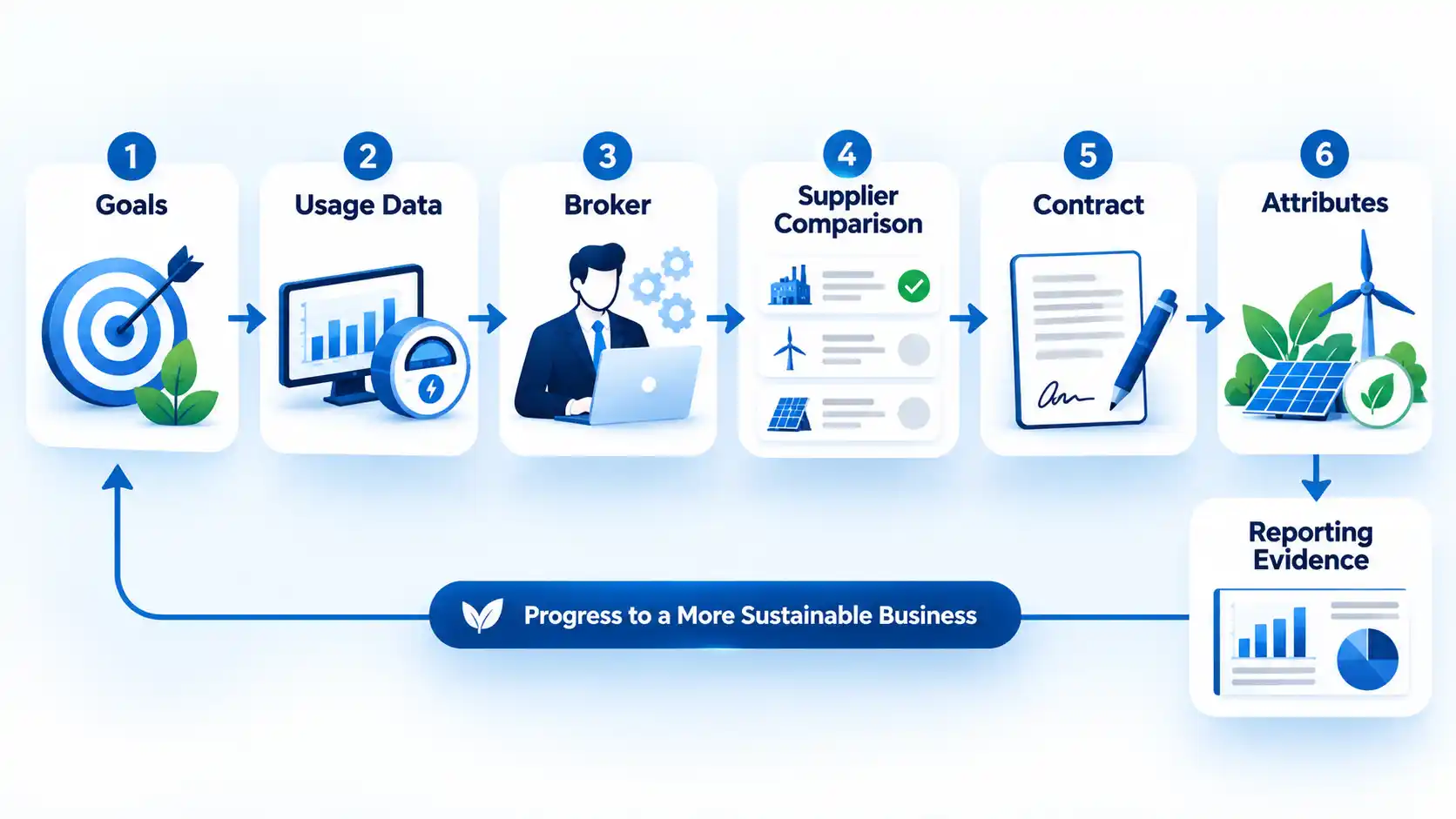
For example, two supplier offers may look similar when judged only by their commercial terms yet differ in what renewable-energy attributes accompany the electricity. The broker’s useful role is to surface that difference so the buyer can evaluate the environmental claim as well as the price and contract structure.
This is also where fixed and flexible business energy contracts can create different risk profiles. A contract that works well for predictable consumption and budgeting is not automatically the right structure for a large user that deliberately manages procurement timing and market exposure.
Renewable Energy Contracts, RECs and Environmental Claims
Renewable electricity procurement has an important accounting detail: the physical electricity arriving through a shared grid does not carry a label showing which generating plant produced each unit. Markets therefore use contractual instruments to track renewable-energy attributes.
In the United States, a Renewable Energy Certificate (REC) represents the property rights to environmental and other non-power attributes associated with one megawatt-hour of renewable electricity generation. The U.S. Environmental Protection Agency explains that RECs are used to track and assign ownership of renewable electricity attributes and to substantiate renewable-electricity use claims on a shared grid. EPA’s REC guidance explains the instrument and its role in renewable-electricity claims.
That means a buyer should not stop at a label such as “green electricity.” It should understand what contractual rights are actually included, who owns the associated attributes, and whether the required certificates are transferred or retired appropriately. EPA says U.S. organizations making renewable-electricity claims need the relevant REC ownership and retirement, and that claims should match the actual scope of the purchase. EPA’s credible-claims guidance explains these ownership, retirement, and scope requirements.
If renewable electricity covers only one building or part of a company’s consumption, the public claim should reflect that limited scope. The contract does not justify saying the entire organization runs on renewable electricity when it does not.
This connection also reaches greenhouse gas accounting. Scope 2 concerns emissions from purchased or acquired electricity, steam, heat, and cooling. The Greenhouse Gas Protocol’s current Scope 2 page says its 2015 guidance includes requirements for energy contracts and instruments, quality criteria for contractual instruments used in the market-based method, and recommendations for transparent disclosure. It also notes that a public consultation on revising the 2015 guidance ran from October 20, 2025 to January 31, 2026. The current GHG Protocol Scope 2 guidance page documents both the existing framework and the revision process.
For businesses using certificate-based procurement, understanding what renewable energy certificates actually represent is therefore part of checking whether a proposed electricity product supports the claim the company intends to make.
What Brokers Can Contribute Beyond Supplier Comparison
Brokerage businesses do not all provide the same services. Some focus primarily on sourcing and negotiating supply contracts, while others may offer additional procurement or energy-management services. The buyer should verify the actual service scope rather than assuming those capabilities come automatically with the word “broker.”
Within procurement, useful work can include organizing historical consumption information, comparing contract structures, coordinating supplier requests for renewable products, tracking renewal dates, and helping internal teams gather contract documentation.
That can make a broker a coordination point between procurement, finance, facilities, and sustainability teams. It does not mean the broker has automatically become an engineer or emissions-accounting specialist.
Suppose a manufacturer wants both a renewable electricity contract and lower electricity consumption. A broker may be able to procure the supply contract, while the consumption problem requires facility measurements and technical investigation. A formal energy audit and energy procurement serve different purposes even when both contribute to the same sustainability program.
What an Energy Broker Does Not Automatically Do
The easiest way to avoid unrealistic expectations is to separate energy procurement from the adjacent disciplines that may support the same sustainability strategy. A provider may offer several of these services under one company, but the underlying jobs remain different.
| Role | Main job | Sustainability contribution | Key limitation |
|---|---|---|---|
| Energy broker | Sources, compares, and helps arrange energy supply contracts. | Can incorporate renewable-energy and reporting requirements into procurement. | Broker status alone does not establish engineering, auditing, carbon-accounting, or legal expertise. |
| Energy supplier | Sells electricity or gas under the supply contract. | May offer renewable or other energy products, subject to market rules and contract terms. | The supplier is the contracting seller, not an independent comparison service. |
| Energy auditor or engineer | Examines how a facility uses energy and identifies technical efficiency opportunities. | Can identify operational or equipment changes that reduce consumption. | An audit does not by itself procure a new electricity contract. |
| Carbon accountant or sustainability adviser | Measures, interprets, and reports environmental performance. | Helps connect energy purchases with emissions inventories, targets, and disclosures. | Accounting expertise does not automatically include energy-market procurement. |
| Legal or regulatory adviser | Interprets applicable contractual and regulatory obligations. | Can assess compliance and legal exposure around contracts or environmental claims. | A broker should not be assumed to provide qualified legal advice merely because it understands the energy market. |
The energy-audit distinction is particularly important. The U.S. Department of Energy describes its commercial-building Audit Template as a tool for entering, validating, and reporting formal energy-audit data, and says the template follows ASHRAE Standard 211 for commercial building energy audits. DOE’s Audit Template illustrates the structured technical nature of commercial energy auditing.
Costs, Conflicts and Regulation Matter
A sustainability objective does not remove the ordinary commercial risks of using an intermediary. Businesses still need to understand broker compensation, supplier relationships, market coverage, contract authority, renewal terms, and dispute procedures.
Commission is one example. A broker may charge the customer directly or receive commission through the selected supplier. The existence of commission does not by itself show that advice is unsuitable, but the buyer needs enough transparency to understand potential incentives and compare the overall arrangement.
Regulation also varies by jurisdiction. In Great Britain, Ofgem published good-practice guidance for third-party intermediaries on July 20, 2026 while preparing for new regulatory powers. The guidance says intermediaries should provide clear information about who they are, their role, the services being offered, market coverage, relevant contract terms, and commission or fee arrangements. Ofgem’s 2026 intermediary guidance describes these expected transparency practices. The same rules should not be assumed to apply unchanged in another country or energy market.
In competitive retail markets, a broker may help a company compare business electricity plans, but available products, broker obligations, and customer protections depend on the jurisdiction.
Businesses should therefore verify the rules that apply where the supply contract will operate instead of relying on a general statement that a broker is “licensed,” “regulated,” or “independent.” Those words can have different legal significance in different markets.
How to Evaluate a Broker’s Sustainability Support
A useful evaluation focuses on evidence and service boundaries rather than environmental marketing language. Before relying on a broker to support a sustainability objective, a business should be able to verify what the intermediary searches, what the proposed contract includes, and who is responsible for specialist work outside procurement.
Verify the result
- The broker clearly identifies the suppliers or market coverage included in its search, rather than implying whole-market coverage without evidence.
- Fees, supplier commissions, or other compensation arrangements are disclosed clearly enough for the business to understand how the intermediary is paid.
- The proposed renewable-energy product specifies the relevant certificates, attributes, contractual rights, or other evidence required for the intended environmental claim.
- The contract documentation identifies which sites, meters, quantities, or periods are actually covered so sustainability claims can match the purchase scope.
- The business can identify which services the broker performs directly and which require an auditor, engineer, carbon-accounting specialist, or legal adviser.
- Any registration, complaint, redress, disclosure, or other intermediary requirements applicable in the relevant jurisdiction have been checked.
A strong result is therefore not simply a cheaper tariff carrying a green label. It is a procurement decision whose commercial terms, environmental attributes, documentation, scope, and professional responsibilities are understood before the contract is signed.
The Practical Role of a Broker in a Sustainability Strategy
Energy brokers can be useful sustainability partners when their role is defined accurately. They can translate energy-purchasing requirements into supplier and contract comparisons, bring renewable-electricity options into procurement, and help a business identify the documentation it needs to support an environmental claim.
They are only one part of the wider picture. Metering and operational improvements address how much energy a facility uses. Engineering and energy audits identify technical efficiency opportunities. Carbon accounting determines how purchases are reflected in emissions reporting. Legal and regulatory specialists address obligations that fall outside ordinary brokerage.
Connecting these functions is more defensible than assuming a broker alone makes an organization sustainable. Broader energy and sustainability initiatives can combine procurement with efficiency, technology, and other measures, while the broker’s clearest contribution remains helping the buyer make better-informed energy purchasing decisions.

💬 Comments