Cybersecurity teams provide round-the-clock protection by combining continuous monitoring, alert investigation, incident response, vulnerability management, identity controls, data protection, and ongoing security improvement. These layers reduce the chance that an attack succeeds and help limit damage when prevention fails, but they cannot guarantee that an organization will never be compromised.
What “24/7 Cybersecurity Protection” Actually Means
Protecting an organization around the clock does not usually mean one person watches every computer, account, and network connection continuously. It means the organization maintains the ability to detect suspicious activity, investigate meaningful alerts, respond to confirmed incidents, and keep preventive controls working regardless of when a problem appears.
The NIST Cybersecurity Framework 2.0 provides a useful way to understand this broader model. Its six concurrent functions are Govern, Identify, Protect, Detect, Respond, and Recover. Monitoring is therefore only one part of the defensive system.
A Security Operations Center, or SOC, is a team or operational capability that monitors security signals and coordinates investigation and response. Some organizations maintain this capability internally. Others use an external provider or combine internal staff with outsourced coverage.
For businesses evaluating outsourced or co-managed coverage, a managed IT security service can supplement an internal IT team with functions such as monitoring, endpoint protection, email security, risk assessment, and security training, although service scope and geographic availability should be checked with the provider.
Organizations that cannot staff every security function internally may combine their own IT team with external cyber threat management services, provided responsibilities, escalation authority, monitoring scope, and incident-response expectations are clearly defined.
Automation can also collect events continuously, correlate activity, generate alerts, and perform predefined responses when configured conditions are met. Human judgment remains important when an alert requires business context, uncertain evidence, or an action that could interrupt legitimate work.
Warning
Continuous security coverage is not a guarantee that every attack will be prevented. Its value is in reducing exposure, detecting suspicious activity sooner, and giving the organization a defined way to contain and recover from incidents.
A company can technically have monitoring running all night and still have weak coverage if important systems do not produce useful logs, alerts are ignored, escalation contacts are unavailable, or responders lack authority to act.
1. Monitoring Networks, Endpoints, Identities, and Cloud Activity
Cybersecurity teams need visibility before they can detect abnormal activity. They therefore collect security telemetry, which is technical information produced by systems about what is happening inside them.
Useful signals can come from employee laptops, servers, firewalls, cloud platforms, email systems, identity providers, business applications, and other infrastructure. Authentication records can show when and where an account logged in. Endpoint tools can report suspicious processes or files. Network devices can record unusual connections, while cloud services can produce logs about administrative changes and access to stored data.
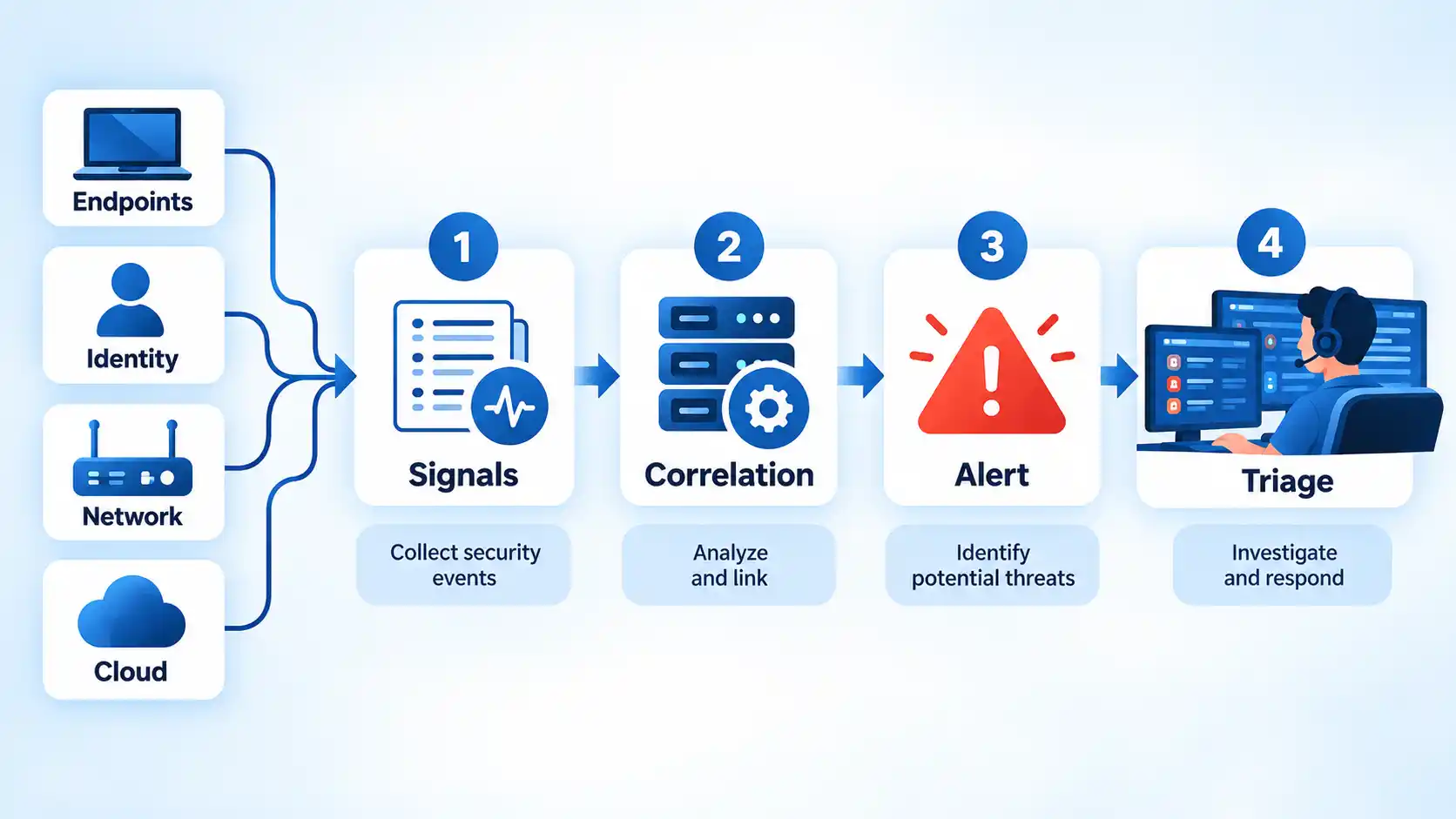
The challenge is not simply collecting more information. A large environment can generate many legitimate events, so security teams use detection rules, behavioral baselines, threat intelligence, and event correlation to determine which activity deserves attention.
For example, an employee signing in successfully is normally unremarkable. The same account signing in from an unusual context and immediately attempting unexpected administrative actions may deserve investigation. The useful signal comes from the relationship between events rather than from either event alone.
Monitoring quality also depends on coverage. A system that does not log relevant activity creates a blind spot. A detection rule that produces excessive false alarms can make genuine problems harder to notice. Useful monitoring therefore requires ongoing tuning, appropriate log retention, and an understanding of which systems and identities matter most to the organization.
2. Investigating Alerts and Responding to Incidents
An alert is not automatically an incident. It is a signal that something may need investigation.
Security analysts typically begin with alert investigation and triage, meaning they determine whether an alert is probably harmless, suspicious, or serious enough to escalate. They may review related account activity, affected devices, network connections, recent configuration changes, or other evidence to understand what happened and how far the activity extends.
If malicious activity is confirmed, the response can involve containing affected accounts or systems, removing malicious access, correcting the underlying weakness, restoring normal operations, and monitoring for recurrence. The exact response depends on the incident.
This is why incident response should not be treated as a separate activity that begins only after everything else has failed. NIST SP 800-61 Revision 3, published in April 2025, integrates incident-response recommendations throughout cybersecurity risk management and connects preparation with detection, response, and recovery.
Consider a malware alert on an employee computer. Investigation may show that the device is only one part of the problem: the employee account may also be compromised, another system may have received the same malicious file, or the account may have been used elsewhere. Responders need to establish the scope before assuming that cleaning one endpoint resolves the incident.
Automated containment can accelerate a response, but high-impact actions require care. Automatically disabling an important account, isolating a production server, or blocking a business-critical service can disrupt legitimate operations if the underlying detection is wrong. Mature response processes therefore define escalation thresholds and who has authority to make consequential decisions.
For individuals investigating whether exposed information may already be circulating, the checks involved in determining whether your data has been compromised differ from enterprise alert triage but follow the same basic principle: evidence should determine the response.
3. Finding and Prioritizing Vulnerabilities Before They Are Exploited
A vulnerability is a weakness that can potentially be exploited to compromise a system, application, device, or service. Security teams reduce attack opportunities by finding these weaknesses and deciding which ones need attention first.
Vulnerability scanners and other assessment methods can identify outdated software, known flaws, insecure configurations, exposed services, and related weaknesses. The resulting findings still need prioritization. Technical severity matters, but so do factors such as whether the affected system is exposed to the internet, what data or business function it supports, whether exploitation is occurring, and what impact a compromise could have.
One especially useful signal is CISA’s Known Exploited Vulnerabilities Catalog. CISA describes it as an authoritative source of vulnerabilities known to have been exploited in the wild and recommends using the catalog as an input to vulnerability-management prioritization.
This distinction matters because two vulnerabilities with similar severity scores may represent very different real-world risks. A flaw already being exploited on an internet-facing system may reasonably require more urgent attention than a similarly rated weakness on an isolated internal device.
Patching is not always instantaneous. Updates may require compatibility testing, a maintenance window, backups, rollback planning, or coordination with a vendor. Where an immediate patch is not safe or available, teams may reduce exposure with vendor-supported mitigations, restricted access, additional monitoring, or temporary isolation.
The objective is therefore not simply to “install every patch immediately.” It is to reduce meaningful exposure while avoiding changes that create unnecessary operational failures.
4. Protecting Accounts and Reducing Human-Focused Attacks
Attackers do not always need to break through a technical control. If they obtain valid credentials, trick an employee into approving access, or compromise a privileged account, they may be able to operate through legitimate systems.
Account security is therefore part of continuous cybersecurity defense. Current CISA guidance emphasizes passwords that are long, random, and unique and recommends password managers to help generate and store them rather than relying primarily on arbitrary character-composition rules.
Multifactor authentication, or MFA, adds another verification requirement beyond a password. CISA’s current business MFA guidance recommends requiring MFA wherever possible, starting with administrative accounts, sensitive-data access, and remote access, while moving toward phishing-resistant methods where practical.
Not all MFA methods provide the same resistance to attack. CISA specifically distinguishes stronger phishing-resistant approaches from weaker methods, so organizations should evaluate more than whether an account merely has “MFA enabled.”
Access privileges also matter. Employees should not automatically retain administrative rights or access to information they no longer need. Limiting privileges reduces what an attacker can reach if an ordinary account is compromised.
User education supports these technical controls. Employees need to recognize unexpected authentication prompts, phishing messages, suspicious attachments, unusual password-reset requests, and other attempts to manipulate them into bypassing security.
For personal devices, reducing unnecessary application permissions, avoiding untrusted software, strengthening account authentication, and keeping Android software current are practical ways to reduce common phone data-leak risks.
No awareness program eliminates human error. The purpose is to make manipulation harder and give people a clear way to report something suspicious before a minor mistake becomes a larger incident.
5. Protecting Sensitive Data With Encryption and Access Controls
Organizations try to prevent unauthorized access, but sensitive information also needs protection when devices, storage systems, or communication paths are exposed.
Encryption transforms readable information into a protected form that requires appropriate cryptographic key material to recover. NIST describes cryptography as using mathematical techniques to protect information, with encryption forming part of a broader set of cryptographic protections.
Encryption is commonly applied to stored information and data moving between systems. For example, it can limit exposure if storage media is stolen or network traffic is intercepted without access to the necessary keys.
The protection is only as strong as the surrounding system. Cryptographic keys have to be generated, stored, used, rotated, recovered, and eventually retired appropriately. If an attacker steals usable keys, gains access through an authorized account, or controls a system after information has been decrypted for legitimate use, encryption alone may not prevent exposure.
Encryption should therefore work alongside access controls, identity protections, secure configuration, monitoring, backups where appropriate, and sound key management rather than being treated as a complete cybersecurity strategy.
Organizations also need to determine which information requires cryptographic protection, where keys will be held, who is permitted to use them, and how access or recovery will work if a key becomes unavailable or compromised.
6. Keeping Security Skills, Detection Logic, and Response Plans Current
Security tools and response plans become less useful if they remain unchanged while infrastructure and attack techniques evolve.
Cybersecurity work also spans different specialties. Monitoring analysts, incident responders, vulnerability specialists, identity teams, security engineers, risk personnel, and other roles do not all perform the same tasks.
The NICE Workforce Framework for Cybersecurity describes cybersecurity work through Task, Knowledge, and Skill statements that are used to define Work Roles and Competency Areas. NIST publishes the framework components separately from the underlying SP 800-181 Revision 1 structure so the component set can be maintained independently.
For an organization, maintaining capability can involve technical training, tabletop exercises, response simulations, updated playbooks, review of important detections, and lessons learned after incidents.
Suppose an alert correctly identifies suspicious activity, but the organization loses several hours because no one knows who can disable the affected account outside normal business hours. That is not primarily a detection failure. It is an operational-readiness failure. Updating the escalation procedure may prevent the same delay during the next incident.
Teams should also revisit detection logic as systems change. A rule built around an application that has been retired provides little value, while a new cloud service may introduce activity that is not yet monitored properly.
Continuous improvement therefore involves people, technical controls, and operating processes together.
How These Security Layers Work Together
Each defensive activity addresses a different part of the problem. The table below shows what each layer is trying to accomplish, the information it commonly relies on, the type of action it can produce, and an important limitation to keep in mind.
| Security activity | Main purpose | Typical inputs or signals | Typical action | Important limitation |
|---|---|---|---|---|
| Monitoring and detection | Identify activity that may indicate an attack or policy violation | Endpoint, network, identity, application, and cloud telemetry | Generate or enrich an alert | Cannot detect activity that produces no useful visible signal |
| Alert triage | Separate routine activity from events that require investigation | Alerts, contextual logs, asset information, and related events | Dismiss, investigate, or escalate | Poor context or alert overload can delay important investigations |
| Incident response | Limit damage and restore trusted operations | Investigation findings, affected assets, and business context | Contain, remediate, recover, and monitor | High-impact actions can disrupt legitimate operations |
| Vulnerability management | Reduce weaknesses attackers could exploit | Scans, asset inventories, vendor advisories, and exploitation evidence | Patch, mitigate, isolate, or document accepted risk | Not every vulnerability can be corrected immediately |
| Identity and account protection | Reduce unauthorized use of legitimate accounts | Authentication events, privileges, and access policies | Require stronger authentication or restrict access | Compromised sessions or misuse of authorized access may bypass some controls |
| Data protection | Limit exposure of sensitive information | Data classification, permissions, and cryptographic controls | Encrypt data and restrict access | Encryption does not protect information after legitimate decryption if the surrounding system is compromised |
| Workforce and process improvement | Keep people, detections, and response processes effective | Exercises, incidents, changing systems, and threat information | Train staff and revise rules, roles, or playbooks | Improvement requires ownership, time, and repeated validation |
These layers are complementary. Strong monitoring cannot compensate indefinitely for exposed, unremediated systems. Fast patching cannot stop every stolen credential. Encryption does not determine whether an alert is investigated promptly. Effective security comes from overlapping controls so that failure in one area does not automatically become a complete compromise.
What 24/7 Cybersecurity Cannot Guarantee
Even a well-run security operation has limits.
A newly discovered vulnerability may be exploited before a patch is available. An attacker may acquire valid credentials that initially resemble legitimate use. A third-party service may be compromised outside the organization’s direct control. Important telemetry may be missing, or a detection rule may not yet recognize a new attack technique.
Operational constraints also matter. A security team may identify a vulnerable production system but be unable to restart it immediately because it supports a critical service. An investigation may establish that suspicious activity occurred without providing enough reliable evidence to attribute it confidently to a particular person or group.
Alert volume is another practical problem. If monitoring systems generate too many low-value warnings, analysts can spend time reviewing noise while a more important event waits for attention.
These limitations do not make continuous security ineffective. They explain why its goal should be stated realistically.
The objective is to reduce avoidable weaknesses, make unauthorized activity harder, improve visibility, detect meaningful problems sooner, contain incidents before they spread further, restore trusted operations, and use what was learned to strengthen the next defensive cycle.
Conclusion
Round-the-clock cybersecurity is not one product, one analyst, or one monitoring dashboard. It is an operating model for managing cyber risk continuously.
Effective programs connect visibility with useful detections, give responders clear authority to act, prioritize vulnerabilities according to actual exposure, protect identities and sensitive data, and keep security processes current as systems and threats change.
No combination of controls removes cyber risk completely. The practical advantage of layered security is that an organization does not have to depend on any single control working perfectly every time.

💬 Comments