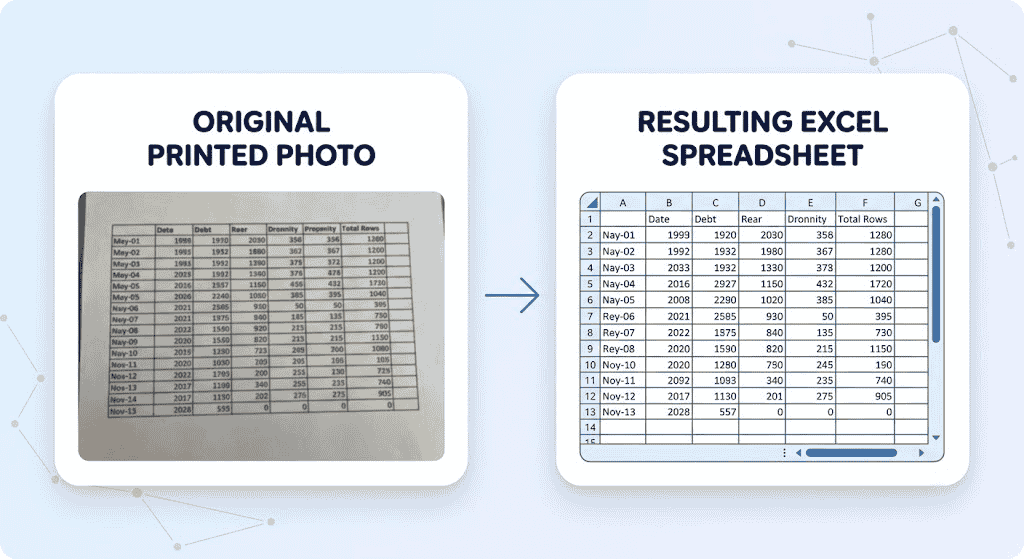
You can turn a JPG image into an editable Excel spreadsheet for free by using an OCR (Optical Character Recognition) tool — software that reads text and numbers inside an image and turns them into real, editable cells. This works whether you have a screenshot of a table, a photo of a printed report, or a scanned document.
Quick Take
If you just need one fast, no-signup option, start with OnlineOCR.net — it needs no account and reads 46 languages. If you’re already inside Excel and have a Microsoft 365 subscription, Excel’s own picture-import tool skips the upload step completely. If you want batch conversion and a preview before download, theonlineconverter.com’s JPG to Excel converter is worth trying. The rest of this guide covers all six options, what each one is actually good at, and where each one falls short.
How OCR Turns an Image Into a Spreadsheet
OCR software looks at the shapes in your image and matches them to letters and numbers. It then rebuilds the layout — rows, columns, spacing — as best it can, and saves the result as an Excel file. Understanding how image-to-text converters work under the hood explains why results vary so much between tools and between images.
This matters most for everyday documents, like a photo of your household budget or expense tracker. Instead of retyping the whole table by hand, you edit the few numbers that changed.
Source image quality changes your results more than the tool you pick. Blurry text, tilted photos, and low light all make OCR guess wrong more often. Cropping out clutter and straightening the angle with a free online photo editor can noticeably improve your results before you even start converting.
None of the tools below get every cell right every time. Numbers with unusual fonts, handwriting, or very small text are still the most common source of errors. Always check the converted file against the original image before you trust the numbers.
1. OnlineOCR.net
OnlineOCR.net is a free browser-based OCR tool. It reads text from a scanned photo and turns it into an editable Excel file, without asking you to install anything.
You don’t need to register to use it. Guest users can convert up to 5 files an hour, with a 15MB size limit per file. If you do register, you get more room: up to 50 free pages, a 200MB file limit, and your converted files are kept for one month. The tool recognizes 46 languages and works from any modern browser.
Steps to convert JPG to Excel with OnlineOCR.net
Step 1: Select your image file using the Select File option, so the tool can read the text inside it.
Step 2: Choose your document’s language, then set Excel as the output format.
Step 3: Click Convert to start the OCR process.
Step 4: Download the finished Excel file to your computer.
2. Pdftotext.info
Pdftotext.info is a simple JPG to Excel converter with a stripped-down interface: drop a file in, click convert, and download. It outputs your data as either a CSV or an XLSX file, and it’s free to use with no installation required.
The site states that your files are handled securely, though it doesn’t publish specific daily file limits or supported languages on its page — if batch size matters for your project, check the tool’s current limits directly before relying on it for a large job.
Steps to convert JPG to Excel with Pdftotext.info
Step 1: Drop the image file you want to convert onto the page.
Step 2: Click the blue convert button to start the OCR process.
Step 3: Download your converted Excel spreadsheet.
3. Theonlineconverter
Theonlineconverter’s JPG to Excel converter reads JPG, PNG, and JPEG images and rebuilds tables inside an Excel file automatically, with a preview step before you download. The free tier allows files up to 10MB with 15 conversion credits per day; a paid plan ($6 a month, billed yearly at $72) raises that to 2GB files, batch processing of up to 50 files, and over 100 monthly credits.
The site says uploaded images are processed and then automatically removed, so you don’t need to worry about your files sitting on a server after you’re done.
Steps to convert JPG to Excel with Theonlineconverter
Step 1: Upload your image by dragging it in, browsing your computer, or pasting a URL.
Step 2: Click Convert in the toolbar.
Step 3: Preview the extracted data, then save your Excel spreadsheet.
4. PDFmall
PDFmall’s JPG to XLSX converter is free and doesn’t require an account. You can upload files from your computer, a direct URL, Google Drive, or Dropbox, which is handy if your image is already stored in the cloud. The site states that your files and their contents aren’t reused after the conversion finishes.
Steps to convert JPG to Excel with PDFmall
Step 1: Choose your JPG image from your computer, a URL, Google Drive, or Dropbox — or drag and drop it onto the page.
Step 2: Pick XLSX as your output format.
Step 3: Click Convert Now, then save your finished XLS file.
5. Excel’s Built-In “Insert Data from Picture”
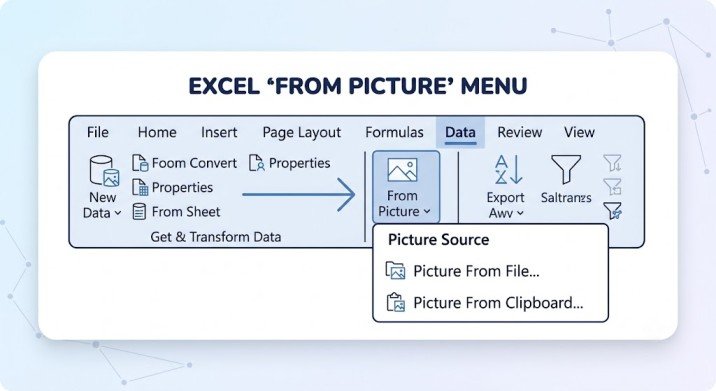
If you already have a Microsoft 365 subscription, you may not need a third-party site at all. Excel has a built-in feature called Insert Data from Picture, and it works directly inside the app on Windows, macOS, the web, and mobile.
This won’t work if you don’t already pay for Microsoft 365 — it’s not a separate free download, it’s a feature bundled into that subscription. It also only supports around 20 languages, mostly European ones, so it’s not the right pick for documents in other alphabets.
Steps to use Insert Data from Picture in Excel
Step 1: Open Excel and go to the Data tab, then select From Picture.
Step 2: Choose Picture From File to upload your JPG, or Picture From Clipboard if you’ve just taken a screenshot.
Step 3: Review the data Excel found in the pop-up box and fix any mistakes.
Step 4: Click Insert Data to drop the table straight into your worksheet.
6. Google Drive’s OCR (and Why It’s Not Ideal for This)
Some guides suggest using Google Drive to open an image with Google Docs, since Drive has built-in OCR. It’s worth knowing about, but it’s a poor fit for converting a table specifically. According to Google’s own documentation, the result opens as a Google Doc, not a spreadsheet, and lists, tables, and columns are “not likely to be detected.” Bold text and font size usually survive the conversion; your table structure usually doesn’t.
This route also caps files at 2MB and needs text at least 10 pixels high to read reliably. If your goal is a spreadsheet, treat this as a fallback for reading plain text out of an image, not a real JPG-to-Excel converter.
How to Choose the Right Tool
Match the tool to what you actually need, not just whichever one loads first.
| Tool | Signup needed? | Free limit | Best for |
|---|---|---|---|
| OnlineOCR.net | No | 5 files/hour, 15MB | Quick one-off conversions, many languages |
| Pdftotext.info | No | Not published | A very simple, no-frills conversion |
| Theonlineconverter | No | 15 credits/day, 10MB | Table preview before download, batch jobs on paid tier |
| PDFmall | No | Not published | Cloud-stored images (Drive, Dropbox, URL) |
| Excel Insert Data from Picture | Microsoft 365 login | Included in subscription | Anyone already working inside Excel |
| Google Drive OCR | Google account | 2MB, 100+ languages | Pulling plain text out of an image, not tables |
If accuracy matters most, use whichever tool lets you preview extracted data before downloading it, and always double-check the numbers by hand. That one habit catches most conversion mistakes before they cause a real problem.
Think about how often you’ll need this, too. A single free conversion is easy on any of the six tools above. But if you’re converting the same kind of document every week, the daily credit limits get tedious fast. Businesses doing that kind of repeat, high-volume work usually move on to AI-powered OCR tools built for digital data entry, which are designed for scale rather than one-off jobs.
Once your data lands in Excel, it’s often still messy — merged rows, stray spaces, or blank cells the OCR left behind. Cleaning up imported spreadsheet data before you start using it will save you time later, since formulas and sorting don’t work reliably on a messy sheet.
And if you’ll eventually need to share the finished sheet as a document rather than a spreadsheet, it helps to already know how to save an Excel file to PDF without losing formatting.
Key Takeaways
Free JPG-to-Excel conversion is genuinely possible today, but every tool has a limit somewhere — a file size cap, a daily credit count, or a language it doesn’t support. Check that limit before you commit to a tool for an important document. Image quality matters more than which tool you pick: a sharp, well-lit, straight-on photo will out-convert a blurry one on any of these platforms. If you already pay for Microsoft 365, try Excel’s native picture import before reaching for a third-party site. And always review the output — OCR is good, not perfect, and the smaller the text in your source image, the more it tends to miss.
Frequently Asked Questions
Do I need to install anything to convert JPG to Excel for free?
No. All the web-based tools covered here run in your browser, with nothing to download. The one exception is Excel’s Insert Data from Picture, which runs inside the Excel app itself rather than a browser.
Why did my converted Excel file come out with mixed-up columns?
This usually happens when the photo was taken at an angle, or when the table has merged cells, faint gridlines, or very small text. Retake the photo straight-on with good lighting, or try a different tool — some handle complex table layouts better than others.
Is it safe to upload sensitive documents, like financial records, to these sites?
Each service listed here states that it deletes or stops using your files after conversion, but you’re still trusting a third party with the image while it’s being processed. For anything genuinely sensitive, Excel’s built-in Insert Data from Picture keeps the file on your own device the whole time, which is a meaningfully different privacy tradeoff than uploading to a website.
Can these tools read handwriting instead of printed text?
Most are built and tuned for printed or typed text, not handwriting, so results on handwritten tables are usually far less reliable. If your source is handwritten, expect to do more manual correction after conversion, regardless of which tool you use.

💬 Comments